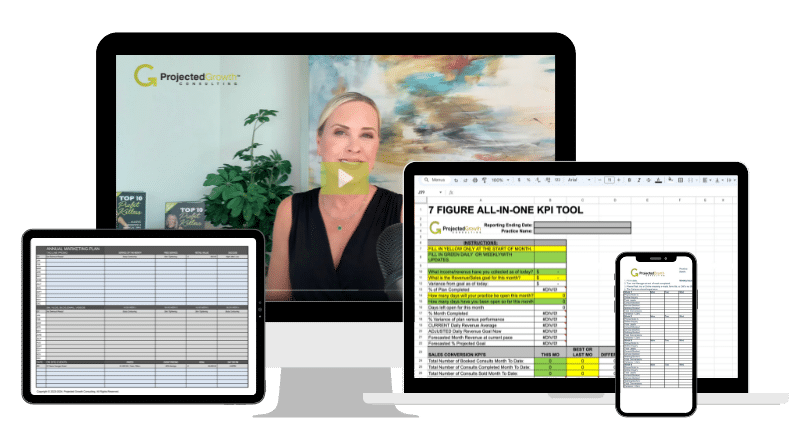
Healthcare business consulting is most useful when it turns a practice owner’s scattered concerns into one operating decision: what should we fix first to protect profit and create capacity? For an aesthetics or wellness practice, the answer is rarely another campaign or software purchase. It is a repeatable way to connect cash, conversion, capacity, retention, and team ownership.
Book a strategy call to apply this profit framework to your practice.
The Profit Control Loop is a 90-day healthcare business consulting method for elective practices. Establish a four-week baseline, choose one binding constraint, assign a measurable owner, and review the same five numbers every week. The loop prevents a practice from changing several variables at once and losing the evidence needed to know what worked.
The first job is not to make the practice look busy. It is to show whether activity is becoming collected cash at a margin that can support the team. A full schedule can hide weak conversion, excessive discounts, cancellations, low-margin services, delayed collections, or provider capacity that is allocated to the wrong work.
Medical Group Management Association (MGMA) describes financial and operations benchmarking as a connected exercise that includes staffing ratios, revenue and expenses, scheduling, call center activity, billing, and turnover. That is the right starting point for an elective practice as well. The operating question is not simply whether revenue rose. It is where demand, delivery, and cash stop moving together.
Use the first week to gather four weeks of actual data, then calculate:
Do not improve all five at the same time. The purpose of measurement is to find the constraint that is currently limiting the rest of the system. If leads are strong but consultation conversion is weak, more leads will increase waste. If conversion is healthy but rooms sit empty, a sales-training project may not be the first move.

The first 90 days should measure one financial result, two conversion or capacity signals, one retention signal, and one ownership signal. Together, these numbers show whether the practice is earning better revenue, using its available capacity, keeping patients, and building a team that can execute without constant owner intervention.
Build the scorecard around the five metrics above, but give each one a starting trigger. The triggers are management guardrails, not universal clinical or industry laws. Adjust them after the baseline is stable and after the practice has enough volume for a fair comparison.
| Metric | Starting trigger | Decision if the trigger is missed |
|---|---|---|
| Cash conversion | Below 90% for two consecutive weeks. | Trace balances, payment collection, cancellations, and service completion before increasing demand. |
| Contribution margin | Below the practice’s approved margin floor for one full month. | Review service mix, product cost, provider compensation, discounts, and pricing structure. |
| Consultation conversion | Below 50% for a meaningful sample of completed consultations. | Listen to calls, observe consultations, and test one consistent recommendation and follow-up process. |
| Provider utilization | Below 70% of available patient-care hours for two weeks. | Separate demand, scheduling, room, and staffing constraints before adding providers. |
| 90-day return rate | Below the practice’s current baseline for two monthly cohorts. | Map the post-visit handoff, rebooking prompt, follow-up, and membership conversation. |
These triggers create a useful management language. Instead of saying that marketing feels slow, the team can say that booked consultations are healthy but completed consultations are not becoming treatment plans. Instead of blaming staffing, the owner can see whether unused capacity comes from demand, scheduling, or a workflow that prevents the team from using available rooms.
MGMA’s practice operations report, based on nearly 1,000 organizations, shows why workforce and access metrics belong on the same scorecard as financial numbers. In its nonspecialty aggregates, front-office support turnover was reported at 40%, while clinical support turnover was 33.33%. The report also noted that time to the third next available appointment for new patients fell from 10 days in 2019 to five days in 2022. Access and staffing are not side issues. They change the revenue a practice can deliver.
Read the MGMA practice operations report and compare its measurement categories with the fields in your practice scorecard.
A scorecard becomes an operating system only when every metric leads to a decision, an owner, and a deadline. Run the same 30-minute meeting each week: name the constraint, inspect the handoff where it occurs, select one countermeasure, and decide what evidence will determine whether to keep or change it.
Use the following Profit Control Loop every week for 13 weeks:
This sequence is deliberately less exciting than a full rebrand or a new software stack. It is also more diagnostic. A consultant can help leadership distinguish a demand problem from a conversion problem, a capacity problem from a staffing problem, and a margin problem from a volume problem. That distinction is where the consulting value becomes operational rather than inspirational.
One Projected Growth Consulting client described the difference this way: My revenue growth increased by 255% since I started working with them. I’ve been able to hire staff strategically utilizing the VIP Inner Circle Training.
The statement is a client experience, not a promise or benchmark. It illustrates the intended connection between growth, hiring, and implementation rather than treating revenue as a marketing-only result. PGC client testimonial, Projected Growth Consulting homepage
Set thresholds from the practice’s baseline, cash needs, capacity, and service economics, then use external benchmarks as context rather than as a substitute for local evidence. A threshold is useful when it changes a decision, has a named owner, and is reviewed consistently enough to reveal a trend.
Start with the practice’s last four complete weeks, but do not mistake a small sample for a stable benchmark. Separate new and returning patients, service lines, providers, and locations where the data supports it. A 60% consultation conversion rate may hide one provider at 80% and another at 35%. An average 75% room utilization rate may hide a profitable room that is overbooked and a low-margin room that is underused.
Use three levels for each metric:
Keep the thresholds visible, but do not use them to punish staff. If a practice treats a dashboard as a ranking system, people will protect the number instead of improving the work. Review the process that creates the metric, ask what support is missing, and preserve a clear distinction between a process defect and an individual performance issue.
The MGMA financial and operations benchmarking resource reinforces this discipline by grouping financial, staffing, access, call center, billing, and turnover measures. For an elective practice, the exact comparison set will differ from a physician group. The principle does not: benchmark the connected system, not one attractive number.
The owner moves from dashboard to execution by giving each countermeasure one accountable role, one observable behavior, and one review date. Healthcare business consulting should reduce owner dependence over time, not create a new weekly meeting where every decision still waits for the founder.
Write a one-page operating brief for the current 13-week cycle. It should state the constraint, baseline, target, countermeasure, accountable role, data source, meeting cadence, and stop condition. The stop condition matters. If a test does not improve the selected metric after the agreed period, the team should learn from it and choose the next intervention rather than defend it indefinitely.
Then add the change to the workflow where the work happens. A conversion issue belongs in the consultation process and follow-up queue. A capacity issue belongs in scheduling and room allocation. A retention issue belongs in the post-visit experience and rebooking process. A margin issue belongs in service-level economics and purchasing. A metric without a workflow owner is only reporting.
For a broader implementation path, Projected Growth Consulting’s Growth Hub is built around the Projected Growth Practice OS: diagnose, prioritize, implement, and scale. The relevant offer is not more information for its own sake. It is structured support for solving one expensive practice problem at a time.

Schedule a practice growth conversation before you add another disconnected tactic.
After 90 days, the practice should have a clearer baseline, one tested operating improvement, stronger metric definitions, and a repeatable meeting cadence. The next decision is whether to deepen the same constraint, move to the next constraint, or standardize the improvement across providers or locations.
Do not judge the framework by whether every number improved at once. Judge it by whether leadership can answer five questions without guessing:
If the answer to all five is visible, the practice is no longer managing by anecdote. It has the beginnings of an operating system that can support better delegation, more predictable growth, and stronger enterprise value. That is the practical role of healthcare business consulting for an elective practice: not to replace the owner’s judgment, but to make the next judgment easier to see and easier to execute.
It connects financial, operational, team, conversion, capacity, and retention decisions into a measurable improvement plan. For an aesthetics practice, the work should result in clearer KPIs, a prioritized constraint, accountable owners, and a review cadence that supports implementation.
Healthcare business consulting should account for the operating realities of healthcare delivery, including provider capacity, patient access, service economics, team workflows, compliance-sensitive processes, and retention. The value is applying business discipline without ignoring how an elective practice actually delivers care.
Collect at least four weeks of data on cash conversion, contribution margin, consultation conversion, provider utilization, and 90-day return rate. Also document cancellations, no-shows, staffing changes, and the handoffs where work is delayed. A clean baseline makes the first consulting conversation more useful.
Use a 90-day cycle to establish a baseline, test one countermeasure, and decide whether to keep or change it. Some workflow signals can move within weeks, while retention and margin trends may need longer cohorts. Results depend on the practice’s data quality and execution.

Written by
Founder & CEO, Projected Growth Consulting
Kelly Smith is a med spa business consultant with 20+ years of industry experience and the founder of Projected Growth Consulting. A former 7-figure med spa owner, published author of 5 books, and international speaker, Kelly has helped 6,000+ practices generate over $250 million in additional revenue through proven growth strategies.