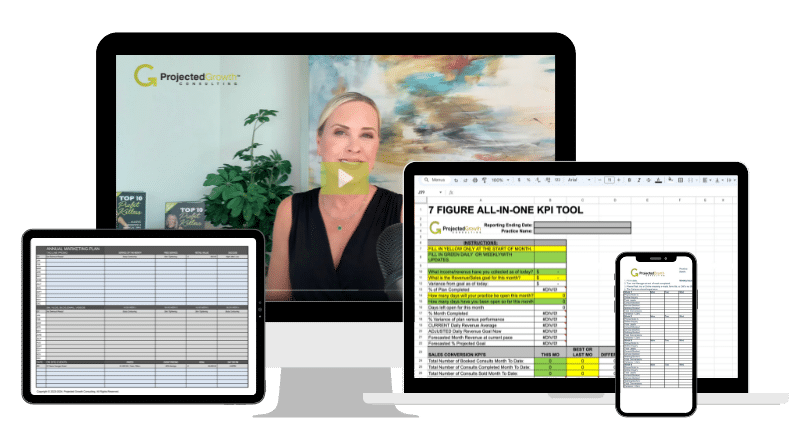
Knowing exactly how many treatments your med spa must sell to cover its monthly bills turns a vague revenue goal into an operating target. A busy schedule can still produce a loss when product costs, commissions, merchant fees, or overhead consume too much of each sale.
A med spa break even analysis calculates the point where contribution margin equals fixed costs. Start by separating fixed expenses from treatment-level variable costs. Then subtract variable cost from price to find contribution margin and divide total fixed costs by that margin. The result is the monthly treatment volume required to cover expenses before profit.
This guide walks through the formulas, a hypothetical worked example, and a practical decision framework. Use it to test pricing, staffing, marketing, capacity, and service-mix choices with your own numbers instead of relying on a generic industry average.
Running a good aesthetic practice needs more than just high sales. A med spa break even analysis is a tool that shows the exact point where your total pay equals your total costs. At this point, you have paid every bill but have not yet earned a profit. This data helps you move past guesswork and build a plan based on real numbers.
Many owners look only at total sales. But high sales can hide deep money issues. You might bring in $100,000 a month and still lose money if your costs are too high. A proper track your med spa break even point check splits your fixed costs from your variable ones. This clear view lets you see how much each service truly adds to your bottom line. It shows if your price covers your tools, staff pay, and rent.
Medical spas often face high fixed costs like rent and medical director fees. They also deal with variable costs such as product use and injector pay. As stated by Projected Growth Consulting, you must balance these costs to reach your goals. If your check shows you need too many visits to cover costs, you may need to raise your rates or cut spending. This is key for a healthy med spa break even analysis and growing your practice.
There is a big gap between just breaking even and reaching your goals. An accounting break-even point is the bare minimum you need to stay open. It is the “zero point” where you do not lose money, but you do not take home a check. Most owners want to do more than just get by. You should use your data to set a real profit goal. This goal includes the money you want to put back in or keep as pay.
To find these numbers, you must look at your contribution margin. This is the price of a service minus the costs to do it. As noted by the Georgia Southern University, med spas give medical care that needs expert staff and costly tools. Knowing your margin helps you see which services help you reach your goals fastest. You can then change your calculate your break even point plan to focus on your best treatments.
To start your med spa break even analysis, you must first sort your costs into two groups. One group stays the same every month. The other group changes based on how many clients you see. Knowing the gap helps you find your true profit on every service.
Most owners start by looking at their bank statements from the last six months to spot these patterns. This step is the base for any clear financial plan. It lets you see exactly where your money goes each month.
Fixed costs are the bills you must pay even if no one walks through your door. These costs do not change with your sales. Common types include your office rent, insurance, and medical fees. Even if you have a slow week, your landlord still expects the full rent check.
Most spas also count base pay and advanced EHR systems as fixed costs. These are the basis of your business that keep the lights on and the doors open. You cannot easily cut these costs in the short term, so they require careful planning.
You should track these items each month to see your total overhead. Since they are stable, they give you a baseline for your spending. Most med spas have high fixed costs because they need nice space and expert care.
You must cover these costs before you can see a real profit. If your fixed costs are $20,000, you know you need to make at least that much in gross profit just to stay in business. Regular audits of these bills can help you find small ways to save.
Variable costs are linked straight to your treatments. If you do not perform a service, you do not pay these costs. They include items like neurotoxins, fillers, and health supplies. These are often called the cost of goods sold.
Every syringe of filler you use is a direct cost that comes out of that specific sale. This is why you must calculate your break even point using the price minus these costs. If you use more supplies than planned, your profit drops.
Staff commissions are also a big part of variable costs. If you pay a nurse based on the work they do, that cost goes up as you see more people. This means your total costs rise as you get busier.
While high variable costs mean you are doing more work, they also mean you must watch your margins. To find your true margin, you need to know just what each service costs in supplies and labor. Tracking waste is also a good way to keep these costs low.
| Cost Category | Frequency | Common Examples |
|---|---|---|
| Fixed Costs | Monthly or Annual | Rent, utilities, and insurance |
| Fixed Costs | Monthly | Base pay and medical director fees |
| Variable Costs | Per Treatment | Botox, filler, and numbing cream |
| Variable Costs | Per Treatment | Staff commissions and per-lead ads |
Many owners forget to track hidden costs. Marketing is a frequent miss. While some ads have a flat fee, your cost per lead is often variable. If you spend more to get people in the chair, count that as a variable cost.
This helps you track your med spa break even point with more care. You do not want to realize too late that your marketing spend is eating all your profit. Even small things like shipping fees for supplies can add up over a month.
Also, watch out for equipment leases. Some leases are fixed monthly costs. But if you pay a fee every time you fire a laser, that is a variable cost. Sorting these right ensures your math is correct.
This step is key to a healthy and successful business. Once you know your costs, you can set prices that ensure you make money on every client you serve. It also helps you decide which services to push and which ones to cut.
To start a med spa break even analysis, you must first know your contribution margin. This is the money left over from each sale after you pay for the things used during the treatment. If you do not know this number, you cannot know if you are making a profit. It is the most vital part of your financial plan. You need this math to know how many clients you must see each month.
You can look at your margin in two ways. First, you have the dollar amount. To find this, take your service price and subtract your variable costs. Variable costs are things like Botox units, needles, and numbing cream. They also include the pay you give to your staff for each job. For example, if a treatment costs $500 and your costs are $200, your dollar margin is $300.
Second, look at the margin rate. This shows how much of each dollar you keep as gross profit. To get this, divide your dollar margin by the total price. In the example above, you divide $300 by $500 to get 60%. This rate helps you compare different services to see which ones help your business grow. A medical spa is a hybrid business, so you must track these numbers to stay open and thrive.
Not all services have the same margin. A neurotoxin treatment may have a lower margin than a laser skin treatment. This is because the product cost for some shots is high. You need to look at your “blended margin.” This is the mean margin across all the items you sell in your practice.
To calculate your break even point, use this blended mean. If some services have 40% margins and others have 70%, your mean might be 55%. Knowing your blended rate helps you set better goals for your team. It also shows you which treatments to push more often. If you only sell low-margin items, you will need to see many more people to pay your bills.
Your margin can change quickly based on your choices. One big factor is giving discounts. If you take $100 off a price, that money comes straight out of your margin. Your costs stay the same, but your profit drops. This makes it much harder to reach your break-even goal. Even a small sale can change your math for the whole month.
Staff pay is another key factor. If you pay your staff a high share of the sale, your variable costs go up. This lowers your margin on every treatment they perform. You should also track your med spa break even point as these costs shift. Small changes in pay or product costs can have a big impact on your monthly profit. Keeping these costs low is the best way to grow your cash flow.
Finally, keep an eye on your waste. If you throw away unused product, your costs go up. This lowers your margin just as much as a discount does. Train your team to use only what they need for each client. This helps keep your margins high and your business strong over time.
To find your med spa break-even point, you must know how many treatments you need to sell to pay all your bills. This med spa break even analysis helps you set clear goals for your staff. You can find the exact number of monthly services required by following a few simple steps.
First, list every expense that stays the same each month. These costs do not change based on how many clients you see. Common fixed costs in medical spa operations include rent, insurance, and medical director fees. You also need to count salaries for front desk staff and software costs.
For this example, let us say your total fixed costs are $30,000 per month. This sum is the amount you must cover before you make a single dollar in profit. Having a clear med spa budget makes it easy to track these numbers each month.
Next, you must calculate how much profit you keep from each service after paying for supplies. This is called the contribution margin. To find it, take the price of a service and subtract the cost of goods sold. These costs include needles, serums, and injector commissions.
Imagine your average treatment price is $600. If your supply and commission costs are $200, your contribution margin is $400. This $400 is what stays in the business to help pay your fixed bills. Using a KPI dashboard can help you see which services have the best margins.
Once you have your total fixed costs and your average margin per service, you can find your break-even volume. This formula tells you exactly how many sales you need. Follow these steps to finish your analysis:
This simple math shows you the path to profit. Every sale after the 75th treatment adds directly to your bottom line. Owners who track their med spa break even point often make better choices about hiring and marketing spend.
Your break-even point is more than just a goal. It is a tool to help you run your business. Once you know your med spa break even analysis result, you can use it to set prices and hire staff. This data shows you which services earn the most and which ones cost too much. You can calculate your break even point to see how many treatments you need to stay in business.
Many owners set prices based on what others charge. This is a risk if your costs are high. Proper pricing needs a full look at your costs and the market. You should base your rates on facts about your spend. The best way to set rates is to know your cost of goods for each procedure. When you know your break-even, you can see if your current price covers your rent and pay.
A clear financial plan helps you move from just paying bills to making a profit. You must monitor track your med spa break even point as part of your weekly checks. This helps you manage your cash flow and set targets that your team can reach. If your costs go up, you will know exactly how much to raise your prices to keep your margin.
Staff pay is one of the biggest costs for a med spa. Your break-even math changes when you hire a new nurse or front desk person. Use your numbers to decide when to grow. If you have too many open hours, your break-even point goes up. This is because your fixed costs stay the same even if you have no clients. You need to keep your rooms full to stay profitable.
Capacity limits often make the math hard for med spa owners. You only have a set number of rooms and hours. You should look at how well you use your space. A busy room helps you pay for your medical director and rent. If you add a new laser, you must find out how many new sales it takes to pay for that tool. This helps you avoid buying gear that does not make money.
You can use a “what-if” test to see how small changes affect your bottom line. This is called sensitivity analysis. For example, what if your marketing spend goes up by ten percent? Or what if you give a discount on a top service? Use your break-even data to see how many more treatments you would need to sell. This keeps you from making choices that could hurt your profit.
Knowing your numbers leads to a better service mix. Some treatments have high product costs, while others mostly use staff time. You should focus on the med spa break even analysis for each type of service. This lets you see which procedures help you reach your goals the fastest. Use these facts to build a practice that grows and lasts for years.
A med spa break even analysis is not a one-time task for your clinic. It is a tool that helps you stay on track each month. You should check your numbers at least once a month to keep your goals in sight. This regular rhythm ensures that your med spa break even analysis reflects the real state of your practice. Without these updates, you might miss shifts in costs or sales that could hurt your profit.
Each month, you must look at your real costs versus what you planned. Check your fixed costs like rent and payroll to see if they stayed the same. Then, track your variable costs such as product use and injector pay. You can track your med spa break even point by using a dashboard to see how many treatments you sold. This helps you find any gaps between your goals and your real results.
As your med spa grows, your break-even point will change. If you add a new laser or hire a new nurse, your fixed costs go up. You will need to calculate your break even point again to find the new target for your team. Regular updates allow you to set fair goals for your staff. This ensures you still earn a profit and keep your financial strategy strong (Source: Irvine Bookkeeping).
One helpful metric is to see which day of the month you break even. Most spas aim to cover all costs by the 15th or 20th of the month. If that day moves later, it means your costs are rising or your sales are slow. You can use this data to adjust your marketing spend or staff hours quickly. Keeping a close eye on these trends helps you keep your business healthy and profitable for the long term.
Finding your break-even point is a vital part of med spa business management. But many owners make simple math errors that hide the truth about their cash flow. If you use the wrong numbers, you might think you are safe when you are actually losing money each month.
The biggest mistake is using total sales to find your break-even point. Gross revenue does not account for the high cost of goods in a medical spa. You must use your contribution margin, which is your price minus variable costs like toxins or fillers. Using total sales makes your med spa break even analysis look better than it really is.
To get a real number, subtract the cost of the product and injector pay from each sale. This leaves you with the actual cash you have to pay your rent and fixed bills. Experts note that high fixed costs like medical director pay and software must be covered by this margin to reach safety. These fixed costs are a core part of medical spa operations that you must track carefully.
Many owners forget to include their own salary in their fixed costs. If you do not pay yourself, your business is not truly breaking even. You should also track small fees that add up over time. Merchant fees for credit cards and small supply costs often go missing from the math. These small gaps can lead to a surprise loss at the end of the year.
Treatment mix also plays a large role in your math. If you only look at your average ticket price, you might miss how different services change your profit. Some services have high margins, while others barely cover their own costs. You need to know the specific margin for every service to set a real goal for your team.
A common trap is thinking that breaking even is the end goal. Breaking even only means you are not losing money. It does not mean you have cash for growth or new machines. You need a buffer to handle slow months or unexpected repairs. A healthy med spa budget should plan for profit beyond just covering the bills.
Setting your goals too low can stall your growth. If you only aim for the break-even point, you will struggle to scale. Use your math to find the number of treatments you need each month to hit your profit goals. This turns a simple math task into a tool for real growth and success in the aesthetic market.
Even if two clinics offer the same services, their money needs often differ. According to Ward Advisory, space limits and how much staff members work are major factors. One clinic might have higher rent or a high salary for a medical director. These differences mean each owner must find a unique goal to cover their monthly costs and stay in business.
There is no universal healthy profit margin for every medical spa. Your result depends on service mix, pricing, product costs, staffing model, occupancy, debt, and owner compensation. Track your own net margin consistently, compare it with prior periods, and build a profit target that supports reinvestment and cash reserves.
Yes, knowing your costs is the first step in setting rates that make money. According to the Spa Project, owners should base their pricing on a deep look at all costs and market research. If your analysis shows you need too many clients to break even, you might need to raise your prices. This choice ensures that every treatment you do earns enough money to pay for your rent and staff.
The main goal is to find the exact number of treatments you must perform each month to pay all your bills. This process covers both fixed costs like rent and variable costs like medical tools. Knowing this number helps you set clear goals for your team and manage your cash flow. As noted by Projected Growth Consulting, these results are key for building a stable and profitable practice.
Running your clinic without a clear profit plan puts your hard work at risk as every month you wait is a month of lost income. Start right now to stop guessing and start building a stable business that grows fast while you keep more of your cash in your pocket. Take the very first step today to save your team from stress and set your clinic on a path toward real growth.
Ready to get profit-focused coaching? Explore the Medspa Growth Accelerator to build a clearer plan for profitable, sustainable growth.

Written by
Founder & CEO, Projected Growth Consulting
Kelly Smith is a med spa business consultant with 20+ years of industry experience and the founder of Projected Growth Consulting. A former 7-figure med spa owner, published author of 5 books, and international speaker, Kelly has helped 6,000+ practices generate over $250 million in additional revenue through proven growth strategies.