A med spa funnel is the system that turns attention into booked consultations, treatment plans, repeat visits, and measurable revenue. For most practices, the problem is not a lack of ideas. The problem is that marketing, booking, consultation, follow-up, and retention are managed as separate activities instead of one connected sales system.
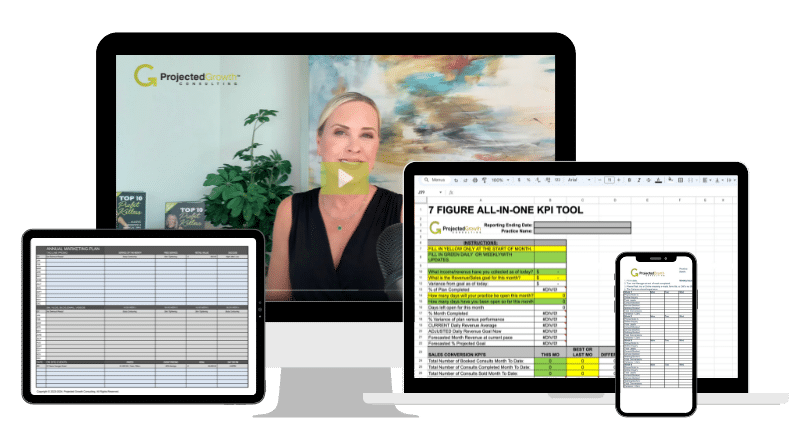
Want to find the leak in your funnel faster? Start by using the 7-Figure All-In-One KPI Tracking Tool to see where leads, consultations, sales, and recurring revenue are breaking down.
Projected Growth Consulting helps med spa owners build the operating discipline behind that system. A strong funnel is not just a landing page, ad campaign, email sequence, or phone script. It is the full path a prospective patient follows from first impression to inquiry, consultation, purchase, follow-up, and long-term loyalty.
A med spa funnel is the step-by-step sales system that moves a prospective patient from awareness to inquiry, consultation, treatment plan, purchase, follow-up, and repeat visits. A strong funnel connects marketing, booking, sales training, KPI tracking, and retention so leads become measurable revenue instead of lost opportunities.
The best funnels are built around the way med spa buyers actually make decisions. A patient may discover a practice through search, social media, a referral, a promotion, or an educational event. They may compare treatment options, read reviews, watch provider content, ask questions, book a consultation, delay a decision, and need several follow-up touches before they buy.
That means a med spa funnel must do more than generate leads. It must help the right people understand the offer, feel confident in the provider, book the next step, receive a consistent consultation, and get timely follow-up when they do not buy immediately.
Revenue leaks usually happen between stages. A campaign may produce leads, but the front desk does not qualify them. A consultation may go well, but the treatment plan is not presented clearly. A patient may be interested, but the follow-up stops after one message. These are not marketing problems alone. They are sales system problems.
Many practices collect names, phone numbers, or email addresses without identifying what the person wants, when they want it, what they have tried, and whether they are financially ready. Qualified lead capture helps the team prioritize the best opportunities and personalize the booking conversation.
A strong consultation needs more than clinical expertise. It needs a consistent opening, clear discovery questions, expectation setting, treatment-plan presentation, objection handling, and next-step confirmation. If each provider or team member handles this differently, conversion rates become unpredictable. This is where medspa sales training can turn interest into a repeatable process.
Many undecided prospects still want the result. They just need more clarity, proof, timing support, or financial confidence. If the team only sends one follow-up message, the practice loses people who might have converted with a better sequence.
Owners cannot fix what they cannot see. If reporting only shows total revenue or total leads, it is hard to know whether the problem is traffic quality, lead response time, booking rate, show rate, close rate, average ticket, membership conversion, or retention.
A high-converting funnel is built in stages. Each stage has a job, a metric, and a next action. When one stage is weak, the entire funnel feels inconsistent.
Awareness begins with visibility in the places your best patients already search, scroll, and ask for recommendations. This can include SEO, paid search, local search, social content, referral campaigns, community partnerships, and educational events. The goal is not just more traffic. The goal is more qualified attention from people who match your services, pricing, and care model. Strong digital marketing for medical spas should make the next step obvious.
Lead capture should give a prospective patient a reason to raise their hand. Examples include a consultation request, event RSVP, pricing guide, treatment quiz, membership inquiry, or educational download. The form or booking path should collect enough information to help the team respond with relevance, not just speed.
Nurture content helps prospects understand the treatment, provider expertise, expected outcomes, candidacy, safety considerations, financing, and what happens at the consultation. This stage reduces uncertainty and improves show rates because the buyer arrives more prepared.
The consultation is where trust, diagnosis, and sales execution meet. A strong consultative process helps the patient feel heard while still guiding them to a clear recommendation. Practices that need a more consistent patient conversation can use aesthetic consultation training to improve discovery, recommendation, and close rates.
Follow-up should be planned before the consultation ends. Document the objection, confirm the next step, and send a sequence that answers the specific barrier. A good follow-up system may include a same-day recap, 24-hour check-in, proof-based education, financing support, deadline reminders, and a final personal outreach.
The funnel does not end after the first purchase. Retention includes treatment-plan adherence, membership conversations, skincare recommendations, recall systems, reactivation campaigns, and patient experience improvements. Strong medspa loyalty programs can turn a one-time visit into recurring revenue.
The right funnel depends on the offer. A Botox promotion, body contouring consultation, new membership, and sales event should not all use the same follow-up path. Use these examples as starting points.
SEO, paid ads, or social content sends the prospect to an educational landing page. The page offers a consultation or treatment guide. The prospect completes a form, receives a confirmation message, gets a pre-consultation education sequence, attends the consultation, receives a treatment plan, and is followed up within 24 hours if they do not buy.
The practice promotes an event to a segmented list. The invite explains the offer, value, limited availability, and booking process. Registered prospects receive reminders before the event. During the event, the team uses a structured consultation and same-day offer. After the event, every attendee receives a documented follow-up sequence. For more ideas, review these medical spa marketing ideas and adapt them to event goals.
A first-time patient completes a treatment and receives a clear plan for maintaining results. The provider explains the value of regular visits, product support, and preferred pricing. The team presents a membership option as the easiest way to stay consistent. Retention messages then reinforce the benefit before each next visit.
A prospect completes a consultation but does not buy. The team records the reason, sends a personalized recap the same day, follows up within 24 hours, shares education related to the objection, and creates a second close attempt. This is especially important for higher-ticket treatment plans where timing, confidence, and financing questions can delay decisions.
Measurement turns the funnel from a guessing game into an operating system. If you only look at total revenue, you find problems too late. If you measure each stage, you can fix the highest-value leak first.
Mid-funnel CTA: Use the 7-Figure All-In-One KPI Tracking Tool to compare lead volume, consultation conversion, close rate, average ticket, and recurring revenue so your next move is based on data.
Track where leads come from and how much it costs to generate each one. A source that produces cheaper leads is not always better if those leads do not book, show, or buy.
Booking rate shows whether your lead response, qualification, and offer clarity are working. If many people inquire but few book, review response speed, call handling, form friction, and the value of the consultation offer.
Show rate measures how many booked prospects actually attend. Confirmation texts, reminder emails, pre-consultation education, deposits, and clear expectations can all improve this stage.
Close rate tells you whether the consultation process is converting interest into accepted plans. If show rate is strong but close rate is weak, review consult scripts, provider confidence, objection handling, offer presentation, and team accountability. These medspa sales strategies can support that review.
Average spend and recurring revenue show whether the funnel is creating profitable relationships, not just one-time transactions. Track treatment-plan value, product attachment, membership conversion, repeat visits, and reactivation results.
Projected Growth Consulting brings the strategy, training, and implementation discipline that many med spa teams are missing. PGC has served 6,000+ practices, helped create $250M+ in client revenue, supported 3,000+ sales events, produced a $62K average event revenue benchmark, and helped clients achieve 30% average growth in 90 days.
The work is practical. Owners need clarity on what is leaking, which number matters most, and what process to install next. That may include executive coaching, sales training, consultation systems, event strategy, KPI tracking, membership architecture, front desk process, leadership support, or the MedSpa Growth Accelerator.
When the funnel is designed correctly, the owner can stop chasing random tactics and start improving the business one bottleneck at a time.
A med spa funnel should make growth more predictable. When your practice can see where leads come from, how quickly they book, whether they show, how consultations convert, and how follow-up affects revenue, every next move becomes clearer.
If your practice has traffic but inconsistent consultations, strong consultations but weak follow-up, or growth that still depends too heavily on the owner, Projected Growth Consulting can help you build the operating system behind the funnel. Explore MedSpa Growth Accelerator or executive coaching to create a stronger sales system for your practice.

Written by
Founder & CEO, Projected Growth Consulting
Kelly Smith is a med spa business consultant with 20+ years of industry experience and the founder of Projected Growth Consulting. A former 7-figure med spa owner, published author of 5 books, and international speaker, Kelly has helped 6,000+ practices generate over $250 million in additional revenue through proven growth strategies.