Med spa consulting helps practice owners turn clinical demand into a stronger, more profitable business. If your schedule is full but cash flow still feels tight, your team is busy but inconsistent, or every growth decision depends on you, the issue is rarely one tactic. It is usually the system behind your sales, operations, marketing, leadership, and financial decisions. Use this guide with PGC’s Business Startup Program, digital marketing for medical spas, and med spa membership model resources when you need help turning strategy into execution.
Ready to identify the biggest growth constraint in your practice? Book a free success call with Projected Growth Consulting.
This guide explains what med spa consulting includes, when a practice needs outside support, what results are realistic, and how to evaluate a consulting partner before you invest. The goal is not to hand you a generic checklist. It is to help you think like a stronger CEO of an aesthetic business.
Med spa consulting is specialized business guidance for medical spas, aesthetic practices, plastic surgery practices, dermatology offices, wellness centers, and aesthetic nurses building or scaling a revenue-producing practice. A strong consultant helps owners diagnose performance gaps, build operating systems, train teams, improve sales conversion, use KPIs, and make smarter decisions about growth.
The important word is specialized. A med spa is not a regular retail business, a regular medical office, or a generic local service company. You are managing clinical safety, patient experience, provider productivity, front desk conversion, treatment packages, memberships, retail, compliance considerations, local competition, equipment decisions, and recurring marketing pressure at the same time.
That is why general business advice often falls short. A consultant who understands the aesthetic industry can connect the numbers to the daily behaviors inside the practice. For example, low monthly revenue may not be a marketing problem. It may be a consult conversion problem, a pricing problem, a follow-up problem, a provider utilization problem, or a leadership problem.
Good consulting brings those hidden constraints into view. Great consulting turns them into an executable plan.
Med spa consulting can include strategy, financial planning, operations, marketing, sales training, team development, startup planning, and event support. The exact scope depends on the stage of the practice, but most engagements fall into several core categories.
Strategic consulting helps owners decide where the practice is going and what has to change to get there. This can include revenue goals, service mix, pricing, staffing, marketing channels, membership structure, retail strategy, expansion planning, and owner leadership priorities.
Without this layer, practices often chase every idea at once. They discount injectables, buy devices too early, run random promotions, hire before the numbers justify it, or copy competitors without understanding their own margins. Strategy brings discipline to those decisions.
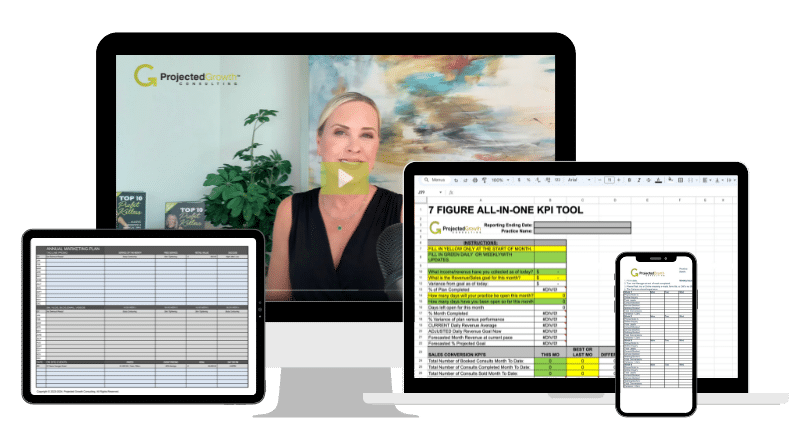
Many owners know their monthly revenue, but they do not know the numbers that explain it. Med spa consulting often includes building a simple, usable KPI system so the owner can track revenue, lead flow, consultation bookings, show rates, close rates, average ticket, provider utilization, cost of goods, payroll percentage, marketing ROI, and membership retention.
Projected Growth Consulting emphasizes this because numbers give owners control. The company offers resources like the 7-Figure KPI Tracker and growth tools to help owners stop guessing and start managing the business from facts.
Aesthetic practices do not grow on leads alone. They grow when the team can convert interest into the right treatment plan with confidence, ethics, and consistency. Consulting may include front desk scripting, lead follow-up, consultation structure, objection handling, treatment plan presentation, financing conversation support, and reactivation campaigns.
If your providers are excellent but your close rate is inconsistent, your practice may need aesthetic consultation training as much as it needs more marketing. The consultation is where trust becomes revenue.
Marketing consulting helps owners decide what to promote, when to promote it, who to target, which channels matter, and how to measure return. This may include annual campaign calendars, paid advertising strategy, local SEO, email marketing, social media direction, referral programs, seasonal offers, and launch planning for new services.
A strong consultant will not treat marketing as a pile of posts. The real question is whether your marketing supports the business model. A campaign that fills the schedule with low-margin discount clients may look busy but still weaken profit. A better approach connects campaigns to margins, provider capacity, consultation quality, and lifetime value.
Operations consulting focuses on how work actually gets done. This can include appointment flow, front desk standards, provider scheduling, patient handoffs, treatment room utilization, med spa inventory management protocols, follow-up systems, membership workflows, and team accountability.
Operational gaps often show up as owner stress. If you are constantly answering the same questions, fixing avoidable mistakes, or stepping into every client issue, the practice needs better systems. Consulting helps turn knowledge that lives in your head into repeatable processes your team can follow.
A med spa owner eventually has to shift from top producer to business leader. Consulting can help with role clarity, compensation structure, hiring plans, meeting rhythms, accountability, staff training, and culture. This is especially important when the practice is moving from founder-led growth to team-led growth.
Leadership consulting is not soft work. It directly affects revenue. A team that understands goals, expectations, scripts, metrics, and patient experience standards will usually outperform a more talented team with no structure.
For new founders, med spa consulting may include concept development, location strategy, business plan creation, equipment selection, service menu design, financial projections, staffing plans, and launch marketing. Owners exploring a new location or acquisition may need similar support before they commit capital.
PGC’s guide to opening a medspa covers many early questions, but a startup or expansion decision often deserves custom planning because the cost of a wrong lease, wrong device, or weak launch plan can be high.
A practice usually needs med spa consulting when growth has become too complex to manage by instinct. You may still be profitable. You may even be growing. The question is whether the business is becoming more predictable or more dependent on the owner’s daily heroics.
Here are the most common signs it is time to get support.
The best time to hire a consultant is before the business is in crisis. It is much easier to build stronger systems while you still have energy, cash flow, and team trust than it is to rebuild after burnout or financial pressure has set in.
Consulting is not magic. It works when the diagnosis is accurate, the plan is practical, and the owner and team implement consistently. With that said, the right partner can produce meaningful changes in a short period because many med spas have fixable gaps in sales process, KPI visibility, marketing structure, and team accountability.
Projected Growth Consulting has served more than 6,000 practices and reports more than $250 million in client revenue created. Its clients have also used PGC systems to generate an average of $62,000 per sales event, and the firm’s growth programs are built around measurable movement, including an average 30% growth in 90 days.
If you want growth tied to numbers instead of vague advice, schedule a free 15-minute success call and talk through your current constraints.
Results depend on the starting point. A startup may measure success by launching with the right business plan, service mix, and opening campaign. A growing practice may focus on consultation close rate, revenue per provider, membership sales, or marketing ROI. An established practice may focus on profit, leadership structure, multi-location readiness, or exit preparation.
The most useful consulting outcomes are usually concrete:
Be cautious of any consultant who promises a specific result without understanding your numbers, team, market, service mix, and implementation capacity. The right partner should be confident, but not careless.
Choosing a consulting partner is a strategic decision. The wrong fit can waste money and create confusion. The right fit can shorten the learning curve, protect profit, and help the owner step into a stronger leadership role.
Your consultant should understand how aesthetic practices actually make money. Ask whether they have experience with injectables, devices, memberships, retail, front desk conversion, provider utilization, patient financing, local competition, and recurring treatment plans. A general coach may understand leadership, but still miss the operational details that drive med spa performance.
A serious consultant should not prescribe before they diagnose. They should want to understand your revenue, margins, team, lead sources, consultation process, operations, and goals. If the solution is the same before and after discovery, you are probably buying a template rather than consulting.
Look for specific experience, client volume, case studies, revenue outcomes, and industry authority. PGC’s scale matters here: 6,000+ practices served, 3,000+ sales events conducted, and $250M+ in client revenue created give the firm a different level of pattern recognition than a consultant who has only worked with a handful of practices.
Advice alone is rarely enough. Ask how the consultant helps with execution. Do they provide templates, coaching calls, staff training, accountability, event support, or done-for-you materials? Do they help the team adopt the system, or do they leave the owner with more homework?
A startup, a $700K practice, a $2M practice, and a multi-location business do not need the same engagement. The best partner will help you choose the right level of support. PGC, for example, offers startup planning, the MedSpa Growth Accelerator, executive coaching, events support, online courses, and practical tools, which allows owners to enter at the level that fits their goals.
Some consultants focus heavily on marketing. Others focus on sales, finance, training, or operations. The best fit depends on your constraints. If you need profit, do not hire a partner who only talks about lead volume. If you need team consistency, do not hire a partner who only gives high-level strategy. If you need structure, choose someone who can build systems.
Use this table when comparing consulting options.
| Evaluation Area | What to Look For | Why It Matters |
|---|---|---|
| Industry fit | Medical aesthetics experience, not just general coaching | Your business model has unique revenue, compliance, and patient experience demands |
| Diagnostic depth | Review of KPIs, sales, operations, marketing, team, and goals | Accurate diagnosis prevents random tactic chasing |
| Implementation | Templates, training, calls, accountability, and practical tools | Execution is where consulting creates value |
| Proof | Client results, case studies, practice count, and industry authority | Pattern recognition reduces your risk |
| Stage alignment | Programs for startup, growth, scale, or events | Your support should fit the current business problem |
| Measurement | Clear KPIs and a plan for tracking progress | You need to know whether the work is improving the business |
Many practice owners wait too long to ask for help because they believe the next marketing campaign, device, hire, or promotion will solve the problem. Sometimes it helps. Often it adds complexity to a business that still lacks the systems to convert opportunity into profit.
Watch for these mistakes:
Consulting should help you stop reacting. Instead of asking, “What should we try next?” you start asking, “What does the data say is constraining growth, and what system will fix it?”
Med spa consulting is worth it when the value of better decisions, stronger systems, improved conversion, higher profit, and owner clarity exceeds the cost of the engagement. For most growth-minded practices, the larger cost is not the consulting fee. It is the money lost through unclear strategy, weak follow-up, undertrained teams, poor pricing, wasted marketing, or owner burnout.
If your practice is already tracking KPIs, converting consultations consistently, maintaining strong profit margins, developing leaders, and executing marketing with discipline, you may only need occasional strategic support. If those systems are missing, consulting can create leverage quickly because it changes how the business operates every day.
The right consulting partner should leave you with more than ideas. You should have a clearer plan, a more accountable team, better numbers, and systems that continue to work after the call ends.
A med spa consultant helps owners improve business performance through strategy, KPI tracking, sales training, marketing planning, operations, team development, startup planning, and growth systems. The consultant’s role is to identify constraints and help the owner implement practical solutions.
Your practice may need consulting if revenue has plateaued, profit is weaker than expected, leads are inconsistent, consultation conversion varies by team member, the owner is the bottleneck, or the business is preparing for startup, expansion, new services, or a major growth push.
Costs vary by consultant, scope, program length, and level of support. A one-time strategy session, online course, group coaching program, executive coaching engagement, and done-for-you event support will all be priced differently. The better question is what business problem the engagement is designed to solve and how progress will be measured.
Yes. Startup consulting can help with business planning, financial projections, service menu design, equipment decisions, location strategy, staffing, launch marketing, and early operating systems. This support can help new founders avoid expensive mistakes before they open.
Some practices see quick wins within weeks when they improve follow-up, consultation structure, pricing, or campaign execution. Larger changes, such as leadership development, membership growth, expansion planning, or full operational restructuring, usually require several months of consistent implementation.
Med spa consulting is not about giving up control of your business. It is about gaining the structure, perspective, and systems required to lead it better. The right partner helps you see what is really holding growth back and gives your team the tools to move forward with confidence.
Projected Growth Consulting has helped more than 6,000 aesthetic practices build stronger businesses through proven growth systems, KPI tools, consulting programs, and hands-on implementation support. Whether you are launching, scaling, improving profit, or preparing for your next stage, the work starts with clarity.
Want to know where your practice has the most growth potential? Book your free success call with Projected Growth Consulting and get a clearer path forward.
Written by
Founder & CEO, Projected Growth Consulting
Kelly Smith is a med spa business consultant with 20+ years of industry experience and the founder of Projected Growth Consulting. A former 7-figure med spa owner, published author of 5 books, and international speaker, Kelly has helped 6,000+ practices generate over $250 million in additional revenue through proven growth strategies.