A med spa owner bottleneck forms when routine decisions, approvals, and problem-solving cannot move forward without you. What once felt like responsible oversight starts slowing patient response times, frustrating capable employees, and keeping you trapped in daily operations. The solution is not to care less. It is to build a leadership system that lets the right people make the right decisions while you stay informed through clear accountability.
Schedule executive coaching with Projected Growth Consulting to build a leadership plan that helps your med spa grow without depending on you for every decision.
A med spa owner bottleneck exists when the owner must approve routine work before the team can act. It causes delayed decisions, weak accountability, staff frustration, and limited growth. Owners can remove the bottleneck by defining decision rights, setting performance guardrails, and coaching leaders to own results.
Founder dependency often develops for understandable reasons. You may have built the practice from the ground up, protected its reputation, trained the first employees, and personally handled the hardest patient conversations. Those habits helped the business survive. They become a liability when the practice reaches a size where one person cannot remain the control center.
The goal is not to disappear from the business. Your role should shift from answering every question to setting direction, developing leaders, reviewing results, and intervening only when an issue falls outside agreed guardrails. This change gives your team room to mature while preserving the standards that made the practice successful.
A busy calendar alone does not prove that you are blocking growth. The better test is whether work stops when you are unavailable. Review the past two weeks and count how often employees waited for your answer before they could move forward.
If four or more statements feel familiar, the problem is probably not individual employee motivation. It is an operating-system problem. The team has learned that waiting is safer than deciding. Your next step is to identify exactly where that pattern appears.

Bottlenecks rarely appear as one dramatic failure. They show up as dozens of small pauses across the patient journey and employee experience. Specific med spa examples make the pattern easier to diagnose.
A patient asks to move a deposit, requests a refund, or is unhappy about a wait. If the front desk must locate you before responding, the patient experiences uncertainty and the employee loses confidence. A written service-recovery policy can define which remedies the manager may authorize and when the owner must be involved.
A campaign stalls because every social post, email subject line, and promotional offer requires your approval. Meanwhile, leads wait too long for follow-up because no one owns response-time performance. A documented annual plan and clear campaign guardrails allow the marketing team to execute while you review results. The six-step blueprint for med spa success offers a broader framework for aligning growth activities.
A manager notices a coverage gap but cannot adjust the schedule without you. A high-performing provider needs coaching, yet the conversation is delayed because the manager is unsure what authority they have. These situations reveal a gap between job titles and actual decision rights.
Every supply order, small expense, or vendor question comes to you. Financial control matters, but requiring owner approval for every dollar creates avoidable delays. Spending limits, approved vendors, and monthly reviews provide control without turning you into the purchasing department.
Delegation fails when an owner hands off tasks without clarifying authority. The employee becomes responsible for an outcome but still lacks permission to make the decisions required to achieve it. That creates confusion rather than freedom.
Decision rights answer four questions: Who decides? Who gives input? What guardrails apply? When must the issue be escalated? Research from MIT Center for Information Systems Research describes decision rights as an essential part of effective governance. The same principle applies inside a growing med spa.
| Decision area | Team owns | Owner reviews | Escalate when |
|---|---|---|---|
| Patient service recovery | Manager selects an approved remedy | Weekly trend and cost report | Clinical risk, legal concern, or remedy exceeds limit |
| Staff scheduling | Manager adjusts coverage within labor target | Monthly labor and capacity results | Overtime or patient access falls outside target |
| Routine purchasing | Department lead orders from approved vendors | Monthly spend by category | New vendor or purchase exceeds limit |
| Marketing execution | Marketing lead runs approved campaign plan | Lead, conversion, and return metrics | Offer changes, budget increase, or compliance concern |
| Hiring | Manager screens and recommends candidates | Finalist and compensation plan | Role is new or compensation exceeds range |
Start with one recurring decision that reaches you several times each week. Document the expected outcome, guardrails, owner, review rhythm, and escalation trigger. Then test the arrangement for two weeks before expanding it.
Do not confuse a guardrail with a script for every possible situation. Employees need enough clarity to protect the practice and enough judgment to respond to real life. The goal is consistent decisions, not robotic behavior.
Weak delegation sounds like, “Please handle this.” Strong delegation defines the result, deadline, authority, resources, and standard of success. It also establishes when the employee should update you, so you do not have to chase progress.
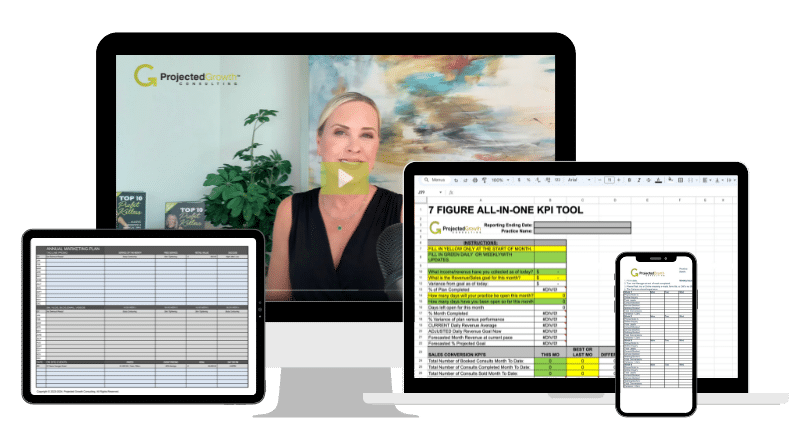
This approach replaces constant approval requests with planned accountability. Employees know what they own, and you know when you will receive an update. A med spa KPI dashboard can help the team review performance without relying on anecdotes.
Explore the MedSpa Growth Accelerator for coaching, tools, and accountability designed for owners building a stronger operation.
Owners often delegate, feel uncomfortable with a different approach, and quickly take the work back. That teaches employees that ownership is temporary. Instead, separate a true risk from a preference. If the employee stays within agreed guardrails and produces the required outcome, allow room for a method that differs from yours.
A useful leadership review is short, consistent, and focused on exceptions. Each leader reports key metrics, commitments completed, current obstacles, and decisions needed. The owner asks coaching questions rather than solving every issue.
When a manager brings a problem, ask for a recommendation and the reasoning behind it. Over time, this builds judgment and reduces reflexive escalation. If a repeated issue appears, improve the system instead of correcting the same mistake one case at a time.
Track a few indicators that show whether founder dependency is declining: the number of routine approvals sent to the owner. Unresolved issues older than seven days, decisions made by managers, completion of weekly commitments, and owner hours spent on strategic priorities. These measures turn “I feel less busy” into visible operational progress.
Trying to delegate everything at once can create unnecessary risk. A phased transition lets the team build capability while you confirm that standards remain intact.
During this phase, explain why the change matters. Employees may initially interpret delegation as abandonment or assume that an owner will reverse their decisions. Make it clear that authority comes with coaching, support, and accountability.
This is often the hardest period for the owner. Resist the urge to step in merely because you could complete the work faster. Your job is now to develop the person and improve the system.
By day 90, success does not mean that the team never needs you. It means routine operations move without constant owner approval, managers solve more problems at their level, and your involvement is reserved for high-value decisions.
It is difficult to redesign your own role while you are still carrying the daily workload. An outside coach can help identify where owner habits, unclear roles, weak measurements, or missing systems are keeping the practice dependent on you.
Projected Growth Consulting has served more than 6,000 medical practices since 2011. Its executive coaching program can focus on clinic culture, organization charts, position descriptions, productivity analysis, compensation planning, financial goals, and leadership plans. That combination helps owners connect leadership changes to measurable operating results.
Executive coaching also creates a place to examine the uncomfortable side of delegation. Owners can work through fears about quality, trust, and identity while still making practical changes. For a wider view of advisory options, read the med spa consulting guide.
Start with high-frequency, low-risk decisions that repeatedly interrupt your week. Good candidates include routine schedule adjustments, approved patient service remedies, or purchases within a defined limit. Avoid transferring a high-risk decision until the employee has the training, context, and guardrails to own it safely.
Use the mistake as coaching data. Review the reasoning, clarify any missing guardrail, and decide whether the issue reflects a skill gap or an unclear system. Take control back only when the risk requires it. Otherwise, continued coaching builds stronger judgment.
Define the required outcome and nonnegotiable standards before transferring authority. Review a small set of relevant metrics on a predictable schedule. This protects quality more effectively than requiring your approval for every action.
Yes, but the owner must separate clinical work from operational ownership. A capable leadership team should run staffing, marketing execution, routine financial controls, and day-to-day problem-solving. The owner can then choose clinical hours intentionally rather than treating patients while also serving as the default manager.
Removing a med spa owner bottleneck is not a single act of delegation. It is a leadership transition built on clear decision rights, visible measures, consistent coaching, and trust earned through results. Start with one recurring decision, establish the guardrails, and give a capable leader room to own the outcome.
Schedule executive coaching with Projected Growth Consulting to create a practical leadership plan for a med spa that can grow beyond you.
About the author: Kelly Smith, founder and CEO of Projected Growth Consulting. Has more than 20 years of experience in medical aesthetics and previously built a seven-figure medical spa.

Written by
Founder & CEO, Projected Growth Consulting
Kelly Smith is a med spa business consultant with 20+ years of industry experience and the founder of Projected Growth Consulting. A former 7-figure med spa owner, published author of 5 books, and international speaker, Kelly has helped 6,000+ practices generate over $250 million in additional revenue through proven growth strategies.