Med spa sales training works best when it gives every team member a clear path from first inquiry to booked treatment plan. Your marketing can create demand, your providers can deliver beautiful outcomes, and your space can feel elevated, but revenue still leaks when the front desk, patient coordinator, and consultation team are not using the same language, follow-up process, and performance metrics.
Want help building a sales process your team can actually follow? Book a free consultation with Projected Growth Consulting to identify the fastest conversion wins in your practice.
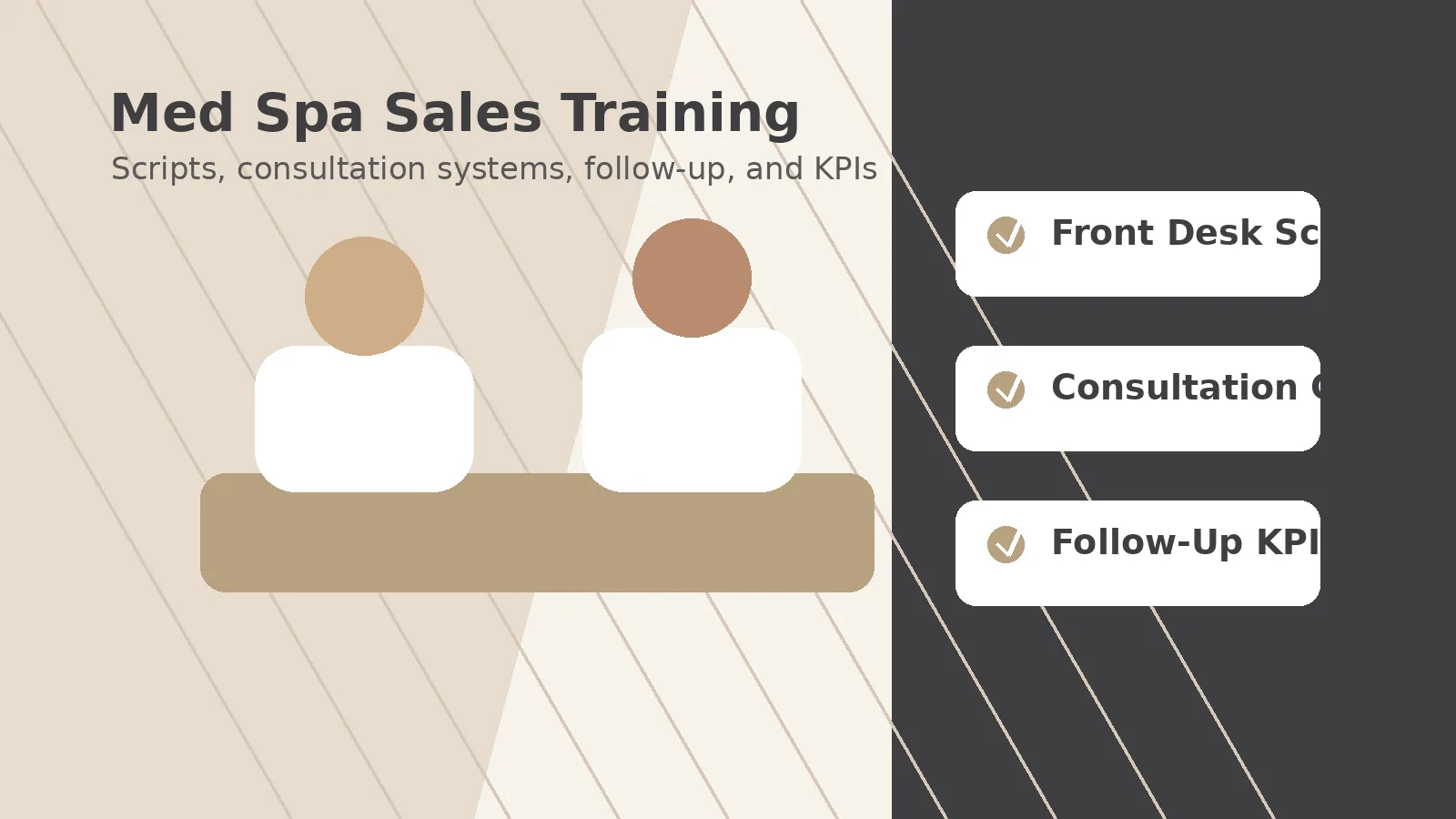
This guide breaks down the practical pieces of med spa sales training: front desk scripting, consultation conversion, objection handling, follow-up, and KPI tracking. Use it to tighten your patient journey before you spend more money on leads.
Med spa sales training is a structured system that teaches your team how to communicate value, guide patients through decisions, and convert interest into booked treatments without sounding pushy or transactional. It includes phone skills, front desk scripts, consultation frameworks, treatment plan presentation, follow-up standards, objection handling, and performance tracking.
The goal is not to turn your team into aggressive salespeople. The goal is to help them lead better conversations. A patient who asks, “How much is Botox?” may really be asking, “Can I trust you with my face, my budget, and my outcome?” A strong sales process helps your team answer that question with confidence.
Projected Growth Consulting has worked with more than 6,000 medical practices and has seen one pattern repeatedly: practices rarely have a lead problem only. Many have a conversion problem hiding behind a marketing problem. Before you increase ad spend, strengthen the path every lead takes once they contact your practice.
The front desk is often the first human voice a new patient hears. That interaction can either create confidence or turn the conversation into a price comparison. This is why front desk sales training deserves the same attention as provider training.
Front desk team members need more than a friendly tone. They need clear answers, approved language, and a repeatable way to move the caller toward a consultation. If the only response to a pricing question is a quick dollar amount, the practice loses the chance to explain customization, safety, provider expertise, and outcomes.
A strong first-call framework includes five steps:
Here is a simple script your team can adapt:
“That is a great question. Botox pricing depends on the areas we treat and the number of units needed for your goals. The best next step is a consultation so we can look at your concerns, give you an accurate recommendation, and explain the full treatment plan. We have openings Tuesday at 2:00 or Thursday at 10:30. Which one works better for you?”
The language is direct, helpful, and confident. It does not hide pricing. It simply protects the practice from quoting out of context.
Every med spa should have a small script library that covers the conversations your team handles every week. Scripts do not need to sound robotic. In fact, the best scripts give team members a structure they can personalize.
This script should help the team move from inquiry to consultation. It should include a warm opening, a question about the patient’s goal, a short value statement, and a booking ask.
This script should acknowledge the price question, explain why exact pricing requires assessment, and move toward a consultation. It should avoid shaming the patient for asking about cost.
Cancellations are not always lost opportunities. Train the team to reschedule in the same conversation by offering specific replacement times and restating the value of the visit.
No-shows need prompt follow-up. A simple, respectful text or call within the same day can recover appointments before the patient mentally moves on.
Past patients are often easier to convert than brand-new leads. Your team should know how to invite them back for maintenance, seasonal treatments, memberships, or updated consultations.
For hiring and role clarity, review this guide on hiring a great medical spa receptionist. The right person still needs the right process.
Consultation conversion improves when the conversation has a clear beginning, middle, and end. Many med spas lose sales because the consultation becomes an information dump. The provider explains every option, the patient feels overwhelmed, and no one confidently asks for the next step.
Strong consultation training teaches the team to diagnose the business side of the conversation as carefully as the aesthetic side. What does the patient want? Why now? What have they already tried? What is the emotional driver behind the treatment? What budget range or timeline needs to be discussed before presenting the plan?
If your team needs deeper help with this part of the patient journey, Projected Growth Consulting’s aesthetic consultation training guide explains how to make consultations more strategic and less improvised.
One common mistake is presenting treatments one at a time instead of showing the full path to the desired outcome. Patients often need a sequence: neurotoxin, filler, skin treatments, home care, maintenance, and follow-up. When the team only sells the first appointment, average ticket and long-term retention suffer.
Train your team to explain:
This creates a more complete patient experience and a stronger revenue model.
Objections are part of the decision process. They do not mean the patient is difficult. They usually mean the patient needs more clarity, more confidence, or a better connection between the recommendation and the outcome they want.
Med spa sales training should prepare the team for the objections they hear most often: price, timing, fear, spouse or partner approval, uncertainty about results, and comparison shopping.
When a patient says, “That is more than I expected,” the team should avoid getting defensive or discounting immediately. A better response is:
“I understand. This plan is designed around the result you told us you wanted, so let me walk you through what is included and what we can prioritize first if you want to phase it in.”
This keeps the conversation focused on value and options.
When a patient says they need to think about it, train the team to clarify the real hesitation:
“Of course. Before you go, is there anything about the plan, timing, or investment that still feels unclear?”
The answer often reveals what needs to be addressed.
Patients may worry about pain, downtime, looking unnatural, or choosing the wrong provider. This is where before-and-after education, provider experience, realistic expectations, and safety protocols matter.
If a patient is comparing med spas only by price, the team should explain what makes the recommendation customized. Competing on the lowest price weakens trust and margin. Competing on expertise, planning, and outcomes gives the patient a better reason to choose your practice.
If objections keep stopping consultations, the issue may be your process, not your people. Schedule a call with Projected Growth Consulting to review where your patient journey is losing revenue.
Many practices train the consultation, then leave follow-up to chance. That is a costly gap. A patient may leave without booking because they need to check their calendar, talk to a partner, review financing, or simply process the recommendation. If no one follows up with structure, the lead goes cold.
Follow-up training should define who follows up, when they follow up, what channel they use, and what message they send. It should also define when the lead is considered closed, paused, or reactivated later.
A practical cadence might look like this:
The key is consistency. If every coordinator follows up differently, you cannot tell whether the issue is message quality, timing, lead quality, or team execution.
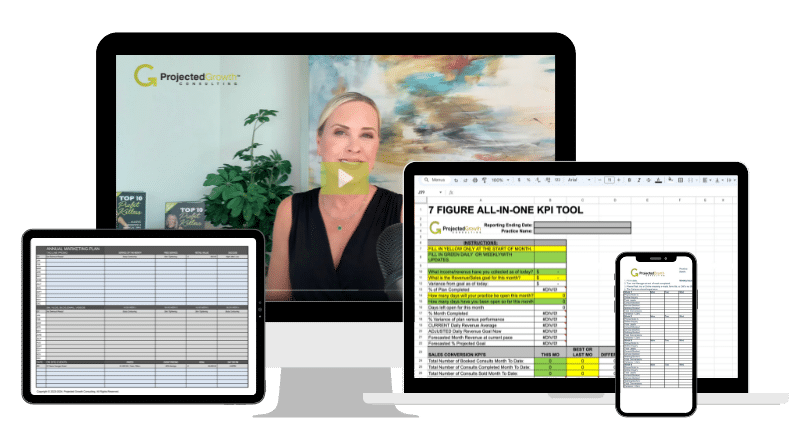
Use your CRM, practice management system, or a lead tracker to record contact attempts and outcomes. Projected Growth Consulting often emphasizes KPI visibility because what is not tracked usually is not managed. Follow-up is no exception.
Training should change behavior, and behavior should show up in your numbers. If your practice does not track before-and-after performance, you cannot prove whether the training worked or where to coach next.
Start with the KPIs that show the patient journey from lead to revenue:
| KPI | What It Shows | Training Question to Ask |
|---|---|---|
| Lead response time | How quickly new inquiries are contacted | Is the front desk responding fast enough to protect conversion? |
| Inquiry-to-consultation rate | How many leads become scheduled consultations | Are scripts moving callers toward the next step? |
| Consultation show rate | How many scheduled consultations actually show | Do confirmation and reminder scripts need improvement? |
| Consultation close rate | How many consultations become paid treatments or plans | Is the recommendation and close clear enough? |
| Average transaction value | How complete each treatment plan is | Is the team presenting full plans or single services? |
| Follow-up conversion rate | How many undecided patients convert after follow-up | Is the follow-up cadence being used consistently? |
| Membership conversion rate | How many patients join recurring programs | Is the team connecting memberships to patient goals? |
Review these numbers weekly at first. A short weekly review can reveal where coaching is needed: missed calls, weak booking language, low show rate, low close rate, or poor follow-up completion.
For practices building recurring revenue, connect sales training to your med spa membership model. Memberships are easier to sell when the team understands how they support the patient’s long-term plan.
A strong training program is not a single meeting. It is a rhythm. Your team needs initial training, role-play, live coaching, call review, consultation review, KPI feedback, and script updates based on what patients are actually saying.
Write down every step from inquiry to purchase: website form, phone call, text, consultation, treatment plan, financing, follow-up, membership offer, and rebooking. Look for gaps where no one owns the next step.
Review calls, emails, texts, and consultation notes. Do not guess. Identify the exact questions patients ask and where your team loses control of the conversation.
Build scripts for the most common moments. Then define standards: response time, number of follow-up attempts, booking language, consultation recap, and CRM documentation.
Short, consistent role-play is more effective than occasional long trainings. Practice price shoppers, treatment plan presentation, financing, cancellation recovery, and “I need to think about it” conversations.
Use the numbers to decide where coaching is needed. If inquiry-to-consultation rate is low, coach the front desk. If consultation close rate is low, coach the consultation structure. If follow-up conversion is low, coach cadence and message quality.
Sales training should support med spa growth systems across the broader business model. Your event strategy, marketing funnel, consultation process, and memberships should work together. This med spa funnel guide can help you connect lead generation to consultations, sales, and retention.
If you are starting from scratch, use this agenda for a focused team training session:
| Training Block | Time | Focus |
|---|---|---|
| Patient journey review | 20 minutes | Where leads come from, where they drop off, and what the team owns |
| Front desk scripting | 35 minutes | Price shoppers, new leads, rescheduling, no-shows, and booking language |
| Consultation framework | 45 minutes | Connect, clarify, recommend, confirm, and close |
| Objection handling role-play | 35 minutes | Price, timing, fear, trust, comparison shopping, and partner approval |
| Follow-up cadence | 25 minutes | Same-day recap, next-day check-in, and reactivation standards |
| KPI review | 20 minutes | Which numbers will be tracked weekly and who owns each metric |
This does not replace deeper coaching, but it gives the practice a starting structure. From there, the owner or manager can run weekly refreshers.
Providers are important, but the front desk controls many of the earliest conversion moments. If the first call is weak, the provider may never get the chance to close.
A script sitting in a shared folder will not change performance. Team members need to say the words out loud, practice the transitions, and get feedback.
Discounts can train patients to wait for the next deal. Teach the team to explain value, customize plans, and use memberships or packages strategically.
The fortune is often in the follow-up. If no one owns it, the practice will keep paying for leads that never convert.
Without KPIs, training becomes a motivational event instead of a business system. Track the numbers and coach from reality.
Projected Growth Consulting helps medical spa owners turn scattered sales activity into a clearer growth system. The company brings experience across sales process optimization, consultation conversion, front desk training, events, memberships, KPI tracking, and executive coaching. PGC has served more than 6,000 practices and has generated more than $250 million in client revenue through practical systems, coaching, and implementation support.
For practices that want hands-on support, PGC’s Events Program and Executive Coaching can help connect team training to revenue growth, KPI visibility, and repeatable execution. The point is not more theory. The point is a team that knows what to say, what to track, and how to follow through.
Ready to tighten your front desk, consultation, and follow-up process? Book a call with Projected Growth Consulting and start building a sales system your team can execute consistently.
Med spa sales training is the process of teaching your team how to convert inquiries and consultations into booked treatment plans through better scripts, consultation structure, follow-up, objection handling, and KPI tracking.
Include front desk staff, patient coordinators, providers, managers, and anyone who speaks with leads or patients about treatments, scheduling, pricing, memberships, or follow-up.
Start with a structured training session, then reinforce skills weekly through role-play, call review, consultation review, and KPI coaching. Sales training should be ongoing, not a one-time event.
Track lead response time, inquiry-to-consultation rate, consultation show rate, consultation close rate, average transaction value, follow-up conversion rate, and membership conversion rate.
Acknowledge the price question, ask what the patient wants to improve, explain why accurate pricing requires a personalized recommendation, and guide the patient toward a consultation with two clear appointment options.

Written by
Founder & CEO, Projected Growth Consulting
Kelly Smith is a med spa business consultant with 20+ years of industry experience and the founder of Projected Growth Consulting. A former 7-figure med spa owner, published author of 5 books, and international speaker, Kelly has helped 6,000+ practices generate over $250 million in additional revenue through proven growth strategies.