The median small business loan for a new medical spa is about $225,000. Banks rarely fund projects based on vague plans or high hopes. A winning plan links every startup dollar to a clear path for profit.
Estimating medspa startup costs requires a clear list of equipment, building work, and cash on hand to satisfy bank lenders who fund new aesthetic practices. Most mid-range sites reach $350,000 to $500,000 once you include laser tools that can cost $200,000 each and the work to build out medical rooms. Banks also need $75,000 in extra cash to pay the bills for 18 months, as shown in SBA loan data for small firms. Winning owners must show how these first steps lead to steady sales to avoid a rejection from the bank or a sudden cash crisis. This detailed plan is the best way to prove your new med spa is a safe bet for a loan and will yield a real profit.
Schedule Your Med Spa Strategy Consultation
Banks do not just look at future sales when they check a loan request. They want to see that you have done the math on every cost. Understanding why accurate startup costs matter to lenders and profit is the best way to prove your business is a safe bet. The path to a fundable business begins now.
Accurate startup costs matter because lenders scrutinize every line item before approving a small business loan. A mid-range med spa requires $350,000 to $500,000 in total startup investment including equipment, build-out, and working capital. SBA data shows the median loan for health service startups is $225,000. Without precise, documented cost estimates, lenders cannot assess your ability to repay.
Choosing to open a med spa is a big move. You need to see a full breakdown of startup cost categories before you talk to a bank. Most owners start with a rough guess on paper. But banks do not want a guess. They want to see a clear plan for every dollar. If your numbers are vague, lenders will say no.
Lenders look for proof that you know the market. Data from the Small Business Administration (SBA) shows the median loan for a med spa startup is $225,000. Some loans go as high as $500,000. If you ask for too little, you will run out of cash. If you ask for too much without proof, the bank will see you as a risk.
Banks need to know you can pay back the debt. They check if your cost plan fits the local market. The US Census Bureau shows more than 9,000 med spa shops exist today. This means the market is busy. Lenders want to see that you have planned for staff, gear, and rent in a way that makes sense for your area.
Real medspa startup costs are not just about opening day. Most new shops take 12 to 18 months to reach steady profit. This is a long time to pay for staff and rent without a large cash flow. If your loan does not cover this wait, your doors may close early. Real numbers help you ask for the right amount of cash to keep the doors open.
Mature med spas with three to five rooms can make $1.2 million to $2.5 million a year. But you cannot reach those numbers if you fail in the first six months. You must plan for the burn rate of your cash while you build your list of clients. This long view is what turns a new shop into a real asset.
Vague guesses about costs can lead to deep stress for new owners and bosses. We often see owners buy gear they do not need yet. This wastes cash that could have gone to ads or payroll. A solid cost plan is the base for your entire business. It shows that you are a smart boss, not just a service expert.
When you build a budget that a bank can fund, you prove your worth. You show that you can lead a team and manage a big budget. This work sets the stage for high growth. Getting your medspa startup costs right is the first step toward a shop that lasts for years.
A loan-ready med spa budget must break startup costs into seven distinct categories: real estate and build-out ($50,000 to $150,000), medical devices and technology ($100,000 to $300,000), licenses and medical oversight ($10,000 to $30,000), initial product inventory ($10,000 to $25,000), launch marketing ($15,000 to $50,000), and working capital reserves ($30,000 to $75,000). Lenders expect each category itemized with specific dollar amounts tied to local market research.
A solid loan request shows the bank you know exactly where every dollar will go. Most med spas need between $200,000 and $1,000,000 to launch, depending on the scale and location. According to SBA 7(a) loan data, the median startup loan for these types of medical businesses is $225,000. To get a yes from a lender, you must break your total budget into seven clear categories.
Your lease deposit and build-out costs often run from $50,000 to $150,000. This fund covers your security deposit and the work needed to make a space medical-grade. You will need special plumbing, HVAC, and electrical work to meet local codes. It is also important to plan for ADA compliance and private rooms for patient exams. For more details on these expenses, see our full breakdown of startup cost categories online.
Equipment is usually the largest single cost for a new practice. Expect to spend between $100,000 and $300,000 to get started. High-end lasers often cost between $50,000 and $200,000 for each device. While these tools are expensive, they also serve as collateral for the loan. You should also budget up to $5,000 for upfront software costs like your EMR and POS systems.
You must have the right legal structure in place before you open your doors. Professional fees for a medical director agreement and state licensing typically range from $10,000 to $30,000. Data from the American Med Spa Association shows that legal rules vary by state, so your budget must reflect local needs. This category also covers your DEA registration and any CLIA waivers you might need for lab tests.
Initial product inventory usually costs between $10,000 and $25,000. This includes your first stock of neurotoxins, fillers, and clinical skincare items. You also need a strong marketing plan to fill your rooms from day one. Expect to spend $15,000 to $50,000 on your website, SEO, and ads before you launch. Finally, set aside $30,000 to $75,000 in working capital to cover your payroll and rent for the first few months.
Working capital covers your monthly operating expenses until the practice reaches profitability, which typically takes 12 to 18 months. To calculate the right amount, multiply your monthly burn rate (payroll, rent, software, supplies, device leases) by six months. For a mid-range practice with $20,000 in monthly expenses, you need $120,000 in working capital. Lenders consider this reserve essential for loan approval.
Most med spa owners focus on the build-out and lasers but forget the cash needed to stay open. You must have enough funds to pay bills until your practice earns a profit. Lenders look for a clear plan that covers your monthly burn rate and an emergency fund. Finding this number correctly makes your loan application much stronger and protects your new business.
Most med spas take 12 to 18 months to reach steady profit. If you run a shop that only does injectables, you might break even in 6 to 9 months. During this time, you must cover a high monthly burn rate. This includes rent, software fees, and med spa insurance which can cost $12,000 per year according to industry benchmarks from Mindbody.
Payroll is your biggest recurring cost. The average annual pay for a med spa worker is about $67,935 according to the Bureau of Labor Statistics. You must also account for device leases. A single high-end laser can cost $1,000 to $5,000 per month. Add in medical supplies and your total monthly spend can reach $50,000 or more very quickly.
Lenders want to see that you have a safety net. A smart goal is to set aside six months of operating capital. For a mid-range practice, this reserve usually falls between $50,000 and $150,000. This fund ensures you can pay your team and keep the lights on even if your first few months are slow.
You also need a small cash fund for daily needs. Most owners keep at least $1,000 in an emergency drawer for quick repairs or small supplies. However, your goal should be a three-month cash buffer to handle larger shocks. Having this cash ready shows you can manage a med spa break even analysis and stay in business through the startup phase.
To find your total, add your monthly costs and multiply by your target months of safety. For example, if your burn rate is $20,000 and you want a six-month cushion, you need $120,000 in working capital. This is the amount you should ask for in your loan on top of your equipment and build-out costs.
Many new owners do not see how long it takes to build a client base. According to the Small Business Administration, median startup loans for health services are around $225,000. A large part of that sum often goes toward working capital to ensure the business does not run out of cash before it finds success.
Lenders need to see how each dollar of startup cost translates into revenue. A stable three-to-five-room med spa generates $1.2 million to $2.5 million in annual revenue. To reach those numbers, you must show that your equipment purchases enable specific treatment volumes. For example, a $200,000 laser requires 15 to 25 treatments per month just to cover its lease payment.
Lenders want to see more than just a list of what you plan to buy. They need to know how those medspa startup costs will turn into a healthy business. To build a strong loan case, you must link your one-time costs to monthly sales goals. This shows that you know the math of the medical spa industry.
A standard medical spa with three to five rooms can expect clear sales. Once a practice is stable, it often brings in $1.2 million to $2.5 million in yearly sales. These numbers come from industry facts used by groups like the Small Business Administration to track growth. Knowing these goals helps you set real targets for your own new business.
Your sales depend on how you use your space and staff. You should plan your sales by looking at each service you offer. Look at the price and the direct cost of the tools. You also need to track how much time an expert spends with each client. High sales do not always mean high gains if your costs are too high.
Buying or leasing lasers is often the largest cost for a new practice. If you lease a laser that costs $200,000, you will have a large monthly bill to pay. You must perform about 15 to 25 treatments every month just to cover that one lease. This math is vital for your break-even analysis and cash flow plan.
The mix of services you offer will change your gains. Some treatments have low costs but take a lot of staff time. Others use expensive tools but can be done fast. A good plan shows how you will balance these services to pay for your tools. Lenders look for this detail to ensure you can pay back your debt.
Great practices focus on the lifetime value of their clients. In this field, a single client is often worth $2,000 to $8,000 over several years. This is because most treatments must be done again every few months. You should also look at your customer acquisition cost to see what you spend to get each new client.
Focusing on repeat sales helps keep your money flow steady. When you plan your budget, include the cost of ads to keep these clients coming back. This long-term view shows lenders that your business can grow and stay healthy. It turns your startup costs into a plan that builds real value.

Your choice between buying equipment outright, leasing, or financing through a loan changes your cost structure. Buying requires the most upfront cash but offers Section 179 tax deductions. Leasing reduces day-one costs by 50 to 70 percent. Financing has interest rates from 6 to 15 percent. Most successful owners use a mix: buy furniture and lease high-end lasers to balance cash flow and capability.
How you pay for your machines will change your whole business plan. You must decide if you want to own your tools from the start or keep more cash in the bank. This choice shifts your startup costs and your monthly risk levels. It also sets how soon your practice will reach its break-even point.
Buying your tools with cash means you own them from day one. You do not have to worry about monthly debt or extra fees. You can also use Section 179 of the tax code to deduct the full cost of the gear in the first year. This can lead to big tax savings if you have the profit to offset it. But this path takes a lot of your startup funds all at once. Many new owners get a $225,000 loan from the SBA to get started. If you use most of that for just one laser, you might run out of cash before you even open your doors.
Leasing is a common way to lower your day-one costs for a new practice. It can reduce your upfront spend by 50% to 70% compared to buying the gear outright. Instead of one large check, you pay a set fee each month. These payments often range from $1,000 to $5,000 per device. This helps you keep a steady monthly burn rate that is easy to track. Leasing also lets you swap old tech for new tools much faster. This is vital in a field where tech changes every few years.
Financing through a loan is a middle ground between buying and leasing. You take out a loan to buy the gear, and the machine itself acts as the collateral for the debt. Rates for these loans often range from 6% to 15% based on your credit. This path lets you own the asset over time while you keep some cash for other needs like marketing or hiring. You should look at our full list of startup cost types to see how these choices fit into your total budget.
| Feature | Buying Outright | Leasing | Financing Loans |
|---|---|---|---|
| Upfront Cash | Full price paid today | 50% to 70% less upfront | Small down payment |
| Monthly Cost | No monthly payments | $1,000 to $5,000 per unit | Set loan payment |
| Asset Ownership | You own it now | You do not own it | You own it with debt |
| Tech Upgrades | Hard to trade in | Easy to swap for new | Must sell to upgrade |
| Collateral Needed | No collateral | Device is the collateral | Device is the collateral |
Your choice should match your business goals and your current cash. If you have a lot of cash, buying might save you money on loan costs. But if you need to stay nimble, leasing is often the best way to manage your medspa startup costs. Most owners find that a mix of paths works best for their first year. For example, you might buy your beds and chairs but lease your high-end lasers. This keeps your debt low while giving you the best tools for your clients.
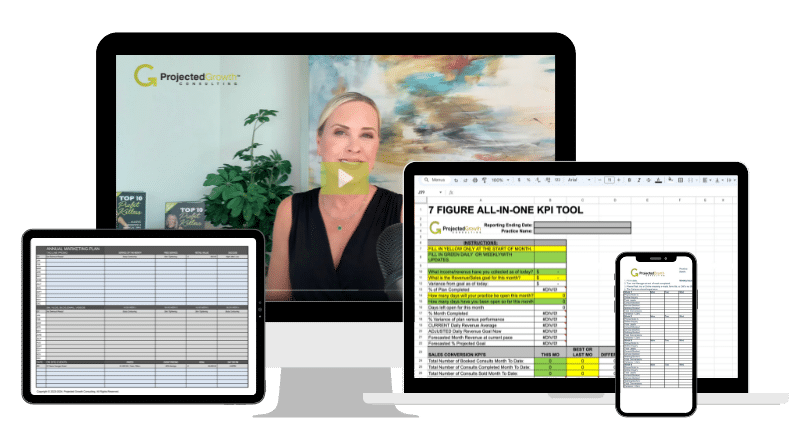
Kelly Smith’s Projected Growth Practice OS transforms startup cost planning from guesswork into a structured system. Instead of treating expenses as isolated line items, the Practice OS connects every budget decision to treatment margins, staffing ratios, and profitability timelines. The Business Startup Program provides lender-ready budget templates, break-even calculators, and expert coaching.
You cannot build a profitable medical spa on guessing games or generic templates. To secure a small business loan and build a practice that thrives, you need a proven operational system. This is where Kelly Smith’s Projected Growth Practice OS and the Business Startup Program become your unfair advantage. Instead of looking at startup costs as a list of independent expenses, our methodology treats them as a connected system that directly drives your bottom-line profitability.
Underestimating cash flow needs is the primary reason why new aesthetic practices fail. Many founders budget for the visible costs (like lease deposits and laser devices) but overlook the operational friction of the first six months. The Practice OS protects your investment by aligning your startup budget with your real-world capacity. We help you map out your service mix, set profitable pricing thresholds, and calculate precise payroll targets based on industry benchmarks like the average annual compensation of $67,935 per employee.
With our Business Startup Program, you do not just guess what you need to borrow. We help you structure a loan-ready budget that clearly shows lenders how you will utilize every dollar. This includes modeling slow, expected, and strong launch months to show how your working capital reserve (typically $50,000 to $150,000) will cover recurring obligations until your cash flow becomes self-sustaining.
A winning startup plan begins with your treatment menu, not your floor plan. The Practice OS teaches you to evaluate every potential offering by its direct cost, provider time, room utilization, and net margin. This prevents the common error of over-investing in expensive device platforms before proving local demand. By launching with a high-margin, lean menu, you reduce your upfront equipment lease burden and reach your break-even point much faster.
Our program provides the exact templates, KPI trackers, and expert coaching you need to navigate state-by-state legal summaries, negotiate device financing, and build a highly profitable team structure. By implementing these systems before you sign a lease or purchase a device, you ensure that your startup costs are optimized for profit from day one. To learn more about structuring your practice for long-term growth, explore our guide on how to scale a med spa using predictable systems.
A typical mid-range medical spa with 3 to 4 treatment rooms requires a startup investment of $350,000 to $500,000. Lean solo practitioner startups can launch for as little as $50,000 to $150,000 by utilizing leased shared spaces and starting with a single service line. Large premium boutique clinics in prime urban centers with extensive equipment suites can easily exceed $1,000,000 in initial startup costs.
Yes, medical spas can be highly profitable, but profitability is not automatic. An established medical spa with 3 to 5 treatment rooms typically generates between $1.2 million and $2.5 million in annual revenue, with mature profit margins averaging 20% to 35%. Achieving these margins requires rigorous control of fixed overhead, structured compensation models, high room utilization, and a service mix focused on high-margin treatments.
The five most significant startup cost categories for a new medical spa include:
While precise failure rates vary, industry data indicates that approximately 30% to 40% of new medical spas close or undergo distressed sales within their first three years. The most common reasons for failure are under-capitalization (running out of working capital), over-investing in expensive capital equipment before establishing a steady client base, and failing to implement structured operational and marketing systems.
Launching a medical spa is a major financial and operational undertaking. Attempting to build your business on guesswork, incomplete budget templates, or unverified cost ranges is a direct route to loan rejection or early insolvency. Your startup budget must be an accurate, strategic blueprint that connects every investment dollar to a validated path for profitability.
Do not navigate this complex process alone. Leverage the decades of experience and proven systems that have helped thousands of aesthetic practice owners succeed.

Written by
Founder & CEO, Projected Growth Consulting
Kelly Smith is a med spa business consultant with 20+ years of industry experience and the founder of Projected Growth Consulting. A former 7-figure med spa owner, published author of 5 books, and international speaker, Kelly has helped 6,000+ practices generate over $250 million in additional revenue through proven growth strategies.