Multi-location med spa management is not a bigger version of running one successful practice. It is a different operating model. The second location exposes every process that still lives in the owner’s head, every leadership gap hidden by proximity, and every number that cannot be trusted until month-end. If your original location is doing $2 million or more, expansion can create enterprise value. It can also multiply inconsistency faster than revenue.
The answer is not more meetings or a longer owner to-do list. It is a deliberate operations architecture: one repeatable way to run the business, with local accountability and central visibility. Projected Growth Consulting calls this kind of disciplined operating model the Projected Growth Practice OS. It gives a growing practice a practical way to diagnose the real constraint, prioritize the next profit move, implement the right system, and scale what works without asking the owner to be everywhere at once.
Multi-location med spa management is the centralized design of standards, leadership roles, financial reporting, and patient-experience controls that lets multiple practices operate consistently while remaining locally accountable. It is not centralizing every decision. It is deciding which decisions must be the same at every site, which outcomes each location leader owns, and which information leadership needs weekly to act before a small problem becomes a multi-site problem.
The current search results are heavy on software features, site-specific customization, and generic scaling advice. Those matter, but they do not solve the core management issue. Software records a process. It does not create one. A five-location practice needs a management architecture that answers four questions every week:
If the answer to any of these is no, opening another site does not fix the business. It makes the weak point harder to see.
Expansion usually breaks down when the founder remains the unofficial operating system. In a single practice, an owner can catch a weak consultation, calm a staffing conflict, approve a discount, and spot a schedule problem in the hallway. At two or more sites, that same habit creates uneven decisions, delayed coaching, and a team that waits for permission rather than solving problems within clear guardrails.
Project leadership should treat the second location as a replication test, not a reward for a strong quarter. Before signing another lease, establish a baseline at the first site. This article addresses established operators at $2 million to $10 million or more in annual revenue. The owner must be able to fund the opening effort and the management layer that follows it.
A new location needs working capital, an accountable leader, consistent recruiting and onboarding, a reliable patient-experience standard, and a scorecard that separates one site from another. There is no universal staff-to-location ratio because provider mix, treatment mix, hours, and state rules vary. Use a structural benchmark instead. Each location needs one named operating leader with authority over daily execution. No regional leader should directly coach more locations than they can visit, audit, and review weekly.
The six-phase architecture moves a med spa from founder-led execution to a repeatable multi-site operating system. The sequence matters. Installing dashboards before naming accountability produces more numbers, not better management. Hiring a regional leader before defining the local playbook creates a costly messenger. Complete each phase deeply enough that the next location inherits a working system rather than a collection of good intentions.
Start by defining the conditions the original location must meet before it earns expansion. This is the point of the multi-location growth plan, but the operations test goes further. The existing site should show consistent monthly performance, a stable leadership bench, documented patient workflows, and enough cash discipline to report the true cost of opening and supporting the next location.
Use a 90-day baseline, not the best month of the year. Review site-level revenue, consultation conversion, rebooking or retention, provider utilization, payroll as a share of revenue, lead response time, cancellations, no-shows, and contribution to overhead. The point is not to chase a borrowed industry average. The point is to know your own normal performance well enough to recognize when the second site is drifting.
Document the handful of workflows that cannot vary by location. This includes lead response, consultation flow, treatment handoff, membership enrollment, checkout, follow-up, complaint escalation, inventory controls, daily huddles, and new-hire onboarding. The med spa operations manual is the source of truth, not a binder created for accreditation and forgotten in a drawer.
A useful playbook has three parts for every process: the trigger, the required action, and the measurable outcome. For example, a new web lead triggers a defined response workflow. The assigned team member follows a documented outreach sequence. The result is measured as response time, booking rate, show rate, and consultation conversion. That structure lets a leader coach a behavior instead of arguing about effort.

Centralize standards and visibility. Keep daily execution close to patients and staff. The owner or executive team should own brand standards, service menu decisions, pricing guardrails, key vendor terms, financial definitions, leadership development, and the scorecard. The location leader should own daily staffing, schedule execution, huddles, coaching, service recovery, local community presence, and weekly scorecard action.
This split prevents two expensive failures. First, locations cannot invent their own version of the brand. Second, the central team does not become so controlling that site leaders avoid making necessary decisions. Put the decision rights in writing. A location manager should know what can be fixed immediately, what requires regional input, and what requires clinical or ownership approval. Local clinical and regulatory requirements should always be reviewed with qualified legal and clinical advisors for the jurisdiction.
Multi-location management works when the calendar creates a predictable loop of visibility, decisions, and coaching. Every location should run the same daily huddle, weekly scorecard review, monthly operating review, and quarterly planning process. The agenda can be short. The discipline cannot be optional.
| Cadence | Focus | Owner |
|---|---|---|
| Daily. | Capacity, handoffs, staffing, recovery. | Location leader. |
| Weekly. | Conversion, retention, labor, inventory. | Location leader and regional review. |
| Monthly. | Site P&L, cash, marketing, people. | Executive and finance leadership. |
| Quarterly. | Capacity, leadership bench, capital, constraint. | Owner and leadership team. |
The weekly scorecard should show location-level data before it is blended into a company total. Company-wide averages hide problems. A strong flagship can make a new site look acceptable while its conversion, staffing, or retention deteriorates. Review both the result and the leading behavior that drives it. A missed revenue target can be caused by fewer consults, slower lead response, lower show rate, weak closing, reduced treatment capacity, or a patient return problem. Treating all misses as a marketing issue wastes time and money.
Financial opacity is the fastest way to confuse growth with progress. A practice can add revenue while losing cash through overstaffing, excessive discounting, duplicated overhead, inventory leakage, or a location that never reaches a healthy contribution margin. Multi-location med spa management requires one chart of accounts, shared metric definitions, and site-level reporting that leaders can understand without waiting for an accountant to explain it.
Use the same definitions across every site for collected revenue, consultation conversion, treatment conversion, recurring revenue, payroll, inventory, discounts, refunds, and marketing-source performance. Then pair financial results with operational drivers. If labor rises, identify whether the cause is low provider utilization, schedule design, overtime, poor staffing mix, or weak revenue per appointment. If a new site misses plan, separate a startup ramp issue from a flawed operating model.
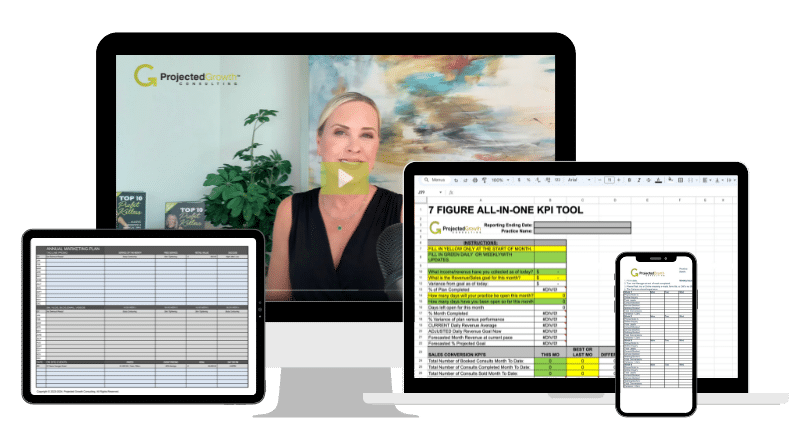
For the weekly layer, start with the core measures in a med spa KPI dashboard. For the monthly layer, tie those measures to the site P&L and cash position. The number of metrics matters less than clarity. Every measure needs an owner, a target based on the practice’s actual model, a current result, and one next action.
The fifth location should not require a fifth version of the owner. It should be the proof that leadership development is working. Build a visible succession path: team member to lead, lead to assistant manager, assistant manager to location manager, location manager to regional leader. Do not promote the best provider or salesperson simply because they are excellent at production. Leadership requires coaching, conflict management, accountability, and the ability to protect standards when the owner is absent.
A practical test is simple: can the location manager explain the scorecard, run the weekly review, identify the constraint, coach the right behavior, and escalate the right issue without a rescue call? If not, the management layer is not ready for another site. Invest in defined role expectations, manager training, observation, and repeated feedback before the opening date forces the decision.

You protect consistency by measuring critical patient moments and giving local leaders a clear service-recovery process. Brand consistency is not identical paint colors or a shared Instagram calendar. It is the patient receiving the same clear communication, respectful handoff, pricing explanation, clinical escalation, follow-up, and recovery when something goes wrong.
Choose a small set of patient-experience standards that every location audits. Examples include time from lead to first response, consultation preparation, treatment-plan explanation, membership presentation when relevant, checkout accuracy, post-treatment follow-up, complaint response time, and review-request timing. Audit the process with direct observation, call reviews, and patient feedback. Do not accept a manager’s assurance that the team understands the standard. Watch the standard happen.
Then create one escalation path. A local leader should be able to resolve routine service issues within defined guardrails. Clinical concerns, material refunds, safety events, and reputational risks need clear escalation to the appropriate clinical, executive, or legal authority. The goal is not to remove judgment. It is to prevent slow, inconsistent judgment from becoming the patient experience.
Expect expansion to take longer than the lease, build-out, and opening calendar suggest because the operating system has to mature between sites. A disciplined team uses the first 90 days of a new location to establish baseline performance and fix early execution gaps. The next 90 days should prove that the manager can run the scorecard, staff the schedule, and protect patient experience without continuous owner rescue.
That does not mean every practice should wait a fixed number of months before opening again. The right pace depends on capital, market demand, leadership capacity, clinical oversight, and the consistency of the first site. The warning signs are clear. Leadership cannot explain a location’s performance. Managers lack authority. The owner covers routine gaps at multiple sites. The company sees location economics only after damage is done.
Projected Growth Consulting has served more than 6,000 practices since 2011. The lesson from scaling work is direct: expansion should follow operational proof, not optimism. The Growth Hub gives owners a way to diagnose the expensive problem in front of them, prioritize the right next move, implement it, and convert the improvement into a repeatable system.
The recurring failures are not mysterious: culture dilutes, the patient experience varies, leaders wait for the owner, and company totals hide a weak location. The correction is not a motivational speech. It is returning to the operating architecture and identifying the broken phase.
A med spa is ready when the original site has demonstrated consistent performance, documented operating standards, a capable location leader, location-level financial visibility, and enough capital to support both the opening and the management structure. Strong revenue alone is not enough.
Use shared systems and metric definitions wherever practical so leadership can compare sites accurately. The goal is not identical tools for their own sake. It is consistent data, clear accountability, and a management rhythm that reveals issues early.
There is no safe universal number. The limit is reached when routine location decisions, coaching, and performance reviews still depend on the owner. Build local management and regional oversight before the owner becomes the delay point.
They standardize the patient moments that matter, train leaders to observe those standards, and use a clear escalation process when service or clinical concerns arise. Consistency is managed behavior, not a marketing slogan.

Written by
Founder & CEO, Projected Growth Consulting
Kelly Smith is a med spa business consultant with 20+ years of industry experience and the founder of Projected Growth Consulting. A former 7-figure med spa owner, published author of 5 books, and international speaker, Kelly has helped 6,000+ practices generate over $250 million in additional revenue through proven growth strategies.