
A med spa operations manual should make the right way to run the practice clear, repeatable, and measurable. It is not a binder that collects dust. It is the operating system your front desk, providers, managers, and owners use to deliver a consistent patient experience while protecting time, inventory, and profitability.
The strongest manuals connect three levels of the business: policy explains what must happen, a standard operating procedure explains how it happens, and a scorecard shows whether it is working. When those levels are aligned, the owner no longer has to solve the same problem every week.
What Is a Med Spa Operations Manual?
A med spa operations manual is the centralized source of truth for the non-clinical and approved clinical workflows that keep a medical aesthetics practice running. It defines ownership, decision rights, daily routines, handoffs, documentation standards, and accountability measures.
Think of the manual as a living management tool. Every section should help a team member answer five questions:
- What: What outcome or task is required?
- Who: Which role owns it, and who is the backup?
- When: What triggers the workflow, and when is it due?
- How: Which steps, tools, and quality checks apply?
- How measured: Which KPI or audit confirms the process works?
A manual is broader than a collection of SOPs. SOPs are its working instructions. The manual also includes operating principles, role expectations, escalation paths, and the management cadence that keeps those SOPs current.
The Seven Essential Sections of a Med Spa Operations Manual
A useful manual should mirror how work moves through the practice. Its seven essential sections define decision rights, patient flow, scheduling, provider utilization, inventory, payments, and KPI accountability. Together, they turn scattered tasks into an operating system the team can follow, measure, and improve.
1. Governance, Roles, and Decision Rights
Ambiguity creates delays. Begin by defining the organizational structure, reporting lines, and decisions each role can make without waiting for the owner. Include job descriptions, opening and closing responsibilities, backup coverage, and an escalation matrix.
The escalation matrix should specify what staff can resolve, what goes to the practice manager, and what requires clinical leadership or ownership. This is especially important for complaints, refunds, adverse events, schedule disruptions, equipment issues, and privacy concerns.
Clinical protocols, scope-of-practice rules, medication handling, consent language, and emergency procedures must be created or approved by appropriately licensed professionals and legal advisors for the jurisdictions where the practice operates. The operations manual should show staff where those approved protocols live and who must be contacted.
2. Front Desk and Patient Journey Workflows
The front desk connects marketing, scheduling, providers, and revenue. Document the entire patient journey, not isolated tasks. A complete workflow can include:
- Lead response and inquiry qualification
- Consultation booking and confirmation
- Pre-visit instructions and forms
- Arrival, check-in, and identity verification
- Provider handoff and room readiness
- Checkout, payment, retail recommendations, and rebooking
- Post-visit follow-up and service recovery
- Review requests and long-term recall
For every handoff, state what information must move with the patient. For example, the consultation-to-provider handoff might require the patient’s goals, stated concerns, timing, previous treatments, and required clinical documentation. This prevents patients from repeating themselves and helps the provider begin prepared.
Support this workflow with focused front desk consultation and sales training so scripts become consistent, patient-centered conversations.
Use scripts as guardrails, not robotic speeches. Give staff approved language for common scenarios, then train them to listen and adapt. For more ideas on reducing friction, review these aesthetic clinic operations tips.
3. Scheduling and Capacity Management
A full calendar is not automatically a productive calendar. Your scheduling standards should match appointment types to the right provider, room, equipment, and amount of time. Define which appointments can be booked back-to-back, which require buffers, and how far in advance rooms or devices must be prepared.
Include rules for:
- Appointment-type durations and cleanup buffers
- New-patient consultation blocks
- High-demand and low-demand time slots
- Deposits, cancellations, no-shows, and late arrivals
- Waitlist activation and same-day opening fills
- Provider call-outs and equipment downtime
- Recurring treatment plans and recall campaigns
Document who reviews tomorrow’s schedule, what they check, and when corrections happen. A daily schedule review should identify unconfirmed appointments, missing forms, open capacity, unusual room or equipment conflicts, and patients who may need a follow-up or rebooking conversation.
4. Provider Utilization and Room Flow
Provider utilization improves when the team reduces avoidable idle time without compromising care. The manual should define how the practice prepares providers to stay focused on the work only they can perform.
Create standards for pre-visit chart readiness, room turnover, supply setup, photography, documentation completion, and checkout handoffs. Then measure the gaps between scheduled time and productive treatment time. If a provider is frequently waiting for rooms, supplies, forms, or patient handoffs, the problem is usually a workflow issue rather than a scheduling issue.
Use a weekly capacity review to compare available provider hours, booked hours, completed hours, and revenue by provider or service category. The goal is not simply to keep everyone busy. It is to identify where demand, staffing, room availability, or process design constrains profitable growth.
5. Inventory and Purchasing Controls
Inventory is cash sitting on a shelf, and weak controls can quietly erode margin. The manual should define how products enter the practice, move between storage and treatment rooms, get recorded when used, and leave through sale, disposal, expiration, or return.
At minimum, document:
- Approved vendors and authorized purchasers
- Receiving, count verification, and storage procedures
- Lot, serial, or expiration tracking where required
- Par levels, reorder points, and purchase approval limits
- Daily or per-treatment usage recording
- Cycle counts and full inventory audits
- Variance investigation, waste, and damaged-product procedures
Assign one accountable owner to each inventory category. Multiple people can participate, but one role must reconcile expected usage against actual counts and resolve variances. For a deeper framework, use these inventory management protocols to protect profit.
6. Cash, Payments, and End-of-Day Reconciliation
Document payment acceptance, financing workflows, refunds, discounts, gift cards, memberships, packages, tips, and outstanding balances. Staff should know what they can approve and when manager authorization is required.
The end-of-day process should reconcile scheduled appointments, completed services, collected payments, product usage, retail sales, and deposits. Exceptions should be investigated promptly rather than carried into the next week. Clear controls protect the practice and reduce uncomfortable conversations between team members.
7. KPI Scorecards and Accountability Cadence
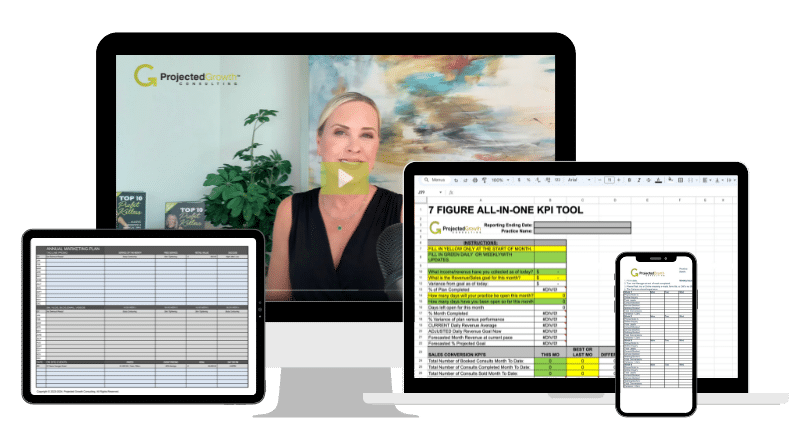
An operations manual becomes a growth tool when every critical workflow has an owner and a number. Choose a small set of metrics that reveal patient flow, team execution, capacity, and financial health.
| Area | Example KPI | What It Helps Diagnose | Review Cadence |
|---|---|---|---|
| Lead handling | Inquiry-to-consult booking rate | Response quality and conversion | Weekly |
| Scheduling | No-show and late-cancellation rate | Confirmation and policy effectiveness | Weekly |
| Patient retention | Rebooking rate | Checkout and treatment-plan follow-through | Weekly |
| Capacity | Provider booked-hour utilization | Demand, schedule design, and workflow constraints | Weekly |
| Inventory | Usage variance and expired inventory | Recording gaps, waste, and purchasing controls | Monthly |
| Financial | Revenue and gross profit by service category | Service mix and margin performance | Monthly |
Every KPI needs a definition, data source, owner, target, review cadence, and required response when performance misses the target. Without those details, a dashboard is decoration. Use the practice’s med spa profitability benchmarks and KPIs to turn scorecard reviews into decisions and assigned actions.
How to Write an SOP Your Team Will Actually Use
An SOP should be short enough to follow during real work and specific enough that a trained team member can complete the process consistently. Use one template across the manual:
- Name and purpose: State the process and why it matters.
- Owner and backup: Identify who is accountable.
- Trigger and frequency: Explain when the process begins.
- Required inputs: List forms, tools, supplies, or approvals.
- Step-by-step actions: Write observable instructions in sequence.
- Quality check: Define what “done correctly” looks like.
- Escalation: Explain what to do when the normal process fails.
- Measurement: Connect the SOP to a KPI or audit.
- Document control: Record the owner, approval date, version, and next review date.
Use screenshots, checklists, or short training videos when a visual demonstration is more useful than prose. Keep each SOP at the point of use, whether that is in a shared knowledge base, practice-management platform, or printed station checklist.
A Practical 90-Day Implementation Plan
Do not try to document everything at once. Build the manual in the same order that operational risk and revenue opportunity appear.
Days 1-30: Map and Prioritize
- Map the patient journey from first inquiry through recall.
- List recurring operational failures and owner interruptions.
- Identify all existing policies, checklists, scripts, and clinical protocols.
- Assign process owners and select the highest-impact workflows.
- Establish document naming, version control, and approval rules.
Prioritize processes that affect safety, patient experience, cash handling, schedule capacity, and expensive inventory. These areas usually create the fastest reduction in risk and daily friction.
Days 31-60: Document and Pilot
- Write the highest-priority SOPs using one standard template.
- Pilot each SOP with the people who perform the work.
- Observe the workflow and remove unclear or unnecessary steps.
- Train backups so knowledge does not stay with one person.
- Connect each major process to its KPI and review cadence.
The best test is not whether an SOP reads well. It is whether a trained backup can use it successfully without calling the owner for clarification.
Days 61-90: Train, Measure, and Improve
- Train the full team and document competency.
- Launch daily huddles and weekly operations reviews.
- Audit adherence to the new procedures.
- Track baseline KPIs and assign corrective actions.
- Schedule quarterly manual reviews and annual approvals.
Once the core systems are stable, connect the manual to a broader med spa success blueprint so operations can support the next stage of growth.
How to Keep the Manual Alive
A manual fails when updates are nobody’s job. Assign a document owner and require a review whenever the practice adds a service, device, software system, location, role, or significant policy change. Also review an SOP after repeated errors, patient complaints, unusual inventory variance, or a missed KPI.
Use a simple governance rhythm:
- Daily: Huddle around schedule risks, capacity, and immediate handoffs.
- Weekly: Review leading KPIs, unresolved exceptions, and assigned actions.
- Monthly: Review financial, inventory, and provider-capacity trends.
- Quarterly: Audit selected SOPs and update the manual.
- Annually: Complete a full operational and professional approval review.
Separate performance management from process improvement. If a well-trained team member ignores a clear process, address accountability. If several capable people struggle with the same process, improve the process.
Common Operations Manual Mistakes
- Writing for compliance rather than use: A technically complete document still fails if staff cannot find or follow it.
- Documenting the ideal instead of reality: Observe the current workflow before designing the better one.
- Leaving ownership unclear: “The team” is not an accountable owner.
- Ignoring handoffs: Most patient-experience failures happen between roles, not within one role.
- Measuring too much: A focused scorecard with required actions is more useful than dozens of passive metrics.
- Treating the manual as finished: The practice changes, so the manual must change with it.
Frequently Asked Questions
What should be included in a med spa operations manual?
Include governance, role responsibilities, front desk workflows, patient journey standards, scheduling rules, provider and room flow, inventory controls, payment reconciliation, escalation paths, SOPs, KPI definitions, and document-control procedures. Professionally approved clinical, privacy, safety, and compliance protocols should also be easy for staff to locate.
How often should a med spa operations manual be updated?
Review selected SOPs quarterly and complete a full review at least annually. Update affected sections sooner when the practice changes services, equipment, software, locations, staffing structure, or approved policies, or when an incident or recurring performance gap reveals a weak process.
Who should own the operations manual?
A practice manager or designated operations leader should own the manual’s organization and review schedule. Individual process owners should maintain their SOPs, while licensed clinical leadership and legal or compliance advisors approve applicable protocols and policies.
What is the difference between a policy and an SOP?
A policy defines the rule or required outcome. An SOP provides the step-by-step method for carrying it out. For example, a cancellation policy states the practice’s requirements, while the cancellation SOP tells staff how to document, communicate, collect fees, and escalate exceptions.
How long should a med spa SOP be?
It should be only as long as necessary for a trained team member to complete the process correctly. Many recurring workflows fit on one or two pages when written as clear steps with a checklist, quality check, and escalation path.
Build an Operation That Can Scale
The purpose of a med spa operations manual is not more paperwork. It is fewer avoidable surprises, clearer accountability, a more consistent patient experience, and a business that can grow without requiring the owner to personally hold every process together.
Projected Growth Consulting helps medical aesthetic practices turn growth goals into practical systems and accountability.
Explore the MedSpa Growth Accelerator to build the systems required for your practice’s next stage.