A solo injector practice hits a structural ceiling the moment the owner’s two hands become the only revenue engine. No amount of additional marketing spend or extended hours will break through that constraint because the bottleneck is not demand, it is delivery capacity. True scaling of a medical aesthetic practice begins when the owner transitions from being the highest-producing clinician to the architect of systems and teams that generate revenue without them.
Book a free strategic consultation with Projected Growth Consulting to build your multi-provider scaling plan. Schedule your call here.
Correctly scaling your medical aesthetic practice requires four interdependent transitions: moving from clinician-delivered revenue to system-dependent revenue, replacing owner-led operations with documented processes. Building a provider pipeline that maintains clinical quality at volume, and converting the owner’s role from chief injector to chief executive. Kelly Smith and Projected Growth Consulting have guided over 6,000 practices through this exact transformation since 2011. Generating more than $250 million in additional client revenue through the Projected Growth Practice OS. A multi-provider practice structured on these principles commands a higher valuation ceiling and frees the owner to work on the business rather than in it.
The transition from solo injector to multi-provider practice is the single highest-leverage decision a med spa owner can make. Yet most owners approach it reactively, hiring when they are overwhelmed rather than when data supports it. This article walks through the diagnostic, structural, and leadership frameworks that separate practices that scale successfully from those that simply add payroll without adding profit.
The arithmetic of a solo practice is brutally simple. One provider has approximately 35 to 40 billable hours per week once charting, consults, and administrative tasks are factored in. At a blended average case rate of $600 to $1,200. The theoretical weekly revenue cap falls between $21,000 and $48,000, and that assumes 100 percent utilization, which no real practice sustains. Once the owner hits 70 percent utilization, they are operating at capacity, the quality of the patient experience begins to degrade. And the margin on each additional booking shrinks because it costs the owner in burnout what it returns in revenue.
Solo practices trade the owner’s time for money by definition. Every dollar earned requires the owner’s physical presence. This creates a double constraint: the owner cannot be in two treatment rooms simultaneously, and any absence for vacation, illness, or business development stops revenue production entirely. According to data from the American Society for Aesthetic Plastic Surgery, aesthetic case volumes correlate closely with macroeconomic cycles, making a single-provider business particularly vulnerable to demand contractions. A practice dependent on one person has no shock absorption.
The owner-as-bottleneck problem extends beyond scheduling. Clinical expertise does not automatically translate to operational excellence. Most solo injectors spend disproportionate energy on low-leverage tasks, from supply ordering to front-desk coverage, because there is no one else to delegate them to. This is precisely the pattern the owner bottleneck article describes, and it is the primary reason practices plateau between $300,000 and $600,000 in annual revenue. Breaking that plateau requires a fundamental restructuring of how the owner spends their time.
The instinctive response to feeling overworked is to hire another injector. But adding a provider to a practice that lacks documented systems doubles complexity without solving the underlying structural problem. Kelly Smith, founder of Projected Growth Consulting and author of five business books on med spa growth. Makes a counterintuitive point: the first hire should not be a clinician at all. It should be an operations or front-desk lead who can absorb the administrative burden that consumes the owner’s non-clinical hours. This frees the owner to build the SOPs, training protocols, and scheduling systems that make a second provider addition profitable rather than dilutive.
| Metric | Solo Provider | Multi-Provider (2-3) |
|---|---|---|
| Weekly billable hours | 35-40 | 70-120 |
| Revenue per room-hour | $150-$300 | $200-$400 |
| Owner clinical time | 80-100% | 20-40% |
| Fixed overhead per provider | 100% | 40-60% |
| Patient acquisition cost per visit | $75-$250 | $50-$150 |
| Provider utilization threshold | 70% | 70% |
| Enterprise valuation multiple | 1-2x EBITDA | 3-5x EBITDA |
Before scaling your medical aesthetic practice by adding providers, the owner must conduct a rigorous diagnostic audit. The fundamental question is whether current operations can absorb additional clinical capacity without eroding margins. Most owners evaluate readiness by how busy they feel. Feeling busy is not a metric. The data required for an informed hiring decision falls into three categories: provider utilization, room economics, and baseline profitability.
Provider utilization is the percentage of available clinical hours that are booked with revenue-generating procedures. A solo practice running below 60 percent utilization has a demand problem, not a capacity problem, and adding a provider will simply dilute the existing patient base. The threshold for readiness is consistently exceeding 70 percent utilization over a rolling 90-day period. This benchmark, which Kelly Smith teaches in the MedSpa KPI dashboard framework, prevents the common mistake of hiring when the real issue is under-marketing rather than over-demand.
Each treatment room in a medical aesthetic practice has a fixed cost, including rent, utilities, equipment depreciation, and support staff allocation. The question is whether a second provider can generate enough incremental revenue per room to cover those fixed costs plus their compensation. Using data from a typical 1,500 to 2,500 square foot med spa layout with two to three treatment rooms. The break-even point for a full-time injector is approximately $8,000 to $12,000 per month in collected revenue above their compensation. If current demand supports that threshold, adding a provider is economically sound.
Before hiring, the practice must demonstrate healthy unit economics at the solo level. Key benchmarks include a cost of goods sold below 22 to 25 percent, gross margins above 70 percent. And a patient acquisition cost that supports the practice’s target return on ad spend. Without these fundamentals in place, adding a provider multiplies inefficiencies rather than growth. Projected Growth Consulting’s comprehensive KPI guide covers the full diagnostic framework.
Once the data supports adding a provider, the next challenge is building a team that maintains clinical quality and revenue per patient. A single substandard hire in a two-provider practice compromises 50 percent of clinical output. A structured hiring process, rigorous onboarding, and intentional retention systems are not optional; they are the operational backbone of a scalable multi-provider aesthetic practice.
The most common hiring mistake in med spas is prioritizing clinical credentials above communication skills and cultural alignment. Patients in a multi-provider practice must receive a consistent experience regardless of which injector they see. The hiring process should include a practical assessment, a patient interaction simulation. And a structured reference check that asks former employers directly about reliability, bedside manner, and treatment philosophy. The interviewing framework recommended by Projected Growth Consulting examines both technical competence and the candidate’s willingness to follow established protocols rather than improvising their own approach.
A new injector’s ramp period, the time between their first day and when they are consistently hitting production targets. Can range from 60 to 120 days depending on onboarding quality. The fastest ramp times correlate with structured training programs that include shadowing documented protocols. A 30-day patient volume progression, and weekly revenue reviews with the owner or practice manager. Documenting treatment protocols as SOPs before the first hire is essential. When the owner is the only person who knows how certain procedures are performed, knowledge transfer becomes a bottleneck.
Provider turnover in the aesthetic industry typically costs 150 to 200 percent of annual compensation when factoring in recruitment. Training, lost patient relationships, and the dip in referral volume. Retention systems should include transparent compensation models, usually a base salary plus a percentage of production ranging from 25 to 35 percent. Combined with a career ladder that creates clear progression from new provider to senior injector to clinical director. Practices in the MedSpa Growth Accelerator program report that team stability improves measurably when providers have visibility into their earning potential and professional development trajectory.
A multi-provider practice cannot operate on verbal tradition. Every recurring operational decision must be captured in a written Standard Operating Procedure, from new patient intake to inventory management to post-treatment follow-up. Kelly Smith’s Projected Growth Practice OS provides the template for this systematization. And the practices that implement it most thoroughly are the ones that achieve the smoothest scale transitions.
The patient journey in a multi-provider practice should be identical regardless of which provider or front-desk team member handles a given interaction. This requires SOPs for every touchpoint: phone inquiry scripts, consultation structure, booking confirmation sequences, treatment room setup, discharge instructions, and follow-up cadence. When each step is documented and measurable, the owner can delegate confidently and audit compliance through simple spot checks rather than personal supervision.
Scheduling in a multi-provider environment requires data-driven decisions about appointment blocks, provider-to-room ratios, and buffer time between cases. A common pattern in growing practices is to schedule two providers across three treatment rooms, using the third room for overflow, consultations, and recovery. The economics improve when the schedule is built around the practice’s highest-margin procedures. With the longest treatment blocks assigned to peak-demand slots and filler services (facials, peels, maintenance treatments) placed in shoulder hours. Tracking med spa KPIs like revenue per room-hour provides the feedback loop for continuous scheduling optimization.
As case volume grows, inventory management shifts from a back-office task to a strategic function. Cost of goods sold must be tracked by provider, not in aggregate, because individual variance in product usage directly affects per-case margin. Negotiating volume-based discounts, establishing automatic reorder points, and conducting monthly variance reviews are the minimum disciplines required to prevent product waste from eating into scaling gains.
Marketing automation and recurring revenue models are not optional at scale; they are the engine that supports the higher fixed cost base of a multi-provider practice. A solo injector can sustain a manual marketing approach because they only need a certain number of new patients per month. A two- to five-provider practice needs a marketing machine that generates leads predictably without the owner’s daily involvement.
The practices that scale most efficiently invest in three marketing channels that produce compounding returns: local SEO for the medical aesthetics practice website targeting city-plus-service queries, a Google Business Profile optimized with regular posts and review generation, and a nurture email sequence for past patients. These channels together create a baseline of incoming leads that covers the practice’s monthly new-patient target. Paid media, including Google Ads and social media campaigns, should be the variable growth lever on top of that baseline, not the primary source of new patients.
Membership programs are the highest-leverage recurring revenue vehicle in aesthetic medicine. A well-designed membership creates predictable monthly cash flow, increases patient retention, and raises the lifetime value of each patient relationship. Practices that implement membership programs through the MedSpa Growth Accelerator framework typically see membership revenue contribute 30 to 50 percent of total monthly revenue within 12 months. For a scaling practice, that predictability is invaluable: membership revenue covers fixed operating costs regardless of fluctuations in new-patient volume. Giving the owner confidence to hire and invest ahead of demand.
Patient retention directly determines whether a multi-provider practice achieves sustainable profitability. The cost of acquiring a new aesthetic patient ranges from $75 to $250 depending on channel and market. While the cost of retaining an existing patient for a follow-up treatment is a fraction of that. Retention systems should include automated recall sequences at the treatment interval, a patient loyalty program, and a systematic process for rebooking patients at checkout. Each percentage point of improvement in retention compounds directly into revenue because the retained patient books more frequently and refers peers at a higher rate than the average new patient.
The personal transformation required for successful scaling of a medical aesthetic practice is often the hardest part of the journey. An owner who built their practice on clinical excellence must develop a completely different skill set: financial analysis, team leadership, strategic planning, and executive decision-making. This transition is not automatic and it is not comfortable. Kelly Smith addresses this directly through Projected Growth Consulting’s executive coaching program, which treats the owner’s leadership capacity as the primary constraint on practice growth.
Every hour the owner spends in a treatment room after the practice has sufficient demand to support another provider is an hour they are not spending on high-leverage owner activities: negotiating vendor contracts. Optimizing the marketing mix, developing team members, refining SOPs, and planning the next phase of growth. The opportunity cost calculation is stark. If the owner’s clinical rate is $800 per hour but an optimized multi-provider practice generates $1,500 to $3,000 per room-hour across multiple providers. Then every clinical hour the owner works prevents the business from operating at its full revenue potential.
Owners who successfully make this transition report the same pattern: the decision to step back from clinical work must be deliberate and timed rather than reactive. Most owners wait until burnout forces the shift, which means the transition happens under stress rather than strategy. The executive coaching approach from Projected Growth Consulting helps owners sequence this transition in a way that maintains practice momentum and preserves patient relationships.
The skills that made a clinician successful, diagnostic precision, procedural competence, relationship building with patients, are different from the skills required to lead a multi-provider practice. Executive skills required include financial literacy (reading P&L statements, understanding unit economics, forecasting cash flow). People management (performance reviews, conflict resolution, delegation), and strategic thinking (market positioning, competitive analysis, growth planning). These skills can be learned, but they require deliberate practice and often external coaching. The owners who invest in their own leadership development before they feel ready are the ones who build practices with sustainable enterprise value.
You have read the framework. The diagnostic phase, the systems layer, the team building, the marketing engine, and the leadership transition. The question now is whether you will take action or stay in the chair. Book a free strategic consultation with Kelly Smith and the Projected Growth Consulting team to map out your specific scaling timeline. The owners who act decisively on this transition are the ones who build practices worth multiples of what their solo operation would ever command.
Schedule your free consultation now and start building your multi-provider practice on a foundation that scales.
A: Your practice is ready when provider utilization consistently exceeds 70 percent over a rolling 90-day period, your gross margins are above 70 percent. You have documented SOPs for the core operational workflows, and your patient pipeline generates more leads than a single provider can handle. Kelly Smith recommends running a full financial diagnostic before making any hiring decision to confirm that the practice economics support adding a provider without margin erosion.
A: The hardest part is the owner’s personal transition from clinician to CEO. Most injectors built their reputation on clinical excellence, and stepping away from the treatment room feels like abandoning their core identity. The operational and systems work is straightforward by comparison. Projected Growth Consulting’s executive coaching directly addresses this leadership transition, helping owners build the executive skills required to lead a growing practice.
A: Start with one additional provider and confirm the economics work before adding more. A two-provider model with one to two support staff and two to three treatment rooms is the minimum viable scaling unit. Once the second provider is fully ramped and generating consistent revenue, evaluate whether demand supports a third. Adding providers faster than the patient pipeline and operational systems can absorb them is a common scaling mistake that dilutes per-provider revenue and increases overhead as a percentage of gross.
A: The data supports engaging an experienced consultant. Practices that work with Projected Growth Consulting report an average 30 percent growth within 90 days. And the firm has generated over $250 million in additional revenue for its clients since 2011. The key value that a consultant like Kelly Smith provides is the framework for scaling. The Playbook that prevents common mistakes like hiring before systematizing or scaling marketing before the service delivery model is locked in.
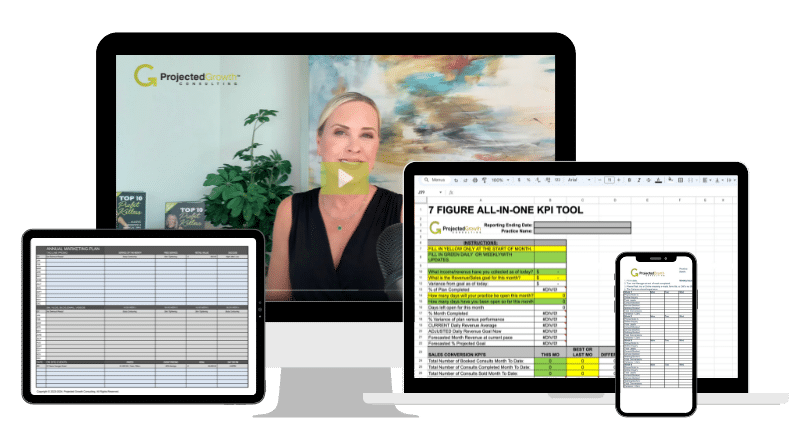
A: The five most important metrics for a scaling aesthetic practice are provider utilization rate. Revenue per available room-hour, cost of goods sold as a percentage of revenue, patient acquisition cost, and patient lifetime value. Projected Growth Consulting provides a comprehensive KPI dashboard tool that tracks all of these metrics in real time. Monitoring these numbers monthly (or weekly during the transition period) ensures that scaling decisions are grounded in data rather than intuition.

Written by
Founder & CEO, Projected Growth Consulting
Kelly Smith is a med spa business consultant with 20+ years of industry experience and the founder of Projected Growth Consulting. A former 7-figure med spa owner, published author of 5 books, and international speaker, Kelly has helped 6,000+ practices generate over $250 million in additional revenue through proven growth strategies.