When revenue feels unpredictable, staff keep escalating problems, and every decision lands on the owner’s desk, the practice needs more than an isolated tactic. It needs an operating sequence that exposes where money, time, and accountability are being lost.
Book a strategy call to discuss your practice overhaul.
Effective medical practice consulting follows one connected loop: diagnose the practice with measurable operating data. Prioritize the most expensive bottleneck, standardize the workflow, strengthen leadership ownership, and build systems that reduce dependence on the owner. This approach connects revenue visibility to staffing, patient experience, and enterprise value instead of treating each problem as a separate project.
Projected Growth Consulting reports serving more than 6,000 practices since 2011 and its website cites average 30% growth in 90 days from its systems. Those claims are not a substitute for diagnosis. The first move is to determine whether your constraint is demand, conversion, capacity, collection, or leadership, then test that conclusion against the numbers and the daily workflow.
The first diagnosis is not “How do we grow faster?” It is “Where does the practice lose visibility between demand, delivery. And collected revenue?” A useful diagnostic examines five connected domains: demand and marketing, patient conversion, clinical and administrative operations, staffing and leadership, and financial performance. The baseline is a shared view of what is happening now, before anyone buys software, adds a service, or changes the team.
That scope is consistent with the areas identified by the Medical Group Management Association, including operations, financial management, staffing, compensation, transformation, and strategic planning. MGMA consulting scope is broad because a revenue problem rarely belongs to one department. The diagnostic should show the handoff where a promising lead, scheduled patient, completed treatment, or outstanding claim stops moving.
| Symptom | Measure | First question |
|---|---|---|
| Leads arrive, but the schedule has open capacity. | Lead source, response time, contact rate, consultation bookings, and show rate. | Where does a qualified inquiry stop receiving a clear next step? |
| The schedule is full, but cash remains unpredictable. | Booked revenue, completed services, collections, outstanding balances, and cancellations. | What is the difference between work performed and cash collected? |
| Providers feel overloaded while routine work waits. | Provider time, room utilization, cycle time, task queue, and rework. | Which handoff or approval forces clinical staff to do administrative work? |
| Performance depends on the owner remembering everything. | Decision ownership, documented SOPs, escalations, and recurring leadership tasks. | What breaks or gets delayed when the owner is away for a week? |
| The practice has data but no reliable management rhythm. | Dashboard definitions, reporting cadence, data owner, and actions taken from each metric. | Which number changes a decision this week, and who is accountable for it? |
Technology belongs after this baseline. The CDC reported that 78.7% of office-based physicians had a certified electronic health record system in 2018, but adoption alone does not prove that a workflow is efficient. The relevant question is whether the system captures and moves the information the team needs for patient care, follow-up, scheduling, and collections. The CDC EHR findings support evaluating function, not simply checking whether a platform exists.
Put these measures on a KPI dashboard for practice profitability, assign an owner to each data point, and record the first question the number raises. That turns medical practice consulting from general advice into a diagnosis the team can test, prioritize, and act on.
A practice bottleneck is the point where demand, staff capacity, clinical delivery, or cash collection slows the entire patient journey. The goal is not to diagnose every weakness at once. It is to map the path from inquiry to collected revenue, identify the slowest constraint, and fix that constraint before adding more marketing, staff, or software.

This sequence turns vague leakage into a visible operating problem with a measurable owner and next action. If the practice cannot identify where demand becomes delay or delay becomes uncollected cash, a focused medical practice operations consulting review is more useful than another disconnected growth tactic.
A diagnosis is useful only when it changes what the owner and team do next. The Practice Growth Audit Scorecard turns a broad list of problems into a short operating agenda. Score each issue across four dimensions: urgency, financial impact, controllability, and owner effort. The score is not a manufactured promise or a universal benchmark. It is a disciplined way to compare competing problems using the facts inside your practice.
Start with urgency. Ask what happens if the issue remains unresolved through the next quarter. A recurring scheduling failure, unworked lead, or payroll problem may deserve attention before a lower-risk branding project. Then assess financial impact. Estimate the revenue protected, recovered, or made more predictable if the issue improves. Use available data, such as missed appointments, conversion rates, collection reports, or service-line margins. If the data is incomplete, label the estimate as a working assumption rather than presenting it as fact.
Next, score controllability. Some conditions depend on external demand, payer rules, or market timing. Others can be changed by rewriting a script, assigning an owner, tightening follow-up, or standardizing a handoff. Prioritize issues where the team has a clear ability to act. Finally, assess owner effort. A solution that requires the owner to personally approve every step may create another bottleneck. Favor changes that can be delegated, documented, and reviewed through a defined cadence.
Use the 30-Minute Profit Priority Planner to select the issue with the strongest combination of consequence and practical control. Write one outcome for the first 30 days, one accountable owner, and the leading indicators that should move before revenue fully reflects the change. For example, a lead follow-up overhaul might monitor response time, contact attempts, booked consultations, and show rate. Those measures tell you whether the operating change is taking hold, not merely whether the month ended profitably.
The next step is implementation, not more analysis. Use the one-hour implementation course to teach the specific behavior, script, workflow, or review process required. Keep the lesson narrow enough that the team can apply it immediately. Record the process in the relevant SOP and set a weekly review with the owner and the person accountable for execution. If the process fails, determine whether the problem is unclear ownership, inadequate training, or a flawed workflow. Do not automatically buy another tool.
Once the first priority has a repeatable operating rhythm, use the CEO Quick-Start Roadmap to sequence the next constraint. This is where medical practice consulting should connect daily execution to a broader Practice OS, including revenue visibility, staffing, leadership, and scalable systems. PGC reports that its systems drive an average 30% growth in 90 days, but that is a customer-reported result, not a guarantee for every practice. The defensible goal is a measurable plan, visible leading indicators, and a team that can execute without relying on constant owner intervention. Review PGC’s framework and implementation options.
Revenue visibility does not come from opening a financial report at the end of the month. It comes from connecting a small set of operating systems so the owner can see what was promised, delivered, collected, delayed, or lost. The objective is not to create a dashboard full of numbers. It is to give each number an owner and a recurring decision.
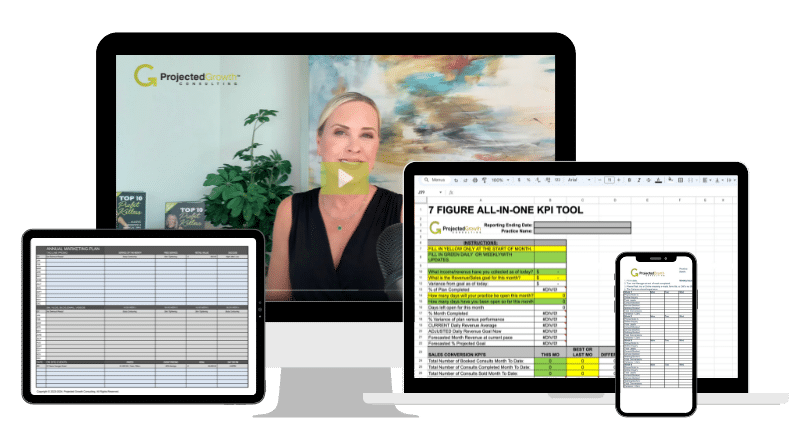
Start with a KPI cadence. Review leading indicators weekly, including booked consultations, show rate, treatment conversion, rebooking, membership enrollment, outstanding balances, and sales follow-up completion. Review lagging indicators monthly, including collected revenue, labor cost, contribution by service line, and recurring-revenue retention. Do not impose universal benchmarks without accounting for specialty, payer mix, pricing, capacity, and patient journey. Instead, establish a baseline, choose one improvement target, and record the action required when performance moves outside the practice’s normal range.
A KPI dashboard for practice profitability is useful only when it drives this cadence. The practice owner should know who prepares it, who reviews it, and what decision follows each variance. A front-desk lead may own show-rate and follow-up data. A clinical or service-line leader may own rebooking. The owner or practice administrator may own collected revenue and margin. If everyone owns a metric, no one owns it.
Revenue leakage often hides inside handoffs. A lead is not contacted after an inquiry. A patient leaves without a documented next appointment. A membership payment fails without a recovery workflow. A supply order is delayed because the approval path exists only in the owner’s head. Write the standard operating procedure for each high-value handoff, name the accountable role, and define the exception path. The SOP should state the trigger, the steps, the system of record, the expected completion time, and how the team escalates a miss.
This is why consulting for medical practice growth must address management mechanics, not just marketing ideas. Research on Lean quality improvement in primary care found measurable efficiency effects in common clinical tasks, supporting the broader principle that defined workflows can reduce avoidable friction. Standardization must still protect clinical judgment and patient experience. It should remove needless variation, not turn care into a script.
Memberships can make cash flow more predictable when the offer is financially sound, clearly explained, and supported by renewal and failed-payment workflows. Track active members, new enrollments, cancellations, utilization, recurring collections, and retention. A membership is not a revenue line to celebrate once. It is a promise that must be delivered consistently.
Sales follow-up deserves the same discipline. Assign every inquiry a next action and due date. Review aging opportunities weekly, then separate genuine demand problems from execution failures. PGC reports that its done-for-you sales events average $62,000 to $70,000 per event. That is a customer-reported result, not a universal forecast. The operational lesson is that sales execution needs a defined offer, capacity plan, follow-up owner, and post-event measurement before an event is treated as a win.
Technology should support a process the team understands. The CDC reported that 78.7% of office-based physicians had a certified EHR system in 2018, but adoption alone does not guarantee clean handoffs or useful management information. Map the workflow first, then configure the EHR, CRM, scheduling, payment, and dashboard tools around that map. If staff must re-enter the same information across disconnected systems, the practice has purchased software without fixing leakage.
Hiring and leadership determine whether an operational overhaul becomes the practice’s new operating standard or another abandoned binder. The durable fix is to define each role’s outcomes, assign decision rights, and inspect a short set of commitments every week. That structure removes the founder as the default answer to every problem.

A job description lists duties. A role scorecard defines performance. For each position, write the three to five results the person owns, the behaviors that support those results, and the evidence reviewed each week. A patient coordinator might own lead response time, consultation bookings, show rate, and follow-up completion. A practice manager might own schedule utilization, payroll control, staff retention, and closure of recurring operational issues.
Use the same scorecard in recruiting, onboarding, coaching, and performance reviews. If the role cannot be evaluated with observable evidence, it is not ready to hire. PGC identifies clear leadership structures, defined performance benchmarks, and optimized staffing as core parts of practice growth, not administrative details. Build a self-sufficient leadership team by making those expectations visible before frustration turns into turnover.
Founders often become the bottleneck because everyone knows they can approve a discount, resolve a schedule conflict, change a script, or settle a staff disagreement. That may feel controlled, but it makes the owner the constraint on growth. Create a simple decision-rights map: what the team member can decide alone, what requires manager approval, and what must reach the owner. Set financial and clinical guardrails where needed, then let the accountable person act inside them.
Review exceptions, not every routine decision. The goal is not to remove leadership oversight. It is to move oversight to the right level so the owner can focus on strategy, cash, culture, and high-value relationships. Standardized systems that allow a practice to operate with less owner dependence also support sellable enterprise value. Mayo Clinic’s change-management guidance reinforces the same point: large-scale change depends on managing people and processes, not installing software alone.
Run one focused meeting at the same time each week. Start with the scorecard, identify any metric below its agreed threshold, and name one owner and one due date for each corrective action. Then review staffing friction, patient-experience risks, and decisions that are being pushed back to the founder. Keep a visible action log and open the next meeting by closing the previous commitments.
This cadence turns leadership from personality-driven rescue into a repeatable management system. It also exposes whether a new process is failing because the process is weak, the role is unclear, or the person lacks training. Fix the actual cause. Hiring more people will not solve a leadership design problem.
Book a strategy call to remove the leadership bottlenecks holding your practice back.
Medical practice consulting builds enterprise value by turning owner-dependent activity into documented, measurable operating performance. The goal is not to attach an unsupported valuation multiple to a revenue target. It is to create evidence that the practice can deliver a consistent patient experience, retain patients, control costs, and make decisions without the owner carrying every critical function.
Start with repeatability. A documented SOP should identify the trigger, responsible role, required steps, quality standard, and exception path. That applies to lead follow-up, consultation conversion, treatment handoffs, rebooking, membership renewals, inventory controls, and month-end reporting. The system is only valuable when someone other than the owner can execute it and a manager can inspect whether it happened.
That is why standardized systems matter to sellability. PGC describes standardized SOPs as a way to reduce owner dependence and build sellable enterprise value through executive coaching and business systems. This is an operating claim, not a promise that every practice will sell at a specific price. A buyer or successor can place more confidence in clean evidence than in a founder’s explanation of how things work.
At the 90-day checkpoint, review leading indicators rather than waiting for an annual result. Confirm that each core workflow has an owner, the KPI dashboard is current, follow-up happens within the defined standard, and retention is measured by cohort or service line. Look for fewer exceptions requiring founder intervention, cleaner weekly meetings, and a visible connection between demand, booked appointments, completed treatments, collections, and rebooking. PGC identifies 90-day measurable growth as a milestone, but its reported average growth claim should be treated as company-reported context, not a guaranteed outcome.
Retention strengthens the same case. A practice with a consistent customer journey, reliable membership renewal process, and documented service recovery is less exposed to one-off promotional spikes. Track active members, renewal rate, rebooking rate, cancellations, and patient return intervals. These measures show whether revenue quality is improving, without pretending that a single month proves durable value.
Six months gives the team enough time to test whether the system survives staffing changes, seasonal variation, and normal operational pressure. Compare the original baseline with current KPI definitions, reporting cadence, margin by service line, retention, and owner hours spent in day-to-day rescue work. PGC positions its MedSpa Growth Accelerator as a six-month implementation pathway covering systems, marketing, operations, and sales. It is a structured path for implementation, not a guarantee of transformation or valuation.
Enterprise value compounds when operating evidence compounds. Keep dated SOP revisions, KPI reports, meeting decisions, training records, and ownership assignments in one accessible operating system. If the owner leaves for two weeks and performance remains visible and manageable. The practice is becoming an enterprise rather than an exhausting collection of personal relationships and workarounds.
Book a strategy call to turn your operating plan into accountable action.
A consultant diagnoses the connected causes of weak performance, then helps the owner implement a focused operating system. That work can include mapping patient flow, clarifying revenue KPIs, standardizing procedures, assigning leadership ownership, and building a 90-day priority plan. The goal is not another generic business plan. It is a repeatable method for finding the constraint, fixing it, and measuring whether the fix holds.
Bring in outside expertise when revenue has plateaued, the owner is the approval point for every decision, patient demand is not converting consistently, or staffing problems keep recurring. You do not need to wait for a crisis. A diagnostic is most useful when you can still protect cash flow and give the team time to adopt new workflows. Start by documenting the bottleneck and its measurable impact, such as delayed follow-up, unused capacity, or inconsistent collections.
Choose a firm with experience in your practice model and a method that connects operations, financial visibility, staffing, and patient experience. Ask what the first diagnostic measures, who owns implementation, how progress is reviewed, and what happens after the initial recommendations. Reject vague promises. A credible firm should explain the tools, decision cadence, benchmarks, and client responsibilities before discussing outcomes.
Use a 90-day cycle to establish a baseline, implement one priority, and evaluate leading indicators. Larger changes need longer reinforcement. Projected Growth Consulting describes a 6-month MedSpa Growth Accelerator focused on systems, marketing, operations, and sales. So owners should judge transformation by sustained adoption and cleaner reporting, not by a short-lived spike in activity. Source: Projected Growth Consulting.
Book a strategy call to turn your operating plan into accountable action.
A focused conversation can help you name the operational bottleneck that deserves attention first. Clarify the measure that will show progress, and choose a practical next step for your practice. Book a strategy call to discuss the constraint holding back your operations and the highest-value move to make next.

Written by
Founder & CEO, Projected Growth Consulting
Kelly Smith is a med spa business consultant with 20+ years of industry experience and the founder of Projected Growth Consulting. A former 7-figure med spa owner, published author of 5 books, and international speaker, Kelly has helped 6,000+ practices generate over $250 million in additional revenue through proven growth strategies.