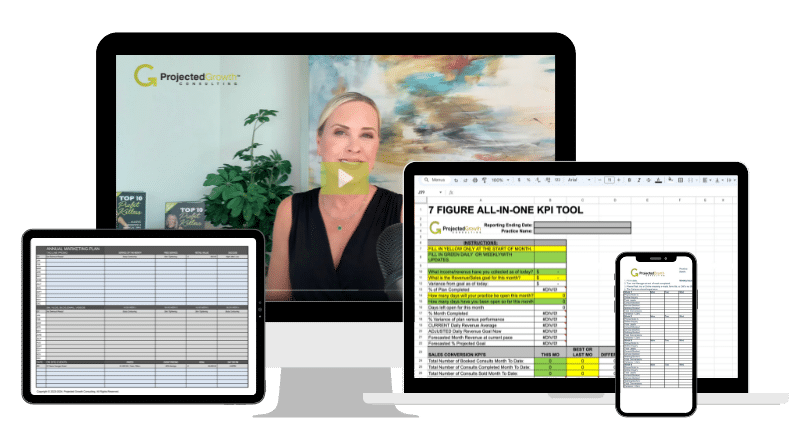
A med spa operations system is a structured four-stage methodology that replaces owner-dependent firefighting with repeatable, data-driven business processes: Diagnose, Prioritize, Implement, and Scale. The Practice OS framework transforms chaotic owner-operated practices into self-sustaining growth engines by identifying the single highest-impact bottleneck. Applying systems and accountability to remove it, and building recurring revenue architecture that scales across multiple locations. More than 6,000 practices have used this approach to generate over $250 million in additional revenue.
Schedule your free consultation to learn how the Practice OS can systematize your med spa operations and unlock predictable growth.
Running a medical spa without a structured operations system is like performing surgery without a pre-operative checklist. You might get through most days through sheer force of effort and instinct. But the outcome is never predictable, never repeatable, and always at risk of breakdown when complexity increases. The typical owner-operator juggles provider schedules, inventory orders, marketing decisions, staff conflicts, and financial oversight on a single unbroken to-do list. That model caps growth at whatever the owner’s personal bandwidth can sustain.
Kelly Smith, founder of Projected Growth Consulting and a former 7-figure med spa owner herself. Faced these same operational ceilings before developing what is now known as the Practice OS framework. The Practice OS is a four-stage operating system purpose-built for medical aesthetics: Diagnose, Prioritize, Implement, Scale. It replaces firefighting with a repeatable method for identifying the real bottleneck in your business. Applying the one fix that moves the needle, locking it in with systems and accountability, then turning your practice into a self-sustaining growth engine. This article walks through each stage with the specificity the framework demands. No generic advice. No best-of lists. Just a proven med spa operations system used across 6,000-plus practices.
The Practice OS begins with diagnosis because data reveals what intuition conceals. In this stage, you pull real numbers on revenue per provider, cost of goods sold. Consultation conversion rates, patient retention, and staff utilization to identify the single constraint that limits everything else. Without this baseline, every fix is a guess. With it, the biggest revenue leak becomes obvious and measurable. The output of this stage is a ranked list of operational gaps with dollar figures attached so you know which fix would recover the most revenue in the next 90 days.
If you cannot immediately name your revenue per provider for the last three months, your cost of goods sold as a percentage of revenue. Your consultation close rate, and your patient retention rate, then you do not have an operations problem. You have a data problem. The diagnosis stage starts with pulling these numbers because every downstream decision depends on them.
With the numbers in hand, look for the single constraint that limits everything else. Is the practice running at full capacity but profit is flat? That suggests a pricing or service-mix issue. Are consultations booked solid but only converting at 30 percent? The bottleneck is sales, not volume. Are providers idle between appointments? The bottleneck is booking utilization, not staffing.
In many practices, the bottleneck is the owner. When every decision, every approval, and every client escalation routes through the owner, practice growth is capped by the owner’s waking hours. This is the most expensive constraint in a medical spa, because it is invisible to the owner and obvious to everyone else. The med spa operations system starts by identifying whether the owner is the bottleneck.
Once you know what to measure, put every relevant metric on a single dashboard that you review weekly. The act of tracking creates accountability. Practices that track operational data visibility through KPIs catch problems days or weeks earlier than practices that rely on feel.
The output of the Diagnose stage is a ranked list of operational gaps with dollar figures attached. You should know which fix, if executed well, would recover the most revenue in the next 90 days.
When you run a diagnostic on a med spa that has never been systematized, the list of issues can be overwhelming. Pricing is inconsistent. Staff roles overlap. Marketing spend goes into channels nobody tracks. Inventory includes 250-plus SKUs with no reorder triggers. Patient retention is below 40 percent. If you try to fix all of these at once, you fix none of them and burn out your team in the process. The Practice OS framework uses a single prioritization criterion: revenue at risk.
For every gap on the diagnostic list, estimate the monthly revenue loss it causes. Pricing inconsistency might cost you 15 percent of gross revenue if services are undervalued. Staff overlap might cost 10 percent in wasted labor. A poor consultation script might cost 40 percent of potential new-patient revenue because half of your consultations walk.
The gap with the highest revenue at risk gets fixed first. Period. Not the easiest fix, not the one the owner is most comfortable with. The one that moves the needle most.
The Practice OS organizes every operational fix into four pillars: Revenue Goals transformation, Digital Marketing ROI optimization, Lead Conversion optimization, and Sales Structure implementation. If your biggest gap is that new-patient consultations convert at 25 percent, your priority falls under Lead Conversion. You do not switch to a marketing overhaul until Lead Conversion is above 60 percent.
Inventory management is a classic example of a middle-priority task that becomes a high-priority task when data reveals it. If your COGS is above 25 percent of revenue, operational process standardization in inventory alone could improve your margins by 5-10 points. But if your consultation conversion rate is 25 percent, fixing the consult script comes first.
The Prioritize stage produces a ranked action list. The top item on that list becomes the sole focus of the Implementation stage.
Implementation is where operational theory becomes measurable reality. This stage converts the single prioritized fix into documented standard operating procedures, named ownership, weekly accountability reviews. And a 30-day proof cycle that validates the change before locking it in as permanent policy. Most practices fail here because they prefer the dopamine hit of buying a new software platform or launching a marketing campaign over the unglamorous work of writing SOPs and running weekly reviews. But implementation is where revenue actually changes.
Write down exactly how the new process works. If the priority is improving consultation conversion, the SOP covers: who greets the patient, what questions are asked in the first two minutes. How pricing is presented, how objections are handled, what the membership offer looks like at the end of the consult, and how follow-up is scheduled. Leave nothing to interpretation.
Every SOP needs a named owner. Not a team, not the practice as a whole. One person who is responsible for ensuring the SOP is followed, the metrics are tracked, and the results are reported at the weekly operations meeting. Without a named owner, accountability dissolves.
Schedule a 30-minute weekly operations review. The agenda is fixed: review the KPI dashboard, report on the priority SOP’s performance, identify deviations, and agree on corrective actions for the coming week. This meeting is non-negotiable. It is the heartbeat of the system.
A process that works one time is not a system. A system is a process that produces the same result every time, with different people executing it, in different circumstances. Run the new SOP for 30 days, measure the outcome against your diagnostic baseline, and adjust based on the data. Only then do you lock it in as permanent practice policy.
The final stage of the Practice OS is building a business that grows without proportional increases in owner effort or overhead. The single most powerful scaling mechanism in medical aesthetics is the membership program. A well-designed membership converts transactional patients into monthly subscribers, creating predictable revenue that is not dependent on new-patient acquisition. PGC clients have generated more than $135 million in membership revenue, proving that recurring income is the engine of scalable growth.
Memberships work because they change the economic model of the practice. Instead of spending marketing dollars every month to fill the schedule, you have a baseline of pre-sold appointments. That baseline allows you to staff optimally, order inventory predictably, and invest in growth activities without cash-flow anxiety.
Scaling requires the owner to step out of daily operations. That is only possible when team members have been trained and empowered to run the systems you implemented in Stage 3. The fastest way to stall a scaling effort is to attempt it without operational foundations for scaling in place.
If your systems work in one location with one provider, they can work in multiple locations with multiple providers. The prerequisite is that every SOP, every KPI, and every accountability cadence is documented and transferable. A second location without a systematized first location doubles your problems, not your revenue. Following the stages of the Practice OS when systematizing your practice for growth ensures your expansion is built on proven operational foundations, not hope. Scaling is not about working harder. It is about building a med spa operations system that does not require the owner to be present. That is what creates enterprise value, and that is what the Practice OS delivers.
Many medical spa owners mistake purchasing software for implementing a business system. While modern point-of-sale platforms and EMR tools are useful for managing daily bookings or storing clinical notes, they are not growth strategies. They function as digital filing cabinets and transactional engines. But they do not teach your front desk how to convert leads, nor do they establish operational guardrails for profit. True sustainable expansion requires structured operational leadership, clear sales protocols, and robust accountability mechanisms that standard software cannot provide.
| Evaluation Criteria | Point-of-Sale & Booking Software | Projected Growth Practice OS Framework |
|---|---|---|
| Purpose | Facilitates transactions and schedules patient appointments. | Drives business growth, staff alignment, and clinical profitability. |
| Scope | Tracks localized interactions, clinical charts, and daily sales. | Addresses end-to-end strategy, marketing, and leadership structure. |
| Implementation | Self-configured setup with minimal ongoing business coaching. | Interactive coaching program led by industry experts. |
| Output | Generates raw administrative and booking data reports. | Provides actionable frameworks yielding 30% growth in 90 days. |
The Projected Growth Practice OS installs the comprehensive leadership standards, concrete accountability systems, and rigorous financial models required to turn clinical talent into scalable business enterprises. By combining proven, step-by-step business methodologies with structured expert consulting, this framework fills the deep strategy and implementation gaps that point-of-sale platforms ignore. This strategic approach ensures your aesthetic clinic converts raw booking data into lasting enterprise value and predictable cash flow.
The Practice OS framework operates as a sequential cycle where each stage builds on the one before it. Skipping Diagnose to jump to Scale produces a larger version of a broken business. Running the stages in order, with discipline, is what separates a systematized practice from a chaotic one.
While a general business coach focuses primarily on motivational advice, generic accountability, and broad leadership concepts. A specialized medical spa consultant installs highly targeted, proven operational frameworks specifically engineered for aesthetic clinics. Projected Growth Consulting provides an interactive coaching program led by industry experts who understand the deep nuances of aesthetic marketing, regulatory compliance, operational bottlenecks, and clinical sales protocols. This tactical consulting approach implements structured business systems rather than relying on standard point-of-sale software. Helping medical spa practices systematically build lasting enterprise value, reduce operational friction, and secure predictable cash flow.
By implementing a comprehensive, step-by-step business methodology rather than relying on surface-level operational changes, aesthetic practices can achieve predictable cash flow and rapid operational scaling. When implementing the strategic operational systems and consulting solutions provided by Projected Growth Consulting. Medical spas routinely achieve up to 30% business growth within the first 90 days of engagement. This growth is driven by structured staff alignment, optimized marketing spend, and high-performance sales training designed to convert clinical talent into sustainable revenue engines.
Point-of-sale and booking platforms function as digital filing cabinets to track schedules and process daily transactions, but they are not growth strategies. They do not teach your front desk staff how to convert cold leads, design profit-driven membership models, or establish robust staff accountability. To convert clinical talent into a scalable business enterprise, owners must install comprehensive leadership standards and structured financial systems that go far beyond basic booking software reporting.
The Diagnose stage measures six core metrics: revenue per provider, cost of goods sold as a percentage of revenue. Consultation close rate, patient retention rate, staff utilization, and marketing cost per lead. Each metric is compared against industry benchmarks to identify the largest gap. For example, if your consultation conversion rate is 25 percent and the benchmark is 60 percent, that gap represents the highest-leverage fix for your practice. The output is a ranked list of every operational issue with its estimated monthly revenue impact attached.
A well-systematized med spa typically operates with 12 to 18 core SOPs covering patient intake, consultation delivery, membership sales. Inventory management, provider scheduling, marketing campaigns, financial reporting, front desk operations, clinical protocols, patient follow-up, online reputation management, and team onboarding. Each SOP follows the same structure: objective, step-by-step procedure, named owner, review cadence, and success metrics. The Practice OS implementation stage adds one SOP at a time, starting with the highest-priority fix, rather than attempting to build all 18 at once.
Yes. The Practice OS is most effective for single-provider practices because those owners face the highest risk of burnout and the lowest enterprise value. A solo practitioner who implements even the Diagnose and Prioritize stages gains immediate clarity on which operational gap to fix, reducing decision fatigue and improving margin. The Implement stage builds SOPs that allow the owner to delegate daily operations. The Scale stage positions the practice for a second provider or acquisition. PGC has systematized hundreds of single-provider practices that later expanded to multi-provider operations.
Operating a successful medical spa requires more than providing clinical excellence; it demands a scalable business model and airtight operational systems. When you systematize your hiring, service protocols, and client retention strategies, you free yourself from daily operational bottlenecks and unlock sustainable revenue growth. Do not let operational friction limit your practice’s potential.
Take control of your growth today. Work with Projected Growth Consulting to build a high-performance practice model that runs efficiently and profitably. To get started, schedule your free consultation and let our experienced advisory team design your operational blueprint.

Written by
Founder & CEO, Projected Growth Consulting
Kelly Smith is a med spa business consultant with 20+ years of industry experience and the founder of Projected Growth Consulting. A former 7-figure med spa owner, published author of 5 books, and international speaker, Kelly has helped 6,000+ practices generate over $250 million in additional revenue through proven growth strategies.