If every pricing decision, staff question, and missed follow-up still comes back to you, your med spa does not have a growth problem alone. It has an owner bottleneck. Coaching that stops at advice will not fix it. The work must turn numbers into one decision, one owner, and a deadline.
Book a call to discuss practical implementation support for your practice.
Effective med spa business coaching starts with a scorecard that combines financial data, clinical metrics, and resource use. It turns the clearest profit leak into one 90-day execution plan. That plan is reviewed weekly until the team, not the owner, owns the work.
Clinical practices need profitability to sustain and grow. Sound decisions require more than a topline revenue number. A useful method connects revenue, margin, conversion, retention, capacity, and team performance to daily actions. Start by confronting what the scorecard reveals about your role in the business.
When the owner is the bottleneck, med spa business coaching should create a repeatable scorecard-to-implementation loop. Measure the operating reality. Identify the most expensive constraint. Assign the next action to the right person, and review evidence until the new behavior becomes part of the business. The goal isn’t more motivation or another folder of advice. It is to make decisions visible, move execution out of the founder’s head, and build a practice that can perform without constant owner intervention.
That distinction matters because profitability is not optional for a clinical practice that needs to sustain and grow. A review in the medical-practice literature states that clinical practices need profitability to sustain themselves and grow. The same source explains that sound management integrates financial data, clinical metrics, and resource utilization. In a med spa, that means the coaching conversation cannot stop at revenue or a marketing calendar.
The first step is an honest baseline. Review revenue, cost of goods sold, margin, consultation conversion, retention, marketing return, capacity, and team performance. Look for the point where the owner is repeatedly compensating for a missing system.
For example, if every unresolved lead comes back to the owner, the visible problem may be weak follow-up. The deeper bottleneck may be that no one owns response time, the consultation process is undefined, or the team has no shared definition of a qualified opportunity. If the schedule depends on the owner approving every treatment plan, the constraint may be decision rights and training rather than demand.
Financial statements are especially useful here. As clinical-practice finance guidance notes, financial statements provide vital information to practice leaders. Use them alongside operational evidence, not as a substitute for it. Compare the income statement with booking patterns, service mix, staffing capacity, and follow-up records. That combination helps separate a genuine demand problem from a workflow problem that the owner has been quietly patching.
Once the scorecard reveals the constraint, choose one profit-relevant move. It might be assigning consultation follow-up, standardizing a handoff, correcting an unprofitable service mix, or creating a weekly capacity review. Write down the new owner, proof of completion, and first review date. “Try to delegate more” is not implementation. A named owner, documented process, and scheduled review are.
This is also where a med spa operating system becomes practical. The system should turn recurring decisions into workflows, scorecards, and team responsibilities so the founder is no longer the default escalation point.

A useful scorecard turns a busy practice into decisions. It should show whether the business produces revenue, keeps enough after direct costs, converts demand, and uses people and rooms effectively. It should also expose where performance depends on the owner. A dashboard full of disconnected numbers is not management. The owner needs a consistent view that prompts the next question.
That approach is grounded in how clinical practices are managed. Sound decisions integrate financial data, clinical metrics, and resource utilization, while financial statements give practice leaders vital operating information. See the research from the National Center for Biotechnology Information and its review of financial statements in clinical practice. For a practical starting point, use the med spa KPI dashboard as the structure, then adapt the definitions to your services, staffing model, and reporting system.
| Metric signal. | What it may reveal. | Next question. |
|---|---|---|
| Revenue by month, service line, provider, and location. | Inconsistent production, an overreliance on one treatment, or a service mix that is not supporting the plan. | Which source of revenue changed, and was the change caused by demand, pricing, capacity, or follow-up? |
| COGS and gross margin by major service category. | High product, labor, or fulfillment costs that make attractive top-line revenue less profitable. | Which service or package is consuming margin, and can the cost or mix be corrected without weakening patient care? |
| Consultation volume, show rate, and consultation-to-treatment conversion. | Weak lead qualification, inconsistent consultation skill, unclear offers, or poor follow-up after the visit. | Where does the patient journey lose momentum, and who owns the next contact? |
| Repeat visit rate, membership activity, and retention by cohort. | A short-term acquisition engine that is not creating durable patient relationships or predictable future revenue. | Are patients leaving because of outcomes, experience, scheduling friction, pricing, or missing reactivation? |
| Marketing spend, qualified leads, booked consultations, and revenue attributed to each channel. | Marketing ROI that is weak, difficult to verify, or being judged by inquiries rather than profitable patients. | Which channel produces qualified demand, and what evidence supports keeping, changing, or stopping it? |
| Provider utilization, room capacity, cancellations, and schedule fill rate. | Unused capacity, bottlenecks, overbooked providers, or demand that the current operating model cannot serve. | Is the constraint marketing, scheduling, staffing, space, or a workflow that creates avoidable downtime? |
| Team ownership of follow-up, sales process, rebooking, and operational tasks. | Undefined roles, inconsistent execution, and an owner who remains the default problem solver. | Who is accountable for this result, what standard is documented, and what evidence will be reviewed next week? |
Do not try to improve every row at once. First establish a baseline using the same definitions and reporting period. Then mark the signal that represents the most expensive leak and assign one person to investigate it. PGC identifies inconsistent revenue, high COGS, inadequate tracking, low conversion, weak follow-up, missing metrics, and inefficient workflows as recurring med spa pain points. Those are not separate reasons to buy more software. They are prompts to clarify the process, owner, and decision attached to each number.
Review the scorecard weekly, but do not confuse a weekly movement with a trend. Record the result, the likely cause, the next action, and the date of the next check. That discipline is what makes med spa business coaching operational rather than motivational: the metric changes the meeting, and the meeting changes what the team does.
Choose the problem with the clearest financial leak, the strongest owner or team control, the fastest path to useful feedback, and enough operating capacity to execute it. That sounds simple. In a reactive med spa, it is a discipline. A revenue plateau, weak retention, poor marketing return, and capacity constraints can all be real at the same time. PGC identifies each as a common growth trigger, but treating every trigger as a simultaneous project guarantees scattered attention. Start with the documented growth triggers, then force the scorecard to produce one decision.
Do not pretend the other problems disappeared. Stop paying for five half-executed solutions. One well-chosen profit move gives the owner a measurable test, gives the team an assignment, and creates evidence for the next decision.
Coaching becomes useful when it produces visible changes in the business, not when the owner leaves a call with more ideas. A weekly cadence creates a short operating loop: review the scorecard, inspect evidence, make one decision, assign ownership, and schedule the next checkpoint. That rhythm keeps a med spa business coaching engagement connected to bookings, consultations, retention, margins, team performance, and the daily work required to improve them.
The cadence should be short enough to sustain and specific enough to expose avoidance. A 30-minute meeting is sufficient when the scorecard is prepared in advance and the discussion stays focused on the selected profit move. The coach facilitates the process, but the owner and team remain responsible for execution.
This structure reflects a broader coaching principle also described in competitor research. Moxie presents monthly business reviews as a time to review progress and update strategy, and describes customized planning followed by implementation support and ongoing monitoring. Those descriptions support the value of a review-and-adjust loop, but they do not establish results for Projected Growth Consulting or for any individual practice. The important lesson is operational: planning must be followed by inspection and adjustment.
Accountability also has to move beyond the owner. Diamond Accelerator describes team ownership and accountability as part of its community and scale phase. For a med spa, that means the person closest to the work should own the next action whenever practical. The owner still makes the decision and removes barriers, but should not become the only person who can complete the system.
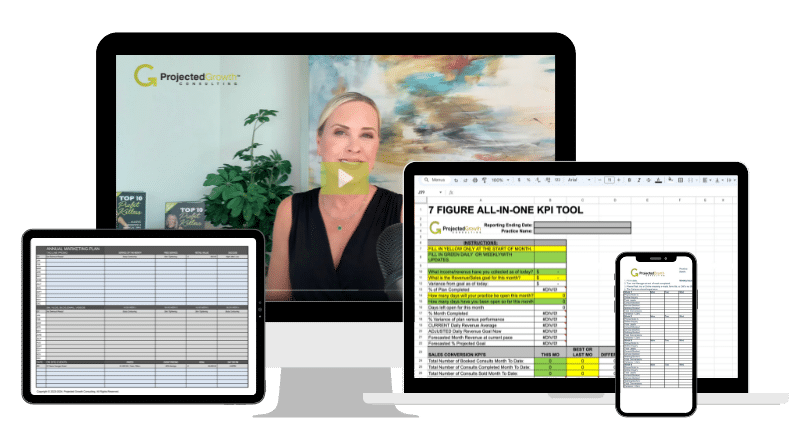
Projected Growth Consulting’s MedSpa Growth Accelerator documents weekly interactive coaching, one-on-one sessions, and a KPI tool as parts of its delivery model. Its 90-day leadership framework can help owners formalize the role, decision, and checkpoint structure. The standard is simple: every week should leave a record of what the numbers showed. What evidence was reviewed, what decision was made, who owns the work, and when the team will verify it.

A useful 90-day roadmap turns coaching into a sequence of decisions, assignments, and review points. It should show what the owner is learning, what the team is changing, and what evidence will determine the next move. Without that structure, coaching can become a collection of good ideas that never reaches the front desk, treatment room, or weekly numbers review.
The milestones are practical: identify quick wins in the first 30 days, work toward measurable growth by 90 days, and use later checkpoints for deeper transformation and scaling. They are not guarantees. They are a framework for sequencing the work.
For owners evaluating med spa business coaching, ask whether the roadmap names the measure, owner, review date, and next decision. If it does, coaching has a path to implementation.
A Practice OS keeps the owner out of the daily reaction loop. It turns recurring decisions into visible routines, assigned ownership, and scheduled review. The team knows what happens next, how success is measured, and when an issue returns for a decision.
The first stage is diagnosis. Start with the operating facts: revenue, cost of goods sold, margin, consultation conversion, retention, marketing return, capacity, and team performance. Review the numbers alongside the workflows that produce them. A weak month may reflect poor follow-up, an overloaded schedule, an unclear sales process, or a service mix problem. Those require different responses.
This is where a med spa KPI dashboard becomes more useful than an owner’s intuition. The goal is not to track every possible metric. It is to establish a shared baseline that lets the owner and team name the actual constraint.
Once the bottleneck is visible, the Practice OS prioritizes one meaningful profit or performance move. Choose the problem with a measurable leak, a realistic degree of control, and a clear owner. If consultation follow-up is the constraint, assign the process, define the evidence of completion, and review the resulting conversion data. Do not launch a pricing project, membership campaign, hiring overhaul, and marketing reset at the same time. That creates activity without learning.
Prioritization also protects the owner’s time. The owner decides which constraint matters most and removes barriers. A manager or team lead owns the repeatable action. Staff members complete the defined steps and bring back evidence, not vague updates.
Coaching is useful when it produces decisions, practice, and accountability. Implementation means translating a recommendation into a workflow, training the people responsible, and checking whether the workflow is being used. PGC describes its delivery journey as assessment and baseline measurement, planning, core-systems implementation, then optimization and refinement. That sequence is different from handing an owner a strategy document and expecting the business to change.
PGC’s MedSpa Growth Accelerator connects weekly interactive coaching and one-on-one sessions with a KPI tool. Marketing plans, peer community, and training in revenue goals, marketing ROI, conversion, sales structure, memberships, and leadership. The format gives the owner a place to make the next decision while the team builds the habit that makes the decision repeatable. Learn more about the MedSpa Growth Accelerator.
The final stage is scale. Review the evidence from the prioritized move, refine the process, document the standard, and assign it to the role that should own it. The owner should remain accountable for direction, financial health, and leadership. But should not be the only person who can interpret a dashboard, rescue follow-up, or solve a scheduling issue.
Kelly Smith, PGC’s founder and CEO, is a former seven-figure medical spa owner with more than 20 years in medical aesthetics and five published business books. Her experience informs a model built around operational ownership, not permanent founder intervention. A Practice OS works when the business can keep moving between coaching conversations because the scorecard, priorities, workflows, and accountability cadence are part of how the practice operates.
Start with the scorecard, not the loudest complaint. Compare revenue, margin, COGS, consultation conversion, retention, marketing ROI, capacity, and team performance. Choose the problem with a measurable leak, a controllable cause, and a clear owner. That keeps coaching focused on one profit move instead of scattering effort across every operational frustration.
Bring the latest reliable numbers, a short list of recurring bottlenecks, and evidence from the team. Useful inputs include financial statements, booking and consultation data, follow-up activity, retention information, marketing results, staffing coverage, and the status of relevant workflows or SOPs. If a metric is missing, record that gap as an implementation task rather than guessing.
It should move quickly enough that each session produces a decision, an assigned owner, and a due date. A practical 90-day structure begins with assessment and baseline metrics, moves into planning, then gives the team time to implement and refine the selected system or profit move. Review evidence weekly so adjustments happen before small misses become operating habits.
Measure the selected profit move first, then watch the supporting scorecard metrics for unintended effects. For example, a conversion improvement should be considered alongside capacity, COGS, retention, and margin. Success is not a busier owner or more activity. It is documented progress against the chosen business constraint, with the team increasingly able to execute without constant owner intervention.
Yes. Established practices often need sharper ownership and better visibility rather than more ideas. The method can expose stalled revenue, weak follow-up, inefficient workflows, or a service mix that no longer supports the practice. It also creates a repeatable cadence for turning decisions into systems, so growth does not depend on the owner personally solving every issue.
Book a call to discuss practical coaching and implementation support for your med spa.
A scorecard and 90-day roadmap only create progress when they guide decisions your team follows each week. If you want practical support connecting coaching to implementation, book a call to discuss your med spa’s next steps. Bring the bottleneck you are trying to solve, and use the conversation to clarify the right starting point, priorities, and accountability structure.

Written by
Founder & CEO, Projected Growth Consulting
Kelly Smith is a med spa business consultant with 20+ years of industry experience and the founder of Projected Growth Consulting. A former 7-figure med spa owner, published author of 5 books, and international speaker, Kelly has helped 6,000+ practices generate over $250 million in additional revenue through proven growth strategies.