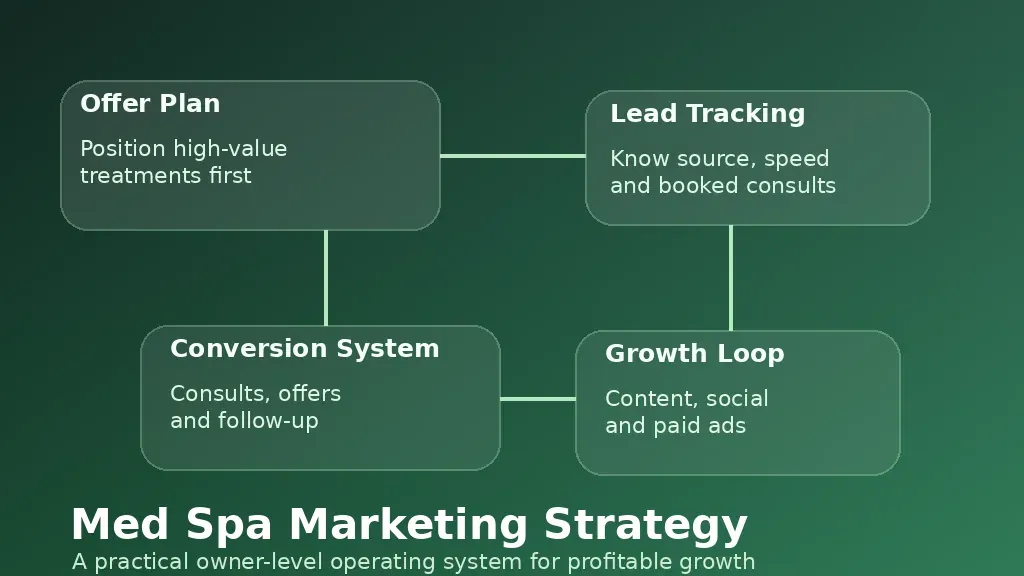
Med spa marketing only works when it is built like an operating system, not a collection of random posts, boosted ads, and last-minute promotions. Owners need a clear way to plan profitable offers, track every lead source, convert consultations, create useful content, use social media with purpose, invest in paid ads carefully, and follow up until the right prospects book.
Ready to replace reactive marketing with a measurable growth plan? Book a call with Projected Growth Consulting to review the highest-value next move for your practice.
This guide is written for med spa owners who are tired of guessing. The goal is not to chase every platform trend. The goal is to build a simple, repeatable system that helps your team know what to promote, who is responsible for each lead, what happens after an inquiry, and which campaigns actually create revenue.
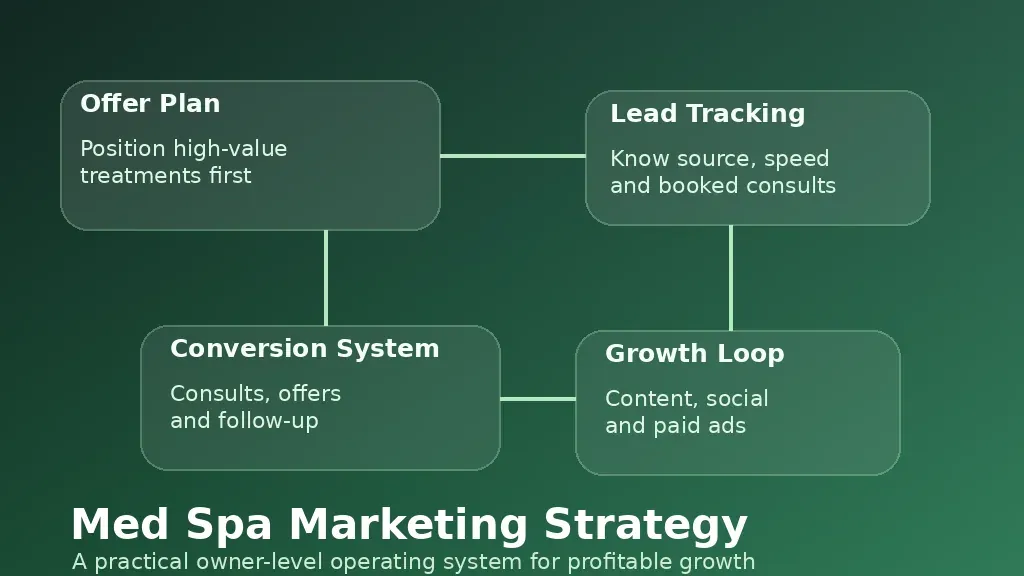
Med spa marketing is the strategy a practice uses to attract qualified prospects, educate them, convert them into consultations, and retain them as long-term patients. Strong marketing connects the offer, message, channel, lead response, consultation process, and follow-up plan so the owner can measure profit instead of only counting likes or leads.
The most important shift is this: marketing is not one department and it is not one channel. A campaign can bring in leads, but revenue depends on how well the front desk responds, how confidently the consultation is run, how clearly pricing and value are explained, and how consistently the team follows up.
For a med spa owner, that means the best strategy starts with business fundamentals. Before spending more money, answer these questions:
This is where Projected Growth Consulting approaches marketing differently from a typical ad vendor. PGC has served 6,000+ practices since 2011 and focuses on the business systems behind growth, including KPIs, marketing planning, conversion, consultation, closing, memberships, events, and leadership.
Most med spa marketing plans fail because they over-focus on visibility and under-build the conversion system. A practice may post often, run ads, discount services, and collect leads, but still miss revenue because nobody is tracking source quality, speed to lead, consultation close rate, show rate, or lifetime value.
The common failure pattern looks like this: an owner feels slow, launches a promotion, gets a short burst of interest, discounts to fill the schedule, then starts over again the next month. That cycle trains patients to wait for deals and keeps the team reacting instead of planning.
A better owner-level strategy fixes the leaks in order. If your offer is weak, more ads will make the weakness expensive. If your front desk response is slow, more leads will create more missed opportunities. If your consultation process is inconsistent, more booked consults will not become more revenue. If your follow-up is casual, the practice will keep losing prospects who needed more time and education.
The problem is rarely a single platform. The problem is the lack of a connected system.
Offer planning is the foundation of profitable med spa marketing because it decides what you want the market to say yes to. A strong offer is not just a discount. It combines the right service, audience, outcome, timing, value stack, and next step so the campaign can create revenue without training patients to shop only on price.
Before building a campaign calendar, review your service menu through an owner lens. The best promotion is not always the most popular treatment. It should support capacity, margin, retention, and your long-term positioning.
For example, an injectable promotion may create quick activity, but a skin health campaign tied to a series, consultation, and maintenance plan may create a stronger patient relationship. A body contouring campaign may work well only if the team has clear consultation scripts, financing language, before-and-after proof, and follow-up sequences.
If you need a more complete planning structure, use the thinking behind a medical spa marketing budget template to align campaign spend with expected booked consultations and revenue goals.
A med spa should track every lead by source, campaign, service interest, response time, contact outcome, booked consultation, show status, close status, revenue, and follow-up stage. These numbers show whether marketing is creating qualified opportunities or simply producing activity that never reaches the treatment room.
Lead tracking does not need to be complicated at first. It needs to be consistent. Owners should be able to open one tracker and see where opportunities are entering the practice, where they are getting stuck, and which sources deserve more investment.
| Metric | What It Tells You | Owner Action |
|---|---|---|
| Lead source | Where the inquiry came from | Shift budget toward sources that book and buy |
| Speed to lead | How fast the team responds | Create response standards for calls, texts, and forms |
| Booked consultation rate | How many leads become appointments | Improve front desk scripts and booking process |
| Show rate | How many booked consults arrive | Add reminders, deposits, or confirmation workflows |
| Close rate | How many consultations buy | Train consultation, objection handling, and treatment planning |
| Revenue by campaign | Which campaigns create sales | Scale winners and stop guessing |
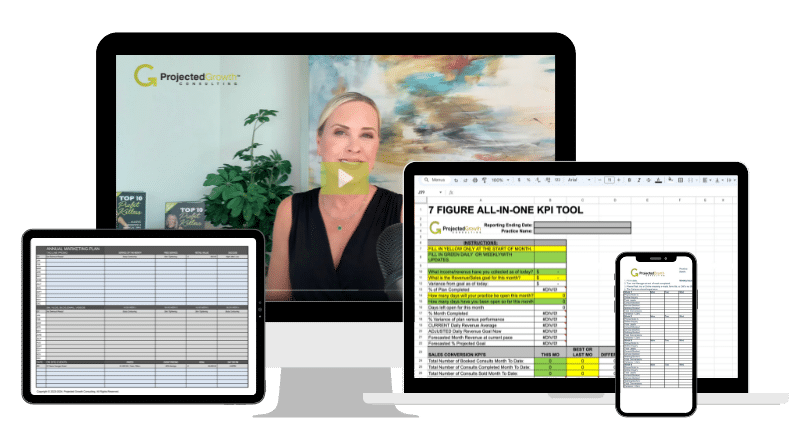
Projected Growth Consulting emphasizes KPI visibility because owners cannot fix what they do not measure. The MedSpa Growth Accelerator includes tools such as the All-In-One KPI Tool and training around revenue goals, digital marketing ROI, lead conversion optimization, sales structure, events, memberships, and social media.
A conversion system turns interest into revenue through a defined process for response, qualification, consultation, recommendation, closing, and follow-up. For med spa owners, this is often the difference between a campaign that feels busy and a campaign that actually grows profit.
The conversion system starts the moment a prospect raises a hand. That could be a form fill, phone call, direct message, webinar registration, event RSVP, or missed call. Each inquiry should enter the same operational rhythm.
If your team gets leads but struggles to turn them into treatment revenue, explore PGC’s aesthetic consultation training resources and build a stronger sales process before increasing ad spend.
Many owners assume the marketing problem is at the top of the funnel. In reality, the largest opportunity may be inside the practice. PGC’s service catalog includes consultation and closing training, secret shopper support, KPI tracking, and coaching because growth depends on what happens after the lead arrives.
Content should reduce friction before the patient ever speaks to your team. The best med spa content answers real questions, explains outcomes in plain language, shows proof responsibly, and helps prospects understand why a consultation is the next logical step.
Content is not just a social media chore. It is a trust-building asset. For higher-consideration services, prospects may need multiple touches before they feel ready to book. Educational content helps them move from curiosity to confidence.
Search content can also support local discovery. A practical SEO plan for medical spas should connect treatment pages, educational blog posts, location relevance, reviews, and conversion paths. The mistake is creating content without a business purpose. Every piece should point toward a consultation, a resource, a membership, an event, or a deeper trust-building step.
Med spas should use social media to show expertise, personality, patient education, team culture, outcomes, and timely offers. The goal is not to become an influencer. The goal is to stay visible, build trust, answer objections, and move qualified prospects toward a consultation or follow-up conversation.
A simple social plan can outperform a complicated one if the team can sustain it. Owners should define content pillars and repeat them weekly instead of starting from scratch every day.
Social media should also feed your other channels. A provider video can become an email, a blog section, a FAQ, a consultation handout, and a paid ad creative. This is how a small team gets more value from one good idea.
For broader digital channel planning, review PGC’s guide to digital marketing for medical spas and connect platform activity to measurable business outcomes.
A med spa should use paid ads when the offer is clear, the landing path is focused, the team can respond quickly, and the owner has a way to track booked consultations and revenue. Paid ads are most useful for targeted growth, but they can waste money fast when conversion and follow-up are weak.
Before launching ads, pressure-test the campaign. Do not send paid traffic to a generic homepage unless that page is built to convert the specific audience. A strong ad campaign needs message match from the ad to the page to the call script.
Paid media can be powerful for seasonal services, event registration, new treatment launches, and remarketing. It should not become the only growth engine. Owners need a blend of organic visibility, referral systems, reviews, educational content, community presence, email and text follow-up, and strong consultation conversion.
Follow-up is the structured process of continuing the conversation after a prospect inquires, misses a call, attends a consultation, receives a quote, or delays a decision. In med spa marketing, follow-up often matters as much as the first ad because many patients need education, reassurance, and timing before they buy.
One text is not a follow-up system. One voicemail is not a follow-up system. A real system uses multiple touches across the right channels and gives the prospect helpful reasons to re-engage.
Retention is not separate from marketing. A thoughtful med spa membership model can stabilize recurring revenue, improve loyalty, and support enterprise value over time.
Want a marketing plan that connects lead generation to consultation, close rate, retention, and profit? Schedule a conversation with Projected Growth Consulting and identify the biggest leak in your current system.
A practical 90-day med spa marketing strategy should diagnose the biggest growth leak, select one or two priority offers, build the tracking system, improve conversion scripts, create focused content, launch or refine campaigns, and review results weekly. The sequence matters because scattered effort creates scattered results.
Use this framework to turn marketing from a stress point into a management rhythm.
This is the type of structure behind PGC’s broader med spa consulting approach. The goal is not more information. The goal is a better decision system for growth.
Owners should fix the constraint that is closest to revenue and easiest to measure. If the practice has plenty of leads but few booked consultations, fix response and booking. If consultations are booked but not closing, fix the consultation process. If close rate is strong but demand is low, fix visibility and offers.
Use the following order when you are unsure:
If the owner wants outside guidance, a medical spa business consultant can help diagnose the operational, financial, and marketing issues that are working together behind the scenes.
The best marketing strategy for a med spa is a connected system that includes profitable offer planning, lead tracking, educational content, social proof, paid ads when ready, consultation training, and structured follow-up. The right mix depends on your capacity, margins, market, and current conversion gaps.
A med spa should set marketing spend based on revenue goals, margins, capacity, service mix, and expected booked consultations. Instead of copying a generic percentage, owners should build a budget that connects spend to campaign goals, lead source tracking, consultation volume, close rate, and revenue.
Many med spas can benefit from paid ads, but ads should not be the first fix if the offer, landing page, response process, or consultation system is weak. Paid ads work best when the practice can track source quality, booked consultations, show rate, close rate, and revenue.
A med spa can get more qualified leads by narrowing the offer, speaking to the right patient problem, creating educational content, improving local search visibility, using proof responsibly, building referral systems, and making the next step easy. Lead quality improves when the message attracts value-focused patients instead of price shoppers.
Med spa leads often fail to convert because response time is slow, front desk scripts are inconsistent, the offer is unclear, the consultation process does not build value, or follow-up stops too soon. Tracking each stage shows whether the issue is lead quality, booking, show rate, closing, or follow-up.
Med spa marketing gets easier when the owner stops asking, “What should we post today?” and starts asking, “Which part of our growth system needs the most attention this week?” That change moves the practice from reactive promotion to disciplined growth.
Start with one campaign, one offer, one tracker, one consultation process, and one follow-up sequence. Review the numbers weekly. Keep what works. Remove what does not. Train the team until the system becomes normal.
Projected Growth Consulting helps med spa owners make that shift with practical tools, coaching, training, events, and growth systems built specifically for the aesthetics industry. If you want a marketing strategy tied to revenue, conversion, retention, and profit, book a call with Projected Growth Consulting and start with the bottleneck that matters most.

Written by
Founder & CEO, Projected Growth Consulting
Kelly Smith is a med spa business consultant with 20+ years of industry experience and the founder of Projected Growth Consulting. A former 7-figure med spa owner, published author of 5 books, and international speaker, Kelly has helped 6,000+ practices generate over $250 million in additional revenue through proven growth strategies.