Medspa consulting should not begin with a campaign calendar if the real constraint is somewhere else. When growth stalls, more leads can make the problem worse if the practice cannot convert inquiries, schedule care, retain clients, or deliver services at a healthy contribution margin. A short constraint audit helps owners identify which part of the operating system is limiting the next stage of growth.
Talk through your practice’s growth constraint
Use one method: trace a recent group of qualified prospects through the full client journey, then test the practice’s ability to serve them profitably. Check five points in order: demand, conversion, capacity, retention, and unit economics. The first point with a measurable shortfall is a better place to investigate than the most visible symptom.
This is an operating diagnosis, not a verdict on a team member or channel. Marketing reports can show clicks and inquiries, but they do not by themselves establish whether the practice has enough demand, answers quickly, has appointment capacity, or earns an adequate contribution after variable costs. The U.S. Small Business Administration provides broad management resources for small businesses; use its small-business resource hub as a starting point for general management topics, then test your own practice data directly.
Start with a defined period—usually the most recent four to eight weeks—and use the same dates across marketing, phone, scheduling, point-of-sale, and finance reports. If your systems cannot connect a prospect to an appointment and a completed visit, note that as a measurement gap. Do not treat missing information as evidence that demand is weak.
Before pulling reports, define what counts as a qualified inquiry and a completed service. Decide whether a returning client asking about a new service belongs in the same group as a first-time prospect. Exclude duplicates and vendor calls, and document how you handle cancellations, reschedules, refunds, and appointments that span reporting periods. These small definitions prevent a team from arguing over totals that were calculated in different ways.
Keep the audit at the level where a decision can be made. An owner may need a weekly view by service and source, while the person responsible for the front desk may need a daily list of open inquiries and follow-up dates. Avoid building a complex report before confirming that the underlying status fields are used consistently. A simple worksheet with five stages, one number for each transition, and links or references to source records is often enough to expose the first question worth answering.

Build one compact worksheet. For each stage, record the count, the source system, the owner responsible for the step, and the next action. Use a consistent definition of a qualified inquiry. For example, exclude vendor calls and duplicate messages, and do not combine inquiries about different service lines if they follow different workflows.
Keep the source visible beside every figure. A booking-platform export may count appointments while a payment report counts completed, paid services. Those are not interchangeable. When definitions disagree, reconcile them before deciding what to change.
For each measure, write down the numerator and denominator rather than recording only a percentage. If 18 of 60 consultations are attended, preserve both numbers and the resulting rate. A percentage can move sharply when the sample is small, and the raw counts help the team see whether the apparent change represents one or many appointments. Note exceptions separately instead of silently removing them from the calculation.
Make a basic reconciliation part of the audit. Select several individual records and follow them from initial inquiry through the final outcome. Confirm that the lead source, service interest, booking status, attendance, sale, and payment agree across the systems involved. This small sample will not prove every report is accurate, but it can reveal a status definition or handoff that systematically distorts the totals.
Demand is the constraint only when qualified inquiry volume is consistently below the level needed to fill profitable available capacity. A full social inbox is not proof of adequate demand, and a quiet advertising dashboard is not proof that the entire market is small. Segment inquiries by source, service, and fit before reaching a conclusion.
Then trace a sample from inquiry to outcome. Review the initial response time, whether the prospect was reached, whether a consultation was offered, whether the appointment was booked, and why an opportunity did not advance. Use the same sample rules for each channel. If inquiry volume looks adequate but prospects are not contacted or booked, the issue sits later in the journey; buying more traffic can simply create a larger backlog.
Set a practice-specific trigger rather than borrowing an industry benchmark without context. For example, an owner might flag a channel when it delivers fewer qualified inquiries than the capacity plan requires for two consecutive review periods. That is an internal decision rule, not a universal med spa standard. Calculate the required inquiry count from your own conversion history and the number of additional completed, profitable appointments you can actually deliver.
Use a simple back-calculation to check whether the volume is plausible. If the practice needs ten more completed appointments and historically one in four qualified inquiries becomes a completed visit, the rough requirement is forty additional qualified inquiries, assuming that conversion pattern still applies and capacity exists. Replace the example ratio with your own cohort data. If your recent sample is small or conditions changed, label the estimate as uncertain rather than presenting it as a forecast.
Compare inquiry quality, not just quantity. A channel may produce many contacts but few people seeking a service the practice offers, while a smaller source may produce more consultations that fit the schedule and service mix. Record the service requested, fit, contactability, and eventual outcome using a consistent rule. Do not call a source ineffective because it attracts a different service mix without checking whether the practice can serve that group.
For a campaign-specific review, compare your findings with the practice’s marketing plan and acquisition priorities. Keep channel diagnosis separate from broad marketing activity. The question is not simply whether an ad generated a lead; it is whether a suitable prospect reached a service that the practice can deliver well.
When qualified inquiries are present, conversion is the next checkpoint. Divide the path into observable transitions: inquiry to response, response to booked consultation, booked consultation to attendance, attendance to accepted plan, and accepted plan to completed service. Identify the first transition that weakens against your own recent baseline.
Review a small, consistent set of records from both successful and unsuccessful outcomes. Listen to calls or read messages only under your practice’s privacy and access policies. Look for operational facts: Was the inquiry answered? Was a next step clearly offered? Did the person receive follow-up? Was the requested service appropriate and available? Avoid judging performance from one unusually busy day or one anecdote.
For a practical review, make a short case sheet for each sampled inquiry: when it arrived, when the first response went out, how many contact attempts were made, whether the person booked, what prevented the next step, and who owned the follow-up. Use neutral categories such as no response, timing conflict, service mismatch, unclear next step, and chose another option. A clear category is more useful than a free-text label such as “not interested” when the record does not explain why.
Choose one point to repair for the next review period. If messages sit unanswered, assign ownership and a backup. If consultations are booked but missed, examine reminders, scheduling friction, and whether the appointment expectations were clear. If consultations happen but plans do not proceed, review how options, timing, and follow-up are handled. Do not change scripts, offer rules, staffing, and media budgets all at once; that makes the result hard to interpret.
Define what a complete handoff looks like. For example, a new inquiry is not finished when someone sends a first reply; the record should show whether the prospect responded, the next contact date, and the eventual result. A staff member taking over a shift should be able to see the next action without reconstructing the conversation. Set a reasonable follow-up cadence consistent with the practice’s policies, and stop when the person declines or asks not to be contacted.
A focused follow-up workflow can help standardize the handoff, but a script is not a substitute for enough appointment availability or a suitable service recommendation. Record the change, the owner, and the measurement date before rollout.
Capacity is the constraint when the practice can generate and convert suitable demand but cannot schedule and deliver it in the right time, place, or provider mix. Look beyond the number of open hours. A calendar may appear full while specific providers, rooms, equipment, or high-demand services remain unavailable; it may also appear open because slots are held, blocked, or not configured for booking.
For each provider and service line, compare bookable hours with completed appointment hours over the same period. Then inspect the gap: cancellations, late starts, turnover time, administrative work, training, and scheduling rules can all affect usable capacity. Do not assume every unbooked hour is sellable. Clinical, licensing, supervision, and scope requirements still govern what a practice may schedule and who may provide it.
| Audit signal. | What it may indicate. | First test. |
|---|---|---|
| Qualified inquiries are low while suitable slots are open. | Demand or channel fit may be the limiting point. | Check inquiry quality and source over the same dates. |
| Inquiries are healthy but consultations are not booked. | Response, follow-up, or scheduling friction may be present. | Trace inquiry-to-booking records and response ownership. |
| Bookings are strong but the next suitable slot is far out. | Provider, room, or schedule capacity may be tight. | Compare bookable hours with completed hours by service line. |
| Appointments are completed but repeat visits are weak. | Retention or follow-up design may need review. | Track completed visits to planned next steps by cohort. |
| Sales rise but cash or contribution does not improve. | Discounting, mix, direct costs, or collection timing may be eroding results. | Reconcile collected revenue and direct costs by service. |
Use the table as a routing guide, not an automatic diagnosis. A single signal can have several causes. Confirm it with the underlying records and ask the person closest to the workflow to explain exceptions. If the constraint is scheduling design or role clarity, an operations audit is more relevant than an immediate increase in ad spend.
Make capacity visible in blocks that match how the practice actually works. A monthly total can hide that one provider has open time on a day when demand is absent, while another provider is booked weeks ahead for the same service. Compare requested appointment windows with actual openings by day, provider, room, and service. If the practice offers several treatment lengths, separate those appointment types instead of treating every hour as interchangeable.
Before adding permanent hours or space, test the schedule mechanics. Review how much time is reserved for administrative work, turnover, breaks, training, and urgent changes; check whether those blocks are needed and placed at useful times. Examine cancellations and late reschedules by day and service, then compare the released slots with the waitlist or other suitable demand. A temporary schedule adjustment may test whether the capacity gap is real, but any change must preserve applicable clinical and operational requirements.

New-client acquisition is only one route to growth. If completed visits do not lead to appropriate next steps, the practice may keep paying to replace clients who could otherwise return. Measure follow-up and repeat activity by service and by cohort, using the practice’s own appropriate care intervals. Do not use a one-size-fits-all schedule or treat a clinical decision as a sales target.
Separate a missed rebooking from a service that has no appropriate immediate repeat visit. For example, group completed visits by service and completion month, then compare the share with a documented next step against the share that returned within the interval the practice considers appropriate. Record cases where a provider advised against another service or a client chose not to return. The aim is to understand the process, not pressure someone into care that is not suitable.
For each service line, distinguish booked value from collected revenue. Then subtract the direct costs that vary with delivery, such as product and supply costs or commissions where applicable. The result is not a complete profit statement, but it can reveal whether a service that looks busy is contributing as expected. Confirm calculations with the person responsible for the books and use consistent accounting definitions.
Keep the calculation practical. Start with collected payments for completed services in the period, then identify costs that can be directly associated with delivering those services. Be consistent about discounts, refunds, package redemptions, product use, and commissions. Do not force shared overhead such as rent into a service-level calculation unless the practice has a defensible allocation method; otherwise the apparent margin may be more precise than the underlying data permits.
Suppose a service line has ample demand and appointments but requires heavy discounting, unusually high variable costs, or repeated rework. Adding marketing might increase activity without improving the economics. Conversely, a service with sound contribution and open capacity may justify a targeted demand test. This is why the audit follows the whole path rather than treating revenue or lead volume as the final score.
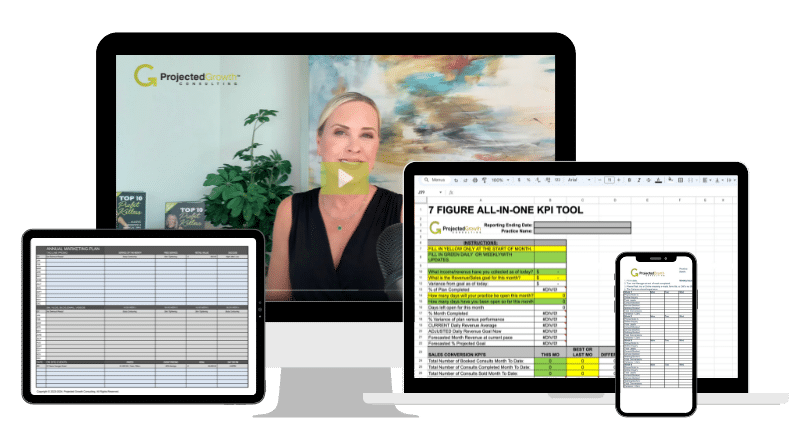
Owners who need a more complete view can use a weekly and monthly KPI dashboard alongside a consistent financial close. For a detailed treatment of service-level margins, review med spa profit margin drivers. Neither dashboard totals nor margin percentages are useful unless definitions and reporting periods remain consistent.
Once the first confirmed constraint is clear, write a one-page test. State the evidence, the specific point in the journey to change, the person accountable, the measure that should move, and the date to review it. Keep the scope narrow enough that the team can tell whether the change helped.
Make the test falsifiable. If the proposed fix is a faster inquiry response, specify what counts as a response and the time window being measured. If the fix is a scheduling change, track both completed appointments and a guardrail such as overtime or provider workload. A result is not useful if the target improves by shifting an unresolved cost or delay to another part of the practice.
Set a checkpoint before the final review. At the weekly check-in, confirm that the action occurred, the owner had the tools and coverage needed, and the data is being recorded. If implementation failed, solve that execution issue before judging the intervention. If the action was completed but the measure stayed flat, revisit the diagnosis and consider whether another stage is responsible.
Do not confuse a test with a guarantee. A 30-day window is a practical review cycle, not proof of long-term causation. Seasonality, staffing changes, service mix, and small sample sizes can distort a short comparison. Keep notes on these factors and continue monitoring the measure after the initial test.
For context about its own experience, Projected Growth Consulting reports having served more than 6,000 medical practices since 2011 and helping clients generate more than $250 million in additional revenue; see its published proof and tools. These are company-reported figures, not a forecast for an individual practice. A useful advisory conversation should still begin with your definitions, reports, constraints, and decisions.
Owners can also compare the audit with a broader med spa consulting guide or learn about executive coaching for aesthetic practices. The point is not to buy a program by default. It is to match outside help to a specific, evidenced operating problem and agree on what success will be measured against. Ask whether Kelly Smith’s Projected Growth Practice OS or the Growth Hub subscription/membership model fits the problem and level of support you need.
Book a call to review your practice’s constraint audit
No. First confirm that qualified demand is the weak point. If the practice has inquiries but loses them during response, scheduling, service delivery, retention, or unit economics, more leads may increase workload without solving the constraint.
Start with a consistent four-to-eight-week operating window when the records allow it, then compare with a longer period if volume is low or seasonality matters. Use the same definitions and dates across systems; do not treat that window as a universal statistical standard.
Make the measurement gap the first action. Add a simple, privacy-conscious inquiry and outcome log with a clear owner, consistent status definitions, and a weekly reconciliation. Avoid using incomplete counts to declare a channel successful or unsuccessful.
Compare suitable demand and wait time with bookable and completed hours by provider, service, and room. Check whether blocked time, workflow rules, cancellations, or administrative load explain the gap before committing to a permanent staffing or facility change.
Bring the audit worksheet, source reports, definitions, the test already attempted, and the decision you need to make. A clear constraint and baseline make it easier to focus an advisory conversation on the practice’s actual operating question.
The best next move is the one tied to evidence: identify the first weak handoff, test a focused change, and review whether the practice can now grow without creating a more expensive bottleneck.

Written by
Founder & CEO, Projected Growth Consulting
Kelly Smith is a med spa business consultant with 20+ years of industry experience and the founder of Projected Growth Consulting. A former 7-figure med spa owner, published author of 5 books, and international speaker, Kelly has helped 6,000+ practices generate over $250 million in additional revenue through proven growth strategies.