Growth programs can sound interchangeable when you are dealing with a revenue plateau, weak follow-up, staff turnover, or margins that do not reflect how hard your practice works. The real buyer question is not whether an institute has polished training. It is whether the program can identify your constraint, attach it to measurable baseline data, and help your team execute the fix without compromising patient care.
Book a strategy conversation with Projected Growth Consulting
A credible practice growth institute should prove four things before you buy: it can diagnose your actual business constraint, prioritize one economic lever, provide implementation support, and measure accountability with agreed metrics. Ask for the baseline, the owner of each action, the timeline, and the evidence you will review before accepting broad promises about growth.
That standard matters whether you run a medical spa, plastic surgery practice, dermatology office, wellness clinic, or another elective medical business. Start by testing what the program can demonstrate before you pay for what it says it can deliver.
A credible practice growth institute should prove four things before asking you to commit: it can diagnose the real constraint, prioritize the highest-value move, help your team implement it, and measure accountability over time. If a program cannot show how those four steps work in your practice, you are evaluating a sales presentation, not a growth system.
Start with diagnosis. The provider should ask for more than your revenue goal and a description of your marketing. It should examine your service mix, margins, lead flow, consultation conversion, retention, staffing, capacity, follow-up, and operating routines.
The goal is to identify the constraint limiting profit or growth now. A practice with weak follow-up needs a different intervention from one with full books, poor margins, or a team that cannot execute consistently.
This level of diligence matters because aesthetic practices combine clinical, operational, financial, and patient-experience decisions. Medical spa literature has described the need to consider key elements before launching or expanding a venture, rather than treating growth as a single marketing problem. Published medical spa research also notes that physicians, including dermatologists, may incorporate medical spas into existing practices. That complexity should be reflected in the assessment you receive.
Next, ask how priorities are chosen. A useful program will name one economic or operational lever to address first. It should explain why that lever outranks competing opportunities and assign an owner and deadline.
It should not hand you a long list of disconnected recommendations. The four-stage Practice OS method is organized around diagnosing, prioritizing, implementing, and scaling repeatable systems. Read about the four-stage Practice OS method to see the distinction.
Finally, clarify implementation and measurement. Who meets with your team? What gets completed in the first 30, 60, and 90 days? Which baseline metrics will be reviewed, and how often?
A dashboard or scorecard should connect actions to margin, service performance, labor, marketing efficiency, follow-up, and retention. If the offer ends with advice and no named accountability process, it has not proved that it can change the way your practice operates.
A credible practice growth institute should identify the bottleneck behind your visible symptoms before recommending a solution. A revenue plateau may reflect weak consultation conversion, poor retention, inadequate follow-up, a service mix that produces thin margins, or a team that cannot absorb more demand. Those problems look similar in a monthly revenue report, but they require different interventions.

Start by asking what the program needs to see before it makes a recommendation. At minimum, the diagnostic should include a baseline of revenue by service, gross margin, labor cost, marketing spend, lead volume, consultation conversion, treatment conversion, retention, cancellations, and provider capacity. The point is not to collect numbers for a presentation. It is to connect the numbers to an operating decision.
For example, more leads will not solve a practice whose consultations are not converting. A new promotion will not repair a service line that consumes labor without producing an acceptable margin.
Hiring another provider may create more complexity if scheduling, follow-up, or leadership ownership is already weak. Ask the advisor to name the evidence that would confirm or disprove each hypothesis.
Financial data is only one part of the diagnosis. The program should also request input from the people who experience the constraint every day: the owner, practice manager, front desk, providers, and sales or patient-coordination team.
Ask where work gets delayed, which decisions remain owner-dependent, what staff members are accountable for, and which procedures are routinely skipped. Compare those answers with the numbers. A dashboard may show declining retention, while team interviews reveal inconsistent post-treatment follow-up or unclear ownership of reactivation.
Specificity matters because a useful diagnosis ends with a defined problem statement. It should not be a motivational label such as “the practice needs more growth.” It might identify low treatment conversion during consultations, unprofitable labor allocation, or a follow-up process without a named owner and deadline. The next step should then have a baseline, an accountable person, and a time period for testing the recommendation.
One practical starting point is a med spa profit scorecard, which organizes margins, service performance, labor, marketing, and operating costs so hidden cash-flow leaks are easier to see. Use it to challenge the diagnosis, not to replace judgment. If a program cannot explain what data it needs, what team inputs it will collect, and how those inputs change the recommended action, it is selling a generic solution rather than diagnosing your practice.
A credible growth program should be able to name the constraint it will address first. If an advisor recommends improving conversion, retention, capacity, and service mix at the same time, the plan may sound comprehensive, but it gives your team no clear order of operations. The practical rule is simple: choose the one economic lever most likely to change cash flow within the next operating cycle. Then make every supporting action serve that priority.
Start with the bottleneck, not the most attractive idea. A practice with strong demand but a full schedule may need capacity and staffing work before it buys more leads. A practice with open appointment slots may need consultation conversion or follow-up discipline. If clients return once and disappear, retention may matter more than adding another service. The owner’s calendar can be the constraint too. When every decision, escalation, and sale depends on the owner, the first lever may be delegation and repeatable workflow rather than a new campaign.
Ask which problem is both measurable and economically material. Define the current baseline, the target movement, the person responsible, and the time window for review. For example, “improve growth” is not a usable priority. “Increase consultation conversion from the current baseline to an agreed target over eight weeks without increasing lead volume” is specific enough to test. It also exposes tradeoffs. The team may need better scripting, faster follow-up, clearer treatment plans, or provider training before marketing spend increases.
Use the same discipline when evaluating service mix. A high-revenue treatment is not automatically the best growth lever if it consumes scarce provider hours, produces weak margins, or creates follow-up demands the team cannot support. Retention may be the better priority when patient counseling, experience, or continuity is the real weakness. Ethical practice matters here: growth should not depend on pushing unnecessary procedures. Research on aesthetic practice emphasizes professional standards and addressing patient concerns as part of responsible care (published aesthetic-practice guidance).
Then require the program to explain what happens next. A priority without an owner, weekly action, and measurement date is only a theme. The four-stage Practice OS method frames this sequence as Diagnose, Prioritize, Implement, and Scale. That order helps prevent a common failure mode: adding tactics before the practice understands which constraint is actually limiting profitable growth.
A practice growth program is not implementation support simply because it includes calls, lessons, or a library of templates. The useful question is what happens after the owner understands the recommendation. Someone must translate the decision into a workflow, assign responsibility, test it with the team, and review the evidence. If the offer ends at education, the owner is still carrying the same execution burden that created the problem.

Ask a prospective practice growth institute to show the working model between sessions. Look for a defined action list, an owner for each action, a deadline, and a way to surface obstacles before the next meeting. Support may include office hours, feedback on scripts or standard operating procedures, KPI reviews, implementation assignments, or access to a specialist who can challenge the plan. The format matters less than the handoff. You should be able to see how a recommendation moves from discussion to a change your front desk, providers, managers, or marketing team can repeat.
Test delivery-model fit before you commit. During the sales process, describe one current constraint in operational terms, such as inconsistent consultation follow-up, weak service-line margins, or a manager who cannot hold the team accountable. Then ask what the first two weeks would involve, which data the program needs, and who is expected to do the work. A credible response will identify the baseline, narrow the first priority, and name the practice-side capacity required. A vague promise to “scale the business” is not an implementation plan.
The first 30 days should establish the baseline and remove ambiguity. That generally means reviewing financial and operational data, agreeing on the primary constraint, clarifying roles, and selecting a small number of measures. Projected Growth Consulting describes its staged journey as weeks 1-2 for assessment and baseline metrics, weeks 3-4 for a strategic plan, weeks 5-8 for core-systems implementation, and weeks 9-12 for optimization and refinement. Treat that sequence as a useful diligence benchmark, not a guarantee that every practice will move at the same speed.
By days 30-60, the selected process should be in live use. The team should know the new standard, the manager should be checking adherence, and the owner should be able to identify what is working and where the process breaks. By days 60-90, the program should be refining the system using actual performance data rather than adding another disconnected initiative. A med spa KPI dashboard can help connect operating activity with financial indicators, so the practice can distinguish busy work from measurable progress.
Before signing, confirm what support remains when implementation gets uncomfortable. Ask how missed assignments, staff resistance, incomplete data, and a failed first test are handled. The right offer does not remove the owner’s responsibility. It makes that responsibility visible, structured, and easier to execute.
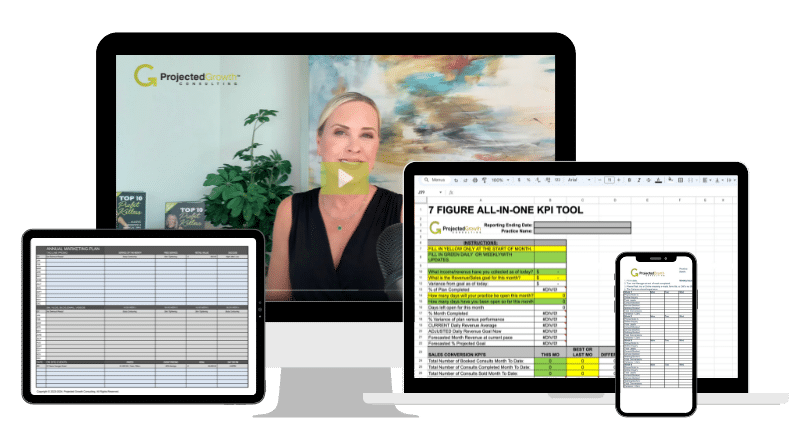
A credible growth program should make progress visible before the monthly revenue report arrives. Ask for a scorecard that separates leading measures, which show whether the team is completing the behaviors that create results, from lagging measures that show whether those results actually occurred. Without both, a practice can celebrate activity while margins, retention, or cash flow continue to deteriorate.
Start by defining a baseline from a stated period, not from memory. For a med spa, review the prior 90 days of collected revenue, consultation volume, conversion, treatment conversion, and average transaction value. Also review rebooking, no-shows, provider utilization, labor cost, marketing spend, and contribution margin by service.
A plastic surgery or dermatology practice may add procedure mix, consult-to-surgery conversion, or days from consultation to procedure. The point is not to track every available number. It is to establish the current operating picture and identify which constraint the program is meant to change.
Every metric then needs four fields:
Review leading measures weekly when the practice is changing a process. Examples include the percentage of inquiries receiving timely follow-up, completed consultation scripts, rebooking requests made, staff training completed, and open operational tasks closed by their due date. Review lagging measures at a cadence that fits the data, often monthly: collected revenue, gross or contribution margin, retention, conversion, provider capacity, and marketing return. A dashboard framework should connect these operating and financial indicators to the decisions they support, rather than display numbers without context. The med spa KPI dashboard resource is useful background for that structure.
Finally, define the response to a miss before the miss happens. If rebooking falls below the agreed target, the owner should not simply demand more effort. The accountable person reviews the underlying appointments, checks whether the process was followed, identifies the constraint, and assigns one corrective action with a deadline. If the same measure misses again, the program should escalate the decision: revise the process, change the owner, adjust the target because conditions changed, or stop the initiative. That discipline is part of how you evaluate a med spa consultant. A practice growth institute earns credibility by showing what will be measured, who acts on the result, and what happens when the first plan does not work.
The right support depends less on the label attached to a program and more on the constraint your practice can address next. A startup needs decisions and infrastructure. A growing practice usually needs consistent execution and management discipline. An established practice needs durable systems, leadership depth, and value beyond the owner’s daily involvement. A credible practice growth institute should be able to explain how its scope changes across those stages.
| Practice stage | What support should address | Questions to ask before committing |
|---|---|---|
| Startup | Business planning, service and equipment decisions, financial assumptions, staffing, compliance, and a workable launch sequence. | Will the team review my assumptions and operating plan, or deliver a generic template? Who helps me make decisions before capital is committed? |
| Growing | Revenue visibility, conversion, retention, team accountability, standard operating procedures, and capacity. The goal is to turn inconsistent wins into repeatable performance. | Who works with my leaders between sessions? Which metrics establish the baseline? What happens when implementation stalls or the owner becomes the bottleneck? |
| Established | Margin improvement, leadership depth, process replication, succession, expansion readiness, and enterprise value that does not depend on one person. | Can the advisors address organizational design and replication, not only marketing? How will they test financial durability, capacity, leadership depth, and repeatable processes? |
Scope is only half the fit test. Examine leadership depth and delivery capacity. A specialist may understand aesthetics yet lack the senior operators needed to guide a multi-provider practice. Conversely, a large advisory team may offer broad resources but little hands-on attention. Ask who attends working sessions, who owns follow-up, how recommendations are documented, and how progress is reviewed.
Also ask what “long-term value” means in measurable terms. For one owner, it may be cleaner financial reporting and a less fragile schedule. For another, it may be a management team capable of running the practice without constant rescue. Medical spa coaching support can be useful when the central need is structured guidance for growth, leadership, and performance, but it should still connect to defined operating outcomes and ownership.
Book a strategy conversation before you commit to a growth program
Ask the program to identify your primary constraint, explain the evidence behind that diagnosis, name the first measurable priority, and show how implementation will be supported. A credible process should also clarify who owns each action, when progress is reviewed, and what happens if the initial strategy does not fit your practice stage.
Look for attention to clinical standards, patient counseling, staffing, service performance, margins, marketing, and operating costs, not just lead generation. Published aesthetic-practice guidance emphasizes ethical care and addressing patient concerns, while a useful business scorecard connects operating decisions to financial performance. See the med spa profit scorecard framework for the categories worth reviewing.
It depends on the constraint your numbers reveal. If demand is healthy but capacity, labor, conversion, or delivery is weak, adding more leads can intensify the problem. A staged method should diagnose first, prioritize one economic lever, implement the fix, and then measure the result. Projected Growth Consulting describes this sequence as Diagnose, Prioritize, Implement, and Scale in its four-stage Practice OS method.
Expect a small dashboard tied to the chosen priority, such as service performance, labor efficiency, marketing performance, operating costs, and financial results. The point is not to collect every available number. It is to assign an owner, establish a baseline, set a review cadence, and use changes in the data to decide the next action. A med spa KPI dashboard can provide the tracking structure.
If you have clarified your practice’s constraint and still need to decide what level of growth support fits, a focused conversation can help you test the match before committing. Book a strategy conversation with Projected Growth Consulting to discuss the right next step for your practice.

Written by
Founder & CEO, Projected Growth Consulting
Kelly Smith is a med spa business consultant with 20+ years of industry experience and the founder of Projected Growth Consulting. A former 7-figure med spa owner, published author of 5 books, and international speaker, Kelly has helped 6,000+ practices generate over $250 million in additional revenue through proven growth strategies.