A med spa can be profitable and still be difficult to sell. If revenue depends on your personal treatments, your memory, and informal decisions, a buyer is not acquiring a durable business. They are acquiring a demanding job with transition risk. The decisions you make now determine whether that changes.
Book a Free Consultation to start building a practice buyers can trust.
Med spa exit planning is a structured 3- to 5-year process for moving your practice from owner-dependent to systems-dependent. While improving profitability, documenting operations, and preparing for the right transition.
That window gives you time to establish a credible exit strategy, correct weak financial and operational controls, and make improvements that show up in buyer diligence. Research on exit strategy likewise emphasizes beginning with the end in mind because the intended outcome should guide decisions throughout the business, not just during a sale. The first step is understanding what readiness actually requires and why trying to compress it into a few months usually leaves value on the table.
Med spa exit planning is the disciplined process of making your practice transferable, financially transparent, and valuable to someone other than you. It is not a listing appointment scheduled when you are ready to retire. The work starts years earlier, while you still have time to improve profitability, replace owner-dependent revenue, strengthen leadership, and resolve operational weaknesses.
There are three broad exit categories. Succession transfers ownership to a family member, physician partner, or internal leader. Merger and acquisition (M&A) sells the practice, or combines it with a strategic buyer, platform, or investor. An initial public offering (IPO) is a public-market path generally associated with much larger organizations, not the typical independent med spa. These categories have different tax, legal, financing, and leadership implications, so your preferred outcome should shape the decisions you make now. The legal and business-planning literature identifies succession, M&A, and IPO as the primary exit routes (Penn State entrepreneurship law research).
Private equity has shown particular interest in healthcare services, including medical aesthetics. Med spas offer a cash-pay revenue model, recurring treatment demand, and potentially strong margins when operations are managed tightly. That combination can support a platform strategy in which an investor acquires a strong practice, adds capital and management infrastructure, and grows through additional locations or acquisitions. In healthcare, private-equity exits commonly involve a later transition to another investor or strategic buyer. Which makes durable systems and documented performance more important than a single strong year (peer-reviewed research on private equity exits in physician practices).
The three- to five-year window matters because meaningful change requires operating history. A buyer needs to see that improved EBITDA, lower owner dependence, clean financial reporting, and reliable retention are repeatable, not the result of last-minute adjustments. Practice Transitions Group reports that owners who use a three-year preparation window to reduce owner dependence, diversify revenue. And clean up financials can achieve EBITDA multiples of 5-7x, while owners who wait until they are ready to leave may receive 3-4x or less (Practice Transitions Group).
That spread is not a technical detail. At $1 million in EBITDA, a 5x valuation is $5 million, while a 3x valuation is $3 million. Your exit plan should therefore function as an operating system for the business. Projected Growth Consulting’s Practice OS approach addresses expensive bottlenecks one at a time, with emphasis on profitability, staffing, leadership, and retention. The objective is straightforward: build a practice whose value survives your departure.
A buyer cannot value what your records cannot prove. Before you worry about deal structure or buyer outreach, make your financial performance clear, consistent, and explainable. Profitability and operational efficiency are primary drivers of enterprise value, so this stage is about building a financial picture that survives due diligence.
Pull at least 36 months of monthly profit-and-loss statements, balance sheets, payroll reports, sales by provider, and revenue by service line. Reconcile the statements to your bank and accounting records. Separate owner compensation, personal expenses, one-time costs, and nonrecurring items so an advisor can calculate normalized EBITDA without guessing.

A comprehensive business plan should also identify your competitive strengths and the market position that supports your numbers. The NCGrowth case study on preparing a medical spa for investors illustrates why this level of business analysis matters.
Track cost of goods sold by treatment category, not just as one annual total. Well-run med spas generally keep COGS below 30% to 40% of revenue. Labor should remain below 50% of revenue, including wages, payroll taxes, commissions, and benefits. If either ratio is above target, investigate pricing, product waste, discounting, utilization, and schedule capacity before adding more marketing spend. A higher top line with uncontrolled delivery costs does not create a stronger exit.
Your dashboard should show revenue, gross margin, EBITDA, cash conversion, new and returning patients, average transaction value, provider utilization, labor percentage, COGS percentage, and recurring membership revenue.
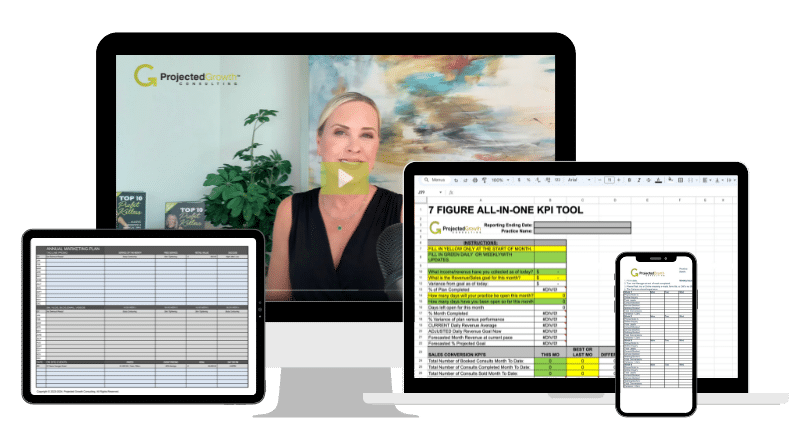
Assign an owner to each metric and record the monthly target, actual result, variance, and corrective action. Use this profit scorecard for tracking profitability for exit readiness, then add the operating metrics covered in this KPI dashboarding guide for practice valuation.
The industry average med spa generates about $1.7 million in annual revenue. Above $2.5 million, you may begin attracting private equity groups and platform buyers, assuming the practice also demonstrates durable margins and reliable systems. These figures are directional, not a promise of valuation. Use them to set a three-year operating plan with explicit revenue, EBITDA, margin, and cash targets. Practice Transitions Group reports these med spa benchmarks, along with the COGS and labor ranges above.
A buyer is not just purchasing your revenue. They are purchasing confidence that revenue will continue after the transition. If you personally generate 60% to 70% of practice revenue, the buyer has to answer a difficult question: what happens to those patients and procedures when you leave? That concentration creates transition risk, and it can suppress the price a qualified buyer is willing to pay.
Use this stage to move the practice from owner-dependent to systems-dependent. The benchmark is not total owner absence. Buyers want owner-generated revenue closer to 20% to 30% of total revenue, which signals that the team. Patient relationships, and operating model can sustain performance without you at the center of every transaction. These benchmarks are reported in practice-transition guidance from Practice Transitions Group.
Separate revenue generated by your own clinical work from revenue produced by associates, other providers, recurring programs, retail, and referrals managed by the team. Review the mix monthly, not just at year-end. If your personal production remains above 30%, identify which services, patients, or referral relationships depend on you and assign a specific transfer plan to each one.
A buyer needs to see more than a collection of talented providers. They need evidence of leadership coverage. Define who owns clinical standards, scheduling, hiring, training, patient retention, and financial accountability. Then give those leaders decision rights, measurable targets, and regular operating reviews. Delegation that leaves every important decision waiting for the owner is not delegation. It is task distribution with the same bottleneck intact.
Start training successors while your performance is strong. Have emerging leaders shadow key decisions, lead team meetings, review scorecards, and manage a defined operating area. Document the reasoning behind your choices so the team learns the standard, not just the task.
Single-provider practices with no associate coverage frequently struggle to achieve even 2x EBITDA because the buyer is effectively underwriting the risk of replacing the owner. That is a valuation problem, not merely a staffing problem. Add provider capacity, standardize patient handoffs, and make retention responsibilities visible in the operating cadence. The goal is a practice that performs consistently when you take a week away, then a month away.
Projected Growth Consulting’s leadership development framework addresses the staffing, leadership, and retention systems required to make that transition credible. In the Practice OS model, reducing owner dependency is not a one-time hiring project. It is a sequence of bottlenecks solved until the business can produce results without relying on one person.
If your practice only works because you remember how everything gets done, a buyer is not acquiring a business. They are acquiring a job with a fragile handoff. Tacit knowledge trapped in the owner’s head creates operational risk, slows due diligence, and weakens the case for durable enterprise value. Documentation is how you turn personal know-how into an asset someone else can operate.
The Practice OS framework treats this as a practical sequence, not a massive documentation project. Solve one expensive operational bottleneck at a time, then make the improved process repeatable.

Do not attempt to document the entire company in one month. Use the Practice OS approach: remove the next bottleneck, standardize the fix, and build the next layer of independence. Over time, the practice becomes systems-dependent rather than dependent on your memory.
Buyers do not value a large top-line number in isolation. They want to understand how revenue is produced, how reliably it repeats, and whether the economics remain attractive after the owner steps away. Profitability and operational efficiency are primary drivers of enterprise value in a strategic sale, so your reporting needs to show the quality of revenue, not just its total.
Separate your revenue into medical services, retail, memberships, packages, and other material categories. A practice that depends almost entirely on one treatment or one promotional channel carries more risk than a practice with several healthy revenue streams. The mix also helps a buyer see which lines create margin, which lines create retention, and which lines are merely filling the schedule.
Membership and package revenue deserve particular attention because they can create recurring or contracted income and improve forward visibility. Report new memberships, cancellations, renewal rates, average monthly revenue per member, package utilization, and deferred revenue separately. Do not label every prepaid package as immediately earned revenue. Clean recognition makes the numbers easier to trust during due diligence.
Practice-wide gross margin can conceal weak economics. Calculate revenue, direct product cost, provider compensation, and contribution margin for each major service line. The acquisition guidance reviewed for this article identifies BOTOX and filler injectables as capable of producing 70% or higher gross margins. But that figure is not a substitute for your own reporting. Track actual product cost, waste, discounts, and labor by treatment so a buyer can distinguish a genuinely profitable line from a high-volume line with thin contribution.
Patient retention rates tell buyers whether revenue is supported by a durable customer base or constant acquisition spending. Report retention by cohort, treatment category, and provider, alongside rebooking rate, visit frequency, average revenue per patient, and membership conversion. A single blended retention number is less useful if it hides churn in a key service line.
Revenue per provider is another essential measure. Show monthly revenue per provider, booked hours, utilization, compensation, and margin. This reveals whether growth comes from a repeatable operating model or from the owner’s personal production. If the practice is approaching or exceeding $2.5 million in annual revenue, that scale can begin attracting private equity groups and platform buyers, according to the competitor research. The threshold is not a guarantee of interest; buyers still test margin quality, retention, and concentration risk.
Use the same dashboard to guide scaling for multi-provider growth. Diversified, recurring, high-margin revenue with credible provider productivity signals a business that can survive transition. That is materially more valuable than revenue that disappears when one person stops working.
The work in the prior stages only creates value if you position the practice for a buyer who can recognize and pay for it. A local individual practitioner may value a stable owner-operated practice, but will usually pay a lower multiple. Regional groups often evaluate established systems and provider depth at roughly 4x to 7x EBITDA. Platform and private equity buyers can reach 10x to 14x or more when the business demonstrates the scale, predictability, and transferability they need.
An individual practitioner may be an excellent successor, particularly when clinical reputation and personal relationships are central to the practice. However, that buyer may have limited financing capacity and may be underwriting their own future employment. If revenue depends heavily on the owner, processes live in the owner’s head. And financial reporting is inconsistent, the buyer sees a job with risk rather than a durable enterprise. That reality compresses the multiple, even when the practice is profitable.
| Buyer Type | Typical EBITDA Multiple | What They Value Most | Best Fit |
|---|---|---|---|
| Individual practitioner | 2x to 4x | Owner skills, patient relationships, simple transition | Small single-provider practice |
| Regional group | 4x to 7x | Provider depth, documented systems, location | Established 2-5 provider practice |
| PE platform | 10x to 14x+ | Cash-pay model, recurring revenue, multi-site scalability | $2M+ EBITDA, multi-location or platform-ready |
A regional group is looking for a business it can integrate without rebuilding it from scratch. It will examine provider productivity, retention, location economics, leadership coverage, and whether the same operating model can work across additional sites. A practice with clean financials, documented workflows, and a management layer can support a stronger negotiation than one that simply reports impressive top-line revenue.
Private equity platforms generally want a cash-pay model without insurance billing friction, recurring membership revenue, and high gross margins. BOTOX and filler injectables, for example, are described in the supplied market research as producing more than 70% gross margin. Platform-quality med spas are reported to trade at 10x to 14x or more EBITDA, but that range is not an entitlement. It is a premium for a business with predictable demand, diversified providers, strong reporting, and clear post-close leadership.
Consider the valuation effect directly. At $2 million in EBITDA, a 4x multiple implies an $8 million sale. A 9x multiple implies $18 million. The difference is not created by a clever listing strategy at the end. It is created by the systems, margins, leadership depth, and recurring revenue you built throughout the exit process. Healthcare private equity transactions commonly move through transitions to other investors or strategic buyers, making operational continuity especially important after closing. Research on private equity exits in physician practices describes this broader investment life cycle.
Your final positioning decision should therefore be made before you are ready to sell. Decide whether your likely buyer is an individual, a regional group, or a platform, then build the evidence that buyer requires. That is the culmination of med spa exit planning: not merely making the practice profitable, but making its value legible to the right acquirer.
Start three to five years before your intended exit. That window gives you time to replace owner-dependent revenue, stabilize profitability, document operations, and correct weaknesses without signaling distress to buyers. An early exit strategy also keeps daily decisions aligned with the outcome you want, rather than forcing short-term fixes at the point of sale. Penn State’s entrepreneurship law guidance similarly emphasizes establishing the ending before making operating decisions.
Buyers want predictable earnings, clean financial records, repeatable operations, and a leadership team that can run the business without the owner performing every critical function. They also look for a clear competitive position and evidence that the practice can grow without proportionally increasing complexity. Profitability and operational efficiency are primary enterprise-value drivers, while diligent records help buyers validate the business during due diligence. UNC’s NCGrowth case study describes a medical spa business plan as a way to identify competitive advantages and present the market opportunity to investors.
Measure how much revenue depends on your personal consultations, treatments, referrals, and approvals, then build a transfer plan for each dependency. Train providers and managers, assign decision rights, and track whether revenue and client retention hold when you step away. The objective is not to disappear overnight. It is to prove that documented systems and a capable team, rather than one person, produce consistent results.
Most owners should involve qualified legal, tax, financial, and transaction advisors before signing a letter of intent. They can help assess entity structure, normalize financials, prepare records, evaluate buyer offers, and manage regulatory or tax issues that affect the transaction. Bring them in early enough to correct problems, not merely to review documents after a buyer discovers them. The Penn State guidance recommends taking exit planning seriously and consulting legal professionals about the transition.
A clear exit readiness plan helps you turn owner-dependent performance into a business with reliable systems, stronger leadership, and measurable value. Projected Growth Consulting can help you identify the next operational priority and connect it to your longer-term goals. Book a free consultation with Projected Growth Consulting to discuss where your practice stands and what to build next.

Written by
Founder & CEO, Projected Growth Consulting
Kelly Smith is a med spa business consultant with 20+ years of industry experience and the founder of Projected Growth Consulting. A former 7-figure med spa owner, published author of 5 books, and international speaker, Kelly has helped 6,000+ practices generate over $250 million in additional revenue through proven growth strategies.