
Your med spa does not have a traffic problem if leads are coming in. It has a math problem. Med spa patient acquisition cost tells you exactly what you pay to turn marketing activity into a new patient. If you cannot state that number by channel, you cannot tell which spend builds profit and which spend only keeps your team busy.
A recent benchmark puts average patient acquisition cost for med spas at $285 per patient. That is a useful starting point, not a pass or fail grade. A $285 patient can be a great buy when the patient returns, accepts a treatment plan, and refers others. It is a bad buy when your front desk loses the inquiry or your offer draws one-time discount shoppers.
Book a Free Consultation to Optimize Your Patient Acquisition Costs — Start with a KPI audit that shows exactly where your ad dollars are going and which channels deliver profitable patients.
The fix is not automatically to slash your Google or Meta budget. First, get a clean view of what you spend, where leads leak, and which channels create booked patients. This five-step CPA optimization method gives you that view. It helps you lower acquisition cost by fixing conversion and allocation before you cut reach.
Many med spa owners run their clinics blind because they do not know what they spend to win a new client. Med spa patient acquisition cost is your total ad and promo spend divided by the number of new patients won in that same timeframe. You can solve this problem by tracking med spa acquisition costs in your practice.
A study on medical spa trends shows the world market is set to hit $45 billion by 2030. With such fast growth, the race is fierce, and guessing is no longer a safe option. If you do not know this number, you cannot make smart choices about your ad budget.
What is a good norm for a med spa? Data shows the mean cost to acquire a new patient is $285. This is lower than other fields of care. For instance, a study on patient acquisition cost across medical fields shows a cross-field mean of about $370. At the top of the scale, cosmetic surgery clinics face a steep cost of $610 to win one patient.
By contrast, your med spa rate of $285 is much lower, but you can still improve. If you do not track this number, you may waste thousands of dollars on ads that do not work.
When you do not track what you spend to win a client, you make poor choices. You might spend too much on ads that do not bring in leads. Or you might cut back on a campaign that works well. Tracking this metric lets you find your best marketing channels. When you know your costs, you can put your funds where they do the most good. This is the first step to scaling your clinic without wasting your cash.
You cannot fix what you do not measure. To stop wasting ad spend, you must know your true med spa patient acquisition cost. This metric tells you the exact cost to bring a new patient through your doors.
The exact formula is: Total Marketing Spend divided by Number of New Patients equals Patient Acquisition Cost. Divide your total marketing spend by the number of new patients you get during a set time. Research from Georgia Southern University shows that tracking key marketing and retention metrics is vital for growth. Without this data, you cannot see which channels generate real profit.
To find your real costs, you must look beyond your primary ad accounts. Follow these steps to map your costs and calculate your true acquisition metrics.
To keep your data clean, you need the right tools. Do not rely on manual spreadsheets or guesswork. Use Google Ads and Meta Ads Manager to track your paid campaigns. Link these campaign accounts to your medical CRM to follow the entire patient journey. This CRM software will help you match your marketing spend to actual clinic bookings. Having these systems in place is key for tracking med spa acquisition costs over time.
Your conversion rate directly impacts your overall med spa patient acquisition cost. Med spas often see cost shifts of 40% to 60% based solely on booking rates. Every phone call or web form is a vital chance to grow. When your team misses a call, you waste your ad budget.
A multi-location practice spending $45,000 to $50,000 per month on marketing may acquire 90 to 130 patients when inquiry-to-appointment conversion runs at 63% to 68%. That also means 32% to 37% of inquiries are not booked. That gap is where a large share of your acquisition cost becomes waste.
To stop that waste, your staff must act fast when a new lead reaches out. Set up CRM alerts, protect same-day consult slots, and use a clear intake script. Then review each unbooked inquiry by source and reason every week. You need to see whether your leak is slow follow-up, poor handoff, price shock, or a weak offer.
Scripted phone intake and daily sales training turn cold leads into loyal customers. You can train your front desk team to use these methods by optimizing your consultation conversion rate. Tracking these results helps you find and fix team sales issues.
To cut your total spend, you must first know where your money goes. Every marketing channel has its own price tag. If you do not track these costs one by one, you cannot see which channels actually help you grow.
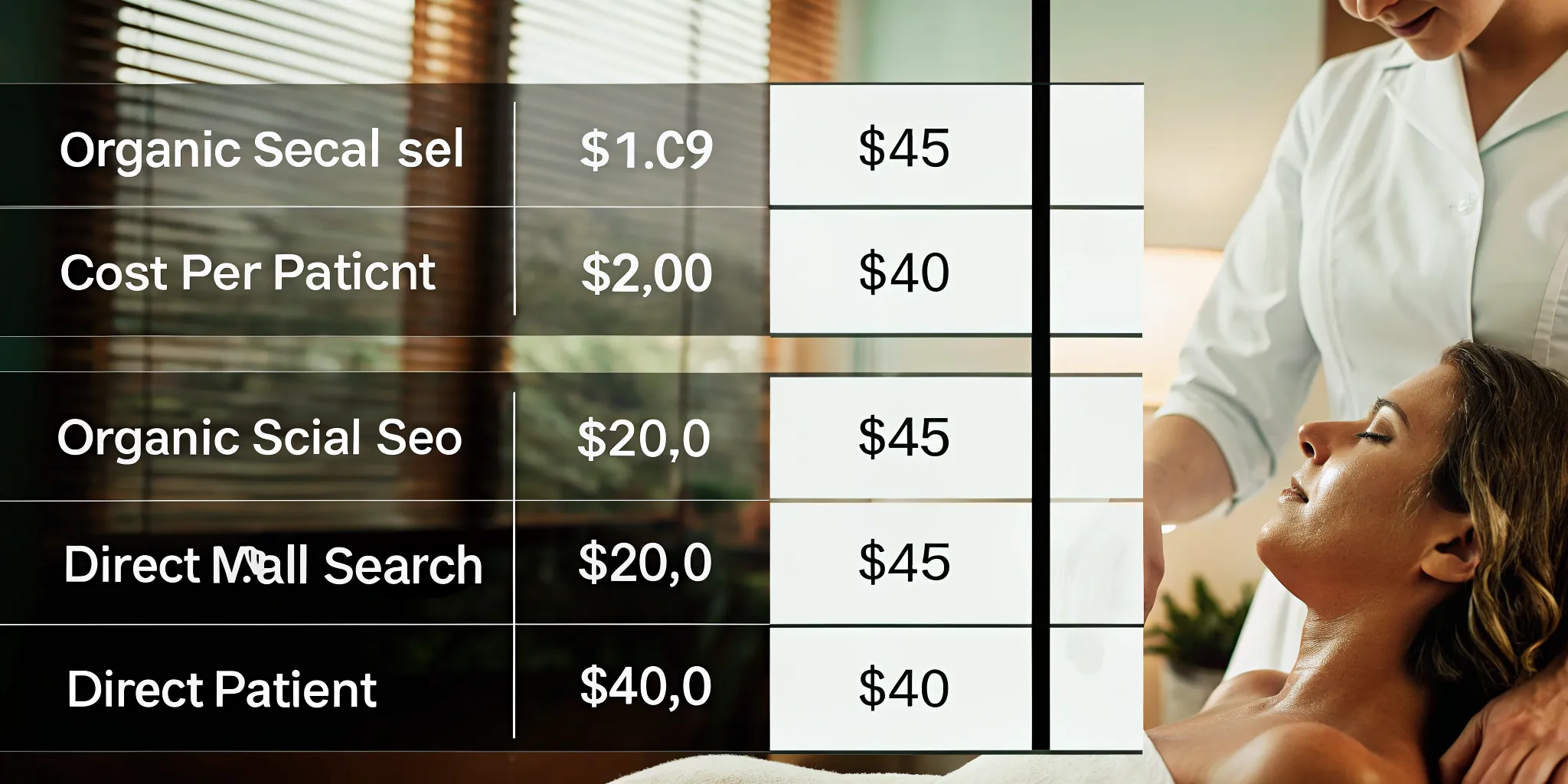
Based on the First Page Sage benchmarks, the cost to acquire a patient varies widely by channel. Organic SEO is the lowest at $215 per patient. Direct Mail runs $240. Paid Social costs about $291. Paid Search (PPC) is the highest at $342.
How channels compare:
| Marketing Channel | Avg Cost per Patient | Typical Volume | Best Use Case |
|---|---|---|---|
| Organic SEO | $215 | High | Long-term practice growth |
| Direct Mail | $240 | Low | Local area targeting |
| Paid Social | $291 | Medium | Visual brand awareness |
| Paid Search (PPC) | $342 | Medium | High-intent leads |
Organic search stands out as the cheapest path to lower your med spa patient acquisition cost over time. Unlike paid ads, SEO does not stop working the moment you pause your spend. A strong piece of search content keeps bringing in leads month after month for free. To stay on top of these figures, you should build a tool to measure your patient acquisition metrics. Knowing your exact costs by channel lets you stop wasting cash on high-cost ads.
To lower your med spa patient acquisition cost, you must move from guesswork to systematic execution. Research from EHL Insights shows the market will hit $45 billion by 2030. With a growth rate of 15.3%, the race for new leads will only get tougher.
Step four of this method is campaign testing. Shift marketing budget toward the channels with the lowest cost per booked, first-time patient. Stop putting more money into platforms that generate clicks but not patients. Once you find your best channels, run regular tests on ad copy and images. Nurture leads that did not book. Talking to past leads is often less costly than buying new ones.

Step five is about systematizing your practice growth. Projected Growth Consulting reports more than $250M in additional client revenue since 2011. Its clients average 30% growth in 90 days after system implementation. The work is not magic. It is a disciplined practice of putting cost, conversion, and profit metrics into daily operations.
You must use tools like tracking med spa acquisition costs to spot cash leaks. By tracking these numbers, you can start systematizing your practice growth. Real systems ensure you never guess where your next patient comes from.
A $285 average hides a wide spread. Practices in the same city with the same services can differ by 40% to 60% on acquisition cost. The difference is seldom the ad platform. It is almost always the handoff from inquiry to booked consultation. A practice that answers the phone within 30 seconds, uses a tracked number, and has a trained intake script will convert at 68% or higher. A practice that lets calls roll to voicemail or sends leads to a generic email inbox will see conversion drop below 40%, which doubles their effective acquisition cost.
This means you can lower your med spa patient acquisition cost without touching your ad budget. Fix the handoff first. Then reallocate from weak channels to strong ones. The budget decision matters less than the conversion decision.
The best med spats do not check their acquisition cost once a quarter. They track it in real time using a KPI dashboard tied to their CRM. They know today’s cost per lead and cost per booked patient before they leave the office. This is the core of what Projected Growth Consulting’s Profit Scorecard delivers: a live view of the metrics that drive profitable growth.
Without this visibility, you are making budget decisions on last month’s data. With it, you can shift spend mid-week when you see a channel underperforming. That speed is what creates a sustained 40% lower acquisition cost.
Patient acquisition cost is the full cost to gain one new patient. Divide total marketing spend by the number of first-time patients acquired in the same period. Include ad spend, agency fees, call tracking, CRM costs, and the staff time needed to handle leads. A published med spa benchmark is $285 per patient, but your own channel-level result matters more.
An acceptable CPA is lower than the gross profit a new patient is likely to create, not simply lower than an industry average. Set a ceiling by treatment type, first-visit revenue, expected repeat visits, and close rate. A high-value treatment plan can support a higher CPA than a one-time promotional service. Track both first-visit profit and 90-day patient value before you call a channel a winner.
Start by fixing the handoff from inquiry to booked consult. Use tracked phone numbers, source fields in your CRM, fast follow-up, and a simple booking script. Then shift budget from channels with weak booked-patient cost to channels that create profitable patients. Practices can have 40% to 60% differences in acquisition cost within the same specialty because of inquiry-to-appointment conversion, according to Patient Prism’s analysis.
There is no one useful number across every practice. A current benchmark ranges from $155 for pediatrics to $610 for cosmetic surgery, with an average of about $370 across specialties. Compare your med spa only after you calculate costs consistently and separate leads from booked, new patients.
You do not need another vague report showing that marketing is expensive. You need a scorecard that shows which dollars create booked, profitable patients and which parts of the practice are leaking demand. That is the operational work behind a lower CPA.
Projected Growth Consulting helps aesthetic practice owners build the KPI visibility, sales process, and operating systems needed to scale profitably. If you are ready to stop guessing, book a call with our team and start with the metric that connects your marketing spend to real growth.

Written by
Founder & CEO, Projected Growth Consulting
Kelly Smith is a med spa business consultant with 20+ years of industry experience and the founder of Projected Growth Consulting. A former 7-figure med spa owner, published author of 5 books, and international speaker, Kelly has helped 6,000+ practices generate over $250 million in additional revenue through proven growth strategies.