Med spa valuation is not just a multiple applied to last year’s profit. A buyer must decide whether reported earnings are repeatable, supported by records, and likely to continue after the owner steps back. This guide uses one practical method—the earnings-to-confidence bridge—to help you connect each reported dollar of earnings to evidence and operating conditions before you make a major decision.
Talk through your practice’s growth and valuation questions
Earnings quality is the degree to which a practice’s reported income reflects sustainable operating performance. It is not a separate valuation formula. It is the evidence behind the earnings figure that an owner, lender, or prospective buyer may examine.
Two practices can report the same EBITDA and still present different levels of confidence. One may have clear monthly closes, stable provider capacity, documented compensation, and repeatable workflows. The other may rely on owner memory, inconsistent bookkeeping, unrecorded expenses, or one provider who generates a large share of collections. The headline number is identical; the support behind it is not.
That distinction matters because a valuation conclusion depends on assumptions about future cash flows, risk, and the rights being valued. A buyer’s diligence may also identify issues that affect deal structure, required transition support, or whether a proposed adjustment is accepted. There is no universal “med spa multiple” that resolves these questions for every practice. The right analysis depends on the business, its records, the transaction, and the professional valuation method used.
The earnings-to-confidence bridge gives you a disciplined way to prepare. For every earnings figure you want another party to trust, show how it was calculated, what evidence supports it, and which operating conditions could change it.
The bridge is a five-step review of the path from accounting profit to a defensible view of repeatable earnings. First reconcile the numbers. Then test proposed adjustments, check durability, connect earnings to operational capacity, and assemble an evidence trail. The output is not a promised sale price; it is a clearer picture of what is known, what is assumed, and what still needs work.
This method also makes internal planning more useful. A practice can review its financial reporting with a qualified accountant, identify operational gaps with its leadership team, and seek valuation advice from an appropriately qualified professional. For an overview of the broader advisory context, see practice management consulting and the med spa consulting guide.
Start with a specific period and a specific earnings definition. Do not begin with a rounded number from a slide deck. Gather the profit-and-loss statements, balance sheets, general ledger, payroll reports, tax returns, and bank or payment processor records for the periods under review. Confirm that the reporting periods align and that the figures reconcile as far as the available records allow.
Write down whether the figure is net income, operating income, or EBITDA, and list the calculation. EBITDA generally refers to earnings before interest, taxes, depreciation, and amortization. It is a financial measure, not a substitute for cash flow, and different parties may define or adjust it differently. Make the components visible rather than relying on a label alone.
Check for common gaps that make the starting figure hard to trust: expenses entered in the wrong period, personal and business transactions mixed together, inconsistent treatment of provider compensation, missing accruals, refunds posted inconsistently, or revenue recorded before services were delivered. Investigate differences between the accounting system and bank deposits instead of plugging the gap with an unexplained adjustment.
Build a simple reconciliation schedule with one row per period. Include the source figure, any reclassification, the reason, and the record that supports it. Keep the original books intact. The goal is a transparent bridge, not a rewritten history.
Use comparable periods and explain any change in the reporting basis. A year-over-year view can help identify a trend, but it can also conceal a sharp recent change, seasonality, or an unusual disruption. If you use monthly results, include the same months across years when possible and flag periods affected by a closure, provider departure, renovation, or launch. Do not remove an inconvenient month without showing it; explain what happened and let the reviewer assess its effect.

When you discover a mismatch, record it as an open item with an owner and due date. If you cannot resolve it, label it as unresolved. Calling out uncertainty early is more credible than treating incomplete information as settled. A consistent monthly close process can help maintain this discipline; see med spa bookkeeping and the guide to a med spa cash flow management process.
For each proposed adjustment, ask three questions: Was the cost or income actually recorded? Was it genuinely unusual or owner-specific? Can you support the amount and explain what replaces it, if anything? If one answer is unclear, do not present the adjustment as established fact.
For example, a one-time repair may be a candidate for separate treatment if the invoice, payment, and reason are documented and the expense is not expected to recur in the ordinary course. A recurring marketing cost does not become nonrecurring just because it occurred during a weak month. Nor does an owner’s time become free simply because the owner plans to leave. If a replacement is needed, the cost and role must be considered.
Use a conservative classification. Keep recurring expenses in the earnings base. Put uncertain items in a separate schedule labeled “requires review.” Describe the evidence and the judgment involved. A buyer or appraiser may disagree with a proposed adjustment; your job is to make its basis inspectable, not to imply that it must be accepted.
For each candidate, create a small support packet: the ledger entry, invoice or payroll record, proof of payment, and a brief note explaining the business context. Then show the calculation from the recorded amount to the proposed adjustment. If a cost covers both personal and business use, specify the allocation method and retain the underlying records. If the service, staff member, or function must continue after a transaction, account for that replacement need instead of presenting the entire expense as removable. Keep estimates clearly marked as estimates.
| Item under review | Evidence to assemble | How to treat it in the bridge |
|---|---|---|
| Documented one-time repair. | Invoice, payment record, date, and explanation of why it was unusual. | Show separately as a proposed adjustment, subject to professional review. |
| Recurring advertising or software expense. | Invoices, contracts, and monthly ledger entries. | Keep it in the recurring cost base unless evidence supports a different conclusion. |
| Owner compensation or duties. | Payroll records, role description, hours, and replacement responsibilities. | Model a supportable replacement cost rather than assuming the work disappears. |
| Unreconciled deposit difference. | Processor statements, bank statements, refund records, and ledger detail. | Leave it unresolved until the difference is traced and documented. |
| New service line with limited history. | Service-level revenue, direct costs, provider schedule, and launch records. | Separate actual results from forecasts and state the assumptions clearly. |
Adjustments need to be evaluated in context. The table is a preparation aid, not a universal accounting rule. Your accountant and valuation professional can help decide whether a treatment is appropriate for the specific analysis.
Move from “What did the practice earn?” to “What must remain true for it to earn that again?” Test the major drivers across several reporting periods, using monthly data where available. Look for patterns and exceptions rather than relying on one strong or weak month.
For revenue, compare collections and completed services by service line, provider, and month. Identify whether the result depends on a limited number of providers, a short-term campaign, a recent price change, or a concentrated set of clients. Separate cash collected from services delivered and track refunds or deferred obligations consistently. A forecast is not historical earnings; label it as a forecast and show its assumptions.
For costs, review compensation, rent, supplies, marketing, software, and other material expenses. Ask whether each is stable, variable with volume, contractually committed, or likely to change. Then test the margin story: if revenue falls, which costs fall with it, and which remain? If the practice expects revenue to rise, does it have enough provider hours, rooms, and administrative coverage to deliver that volume?
Do not hide a dependence simply because it is manageable. If an owner personally handles consultations, recruiting, vendor negotiations, or client retention, document those duties. Then specify who performs them today and what transition or replacement would be required. The same applies to a high-producing provider or a single referral source.
Turn the repeatability test into a driver map. For each major revenue stream, note the service delivered, the providers who perform it, the room or equipment required, the related direct costs, and the source of demand. Mark each driver as stable, changing, or uncertain, and cite the period or record behind that judgment. For instance, if collections rose after a price change, separate the effect of price from changes in appointment volume and service mix. If a new service is still ramping, show actual results by month rather than annualizing a short period as though it were established performance.
Finally, write a short downside case using the practice’s own records: what would happen if the most productive provider reduced hours, a campaign ended, or a material expense increased? You do not need to claim a precise forecast if the data cannot support one. State the assumption, describe which costs can adjust, and identify the operational response. This shows where earnings are resilient and where they rely on a condition that needs protection or a transition plan.
As a reminder that valuation assumptions matter, the Institute of Certified Valuation Specialists’ Valuation News Updates reports an estimate of a 4.60% U.S. implied equity risk premium as of January 1, 2024, based on trailing 12-month cash yield. That figure is not a med spa valuation multiple or a practice-specific discount rate. It illustrates why valuation inputs and the date behind them should be stated rather than treated as timeless constants.
A repeatable earnings claim needs an operating explanation. Connect the financial trend to what the practice can actually deliver: provider schedules, room availability, service mix, staffing, lead handling, and follow-up. An owner should be able to explain why the reported result occurred and which parts of the operating model can sustain it.
Choose a small set of measures that tie to the earnings drivers. For example, review completed appointments, utilization by provider or room, revenue and direct costs by service, cancellation and rescheduling patterns, and conversion from consultation to treatment where the practice records it consistently. Define each measure, the system of record, the review frequency, and the person responsible. Avoid combining figures that use different definitions.
Then test a practical scenario. If one provider reduces availability, what happens to appointment access, completed services, payroll, and collections? If marketing generates more inquiries, can the team respond promptly and schedule consultations? If a service has strong sales but high supply or labor costs, does the contribution justify the capacity it uses? The answers should be grounded in your records, not an industry-wide claim that may not fit your practice.

Make the capacity check concrete with a weekly schedule. List available provider hours and rooms, then compare those slots with completed appointments and the practice’s recorded cancellations. If demand appears to exceed capacity, verify that the constraint is real: unused time may reflect scheduling gaps, uneven shifts, or service durations that were not recorded consistently. If a forecast assumes more appointments, show which additional hours, staff coverage, and room availability make them possible. This avoids treating hoped-for demand as earnings already secured.
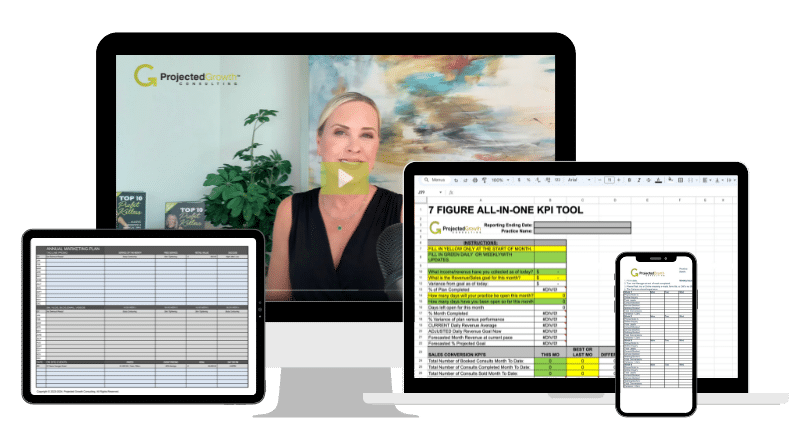
This is where a scorecard becomes useful. A med spa profit scorecard can help an owner organize the questions and identify where figures need consistent definitions. For deeper operational diagnosis, compare the findings with a med spa operations audit or review how to systematize med spa operations. Projected Growth Practice OS and the Growth Hub subscription/membership model can be considered as part of the owner’s ongoing operating rhythm; choose a format that matches the problems and support the practice needs.
Organize the proof so a person unfamiliar with the practice can trace a material claim without relying on the owner’s memory. Use a secure, access-controlled folder and have professional advisors guide what should be shared and when. Do not put confidential client or employee information into an unsecured file.
Keep a short “claim-to-proof” index. For each claim—such as “service-line revenue increased” or “this expense was unusual”—record the source file, the reporting period, the calculation, and any limitation. This makes it easier to update the analysis and reduces the risk that a forecast, management estimate, and historical result become mixed together.
Give the folder a simple naming and version convention, such as period, document type, and revision date. Add a readme that defines the reporting periods, accounting basis, KPI definitions, and where the reconciliation schedule lives. When a figure changes, preserve the earlier version and record why the update was made. That small discipline helps advisors distinguish a corrected source record from a new management assumption. Review access permissions before sharing, and remove unnecessary client-identifying details from operational reports.
Preparation does not guarantee a particular value or transaction outcome. It improves the quality of the discussion by making the practice’s strengths, dependencies, and unknowns easier to see. If an owner is weighing growth against a future sale, the same evidence can help prioritize operating work before speaking with a potential buyer. Related planning resources include med spa exit planning and how to sell a med spa.
Book a call to discuss your practice’s next steps
No. A multiple is only one possible valuation input, and there is no single figure that applies to every practice. The valuation method, available evidence, operating risks, transaction terms, and purpose of the analysis all matter. Ask a qualified valuation professional to explain the method and assumptions used for your situation.
No. Each proposed adjustment needs documentation and a defensible explanation. Recurring costs should not be labeled nonrecurring simply because the owner would prefer a higher earnings figure. Consider replacement costs for the owner’s work and have the adjustments reviewed by your accountant and valuation professional.
Begin with consistent financial statements, general ledger detail, bank and payment processor records, payroll reports, and tax filings for clearly defined periods. Reconcile the starting figures before building an adjustment schedule. Then connect financial performance to service, provider, and capacity records that the practice maintains reliably.
No. Better documentation can make the basis for earnings easier to understand and test, but it cannot guarantee a value, buyer interest, financing, or transaction outcome. Use the process to identify credible strengths and material gaps, then get advice suited to the valuation purpose.
When earnings, records, and operating capacity tell the same story, an owner can have a more productive valuation conversation and a clearer list of actions to take next.

Written by
Founder & CEO, Projected Growth Consulting
Kelly Smith is a med spa business consultant with 20+ years of industry experience and the founder of Projected Growth Consulting. A former 7-figure med spa owner, published author of 5 books, and international speaker, Kelly has helped 6,000+ practices generate over $250 million in additional revenue through proven growth strategies.